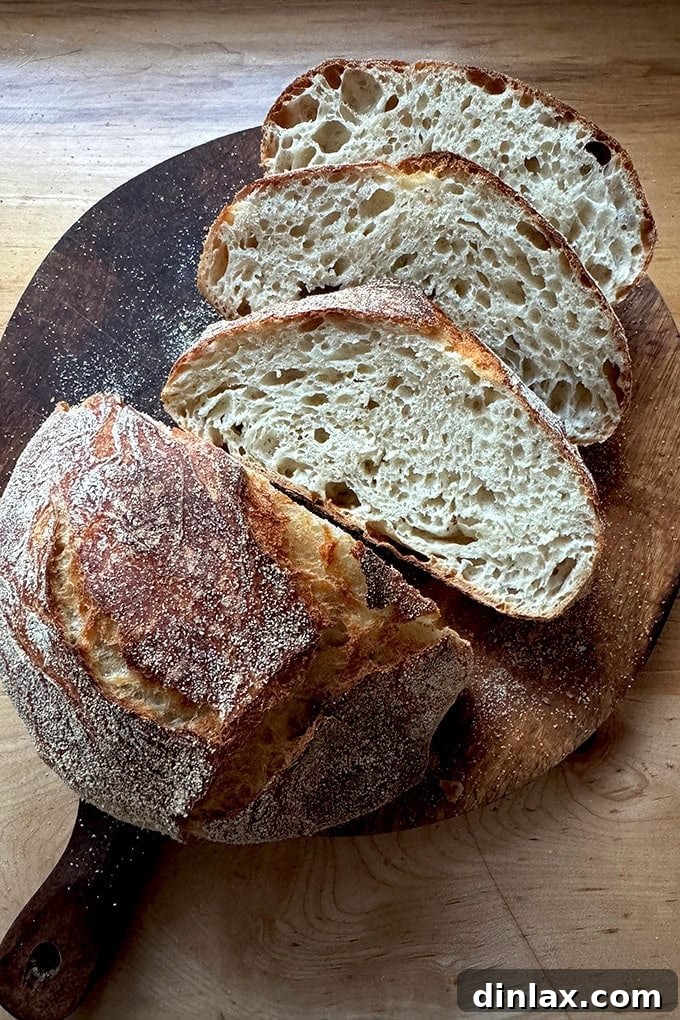
Imagine pulling a warm, aromatic loaf of bread from your oven – a perfect sphere with a deeply golden, crackling crust and an irresistibly airy, open crumb. This isn’t a dream reserved for professional bakers or those with hours to dedicate to kneading. Welcome to the world of Jim Lahey’s No-Knead Bread, a revolutionary recipe that empowers even novice home cooks to achieve bakery-quality results with minimal effort. Forget endless hours of intensive kneading; this dough comes together in just 5 minutes of active preparation, allowing time to work its magic, transforming simple ingredients into something truly extraordinary.
If the thought of tackling elaborate sourdough recipes or complex artisan bread methods feels daunting, Jim Lahey’s no-knead bread offers a refreshing, stress-free alternative. This ingenious recipe simplifies the entire bread-making process, demanding little equipment and even less specialized skill. It’s designed for busy individuals who crave the unparalleled taste and texture of homemade artisan bread without the typical commitment. Whether you envision a rustic boule perfect for dipping into a hearty soup, or slices toasted and generously slathered with butter and homemade jam for a delightful breakfast, this recipe is your gateway to culinary satisfaction.
The Science Behind the Simplicity: Why No-Knead Bread Works
Many aspiring bakers are accustomed to the laborious process of kneading dough, believing it’s the only way to develop the gluten necessary for a well-structured loaf. Jim Lahey’s method elegantly challenges this notion. The secret to this “no-knead” marvel lies primarily in two fundamental principles: extended fermentation time and a unique baking environment. Understanding these elements will not only demystify the process but also enhance your appreciation for this surprisingly simple technique.
Time: The Ultimate Kneading Substitute
First and foremost, time is the hero of this recipe. Instead of mechanical kneading, which rapidly aligns gluten strands, the no-knead method relies on a long, slow rise—typically 12 to 18 hours. During this prolonged fermentation at room temperature, two crucial developments occur:
- Gluten Development: The yeast, fueled by the sugars in the flour, produces carbon dioxide gas. As this gas expands, it gently stretches and strengthens the gluten network within the dough. This slow, natural process allows the gluten proteins (gliadin and glutenin) to hydrate thoroughly and form a robust, elastic structure, much like what is achieved through traditional kneading, but without any physical effort from the baker. This extended hydration results in a dough that is both extensible and strong, capable of trapping the gas produced during fermentation to create that characteristic airy crumb.
- Flavor Development: The extended fermentation also significantly enhances the flavor of the bread. Yeast and bacteria (naturally present in flour) work together to break down complex carbohydrates into simpler sugars, producing a myriad of aromatic compounds. This lengthy process imparts a deeper, more complex, and nuanced flavor profile to the bread, moving it far beyond the blandness often associated with quickly risen loaves. You’ll notice subtle tangy notes and a rich, wholesome taste that can rival artisan bakery bread.
The Baking Method: A Dutch Oven’s Magic
The second key to success is the specialized baking method utilizing a Dutch oven. This heavy, lidded pot creates a mini-oven within your main oven, mimicking the conditions of a professional steam-injected bread oven. Here’s how it works:
- Steam for “Oven Spring”: When the dough is placed into the preheated, covered Dutch oven, the trapped moisture within the dough quickly evaporates and turns into steam. This steam fills the enclosed space, keeping the crust soft and pliable for the initial phase of baking. This pliability allows the carbon dioxide gas produced by the yeast, along with the expanding steam, to push against the dough’s gluten structure, causing a dramatic and rapid expansion known as “oven spring.” This is what gives the bread its impressive volume and prevents the crust from setting too early and restricting the rise.
- Crust Formation: After the initial 30 minutes of covered baking, the lid is removed. This exposes the bread to the dry, intense heat of the oven. The gelatinized surface of the dough, softened by the steam, now dries out rapidly, forming a beautifully crackly, deeply browned, and incredibly crispy crust. The cornmeal dusted on the exterior further aids in achieving this desirable crunchy texture, adding another layer of sensory delight.
This combination of prolonged fermentation for internal structure and flavor, coupled with the Dutch oven’s ability to control moisture during baking, transforms minimal effort into maximum reward, resulting in a loaf that is both visually stunning and exquisitely delicious.
Crafting Your Artisan Loaf: A Step-by-Step Guide
Embarking on your no-knead bread journey is remarkably straightforward. Let’s walk through each stage, from gathering your basic ingredients to the final, satisfying reveal of your freshly baked bread.
Gather Your Simple Ingredients
You’ll be amazed at how few components are needed to create such a magnificent loaf: all-purpose or bread flour, salt, instant yeast, and water. While the type of flour can influence the final texture, a good quality all-purpose flour works wonderfully. For yeast, instant yeast is highly recommended as it can be mixed directly with dry ingredients without needing to be proofed separately.
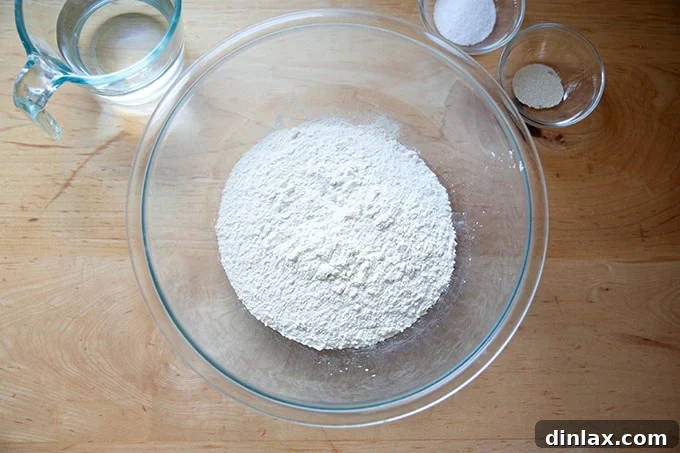
Begin by combining the dry ingredients: flour, yeast, and salt in a large bowl. Ensure they are well integrated before adding the liquid.
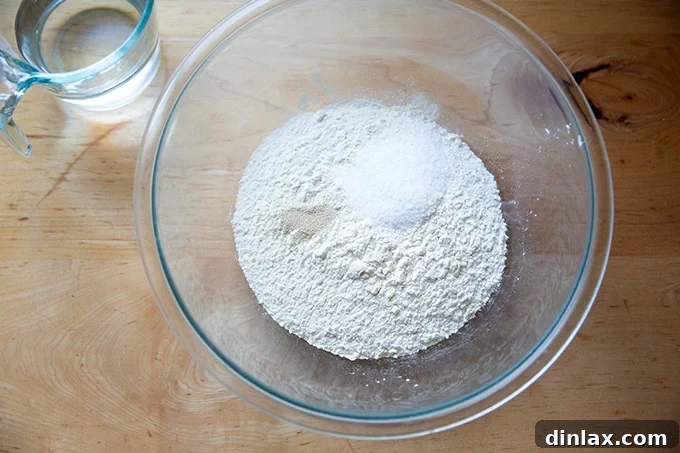
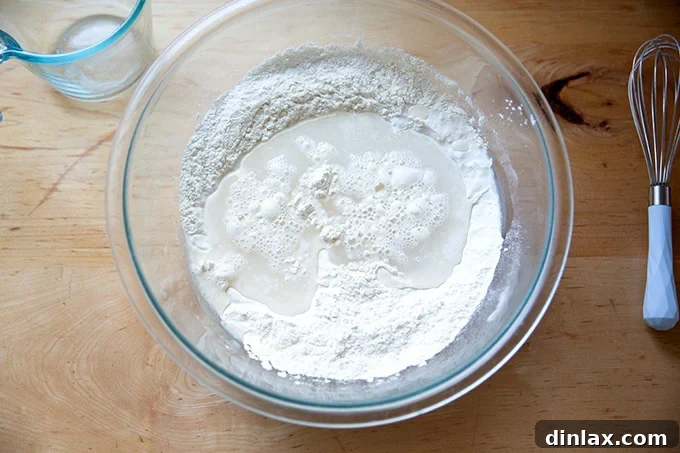
Whisk these dry components together to ensure an even distribution. This prevents pockets of unmixed salt or yeast, which could affect the dough’s rise and flavor. Once thoroughly combined, pour in the measured water.
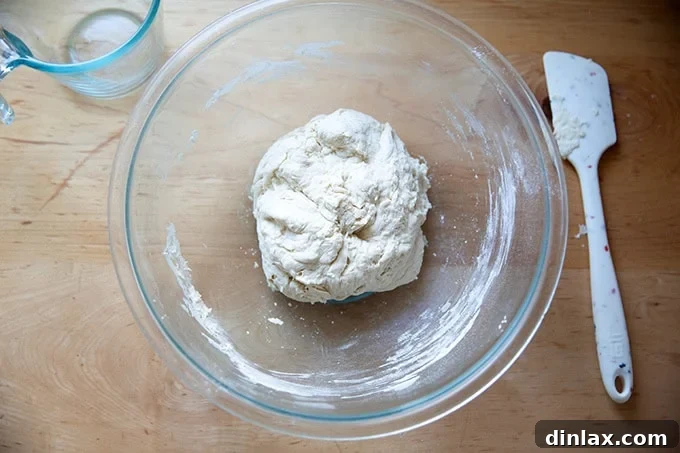
Stir with a wooden spoon or spatula until all the flour is hydrated and you have a shaggy, sticky dough ball. There’s no need for vigorous mixing; just ensure there are no dry spots.
The Long Fermentation: Time is Your Ally
Once the dough is mixed, cover the bowl tightly with plastic wrap to prevent it from drying out. This marks the beginning of the crucial first rise, which can last anywhere from 12 to 18 hours at room temperature. This extended period allows the gluten to develop and flavors to deepen naturally.
**Optional Enhancement: The Stretch and Fold Technique**
While truly “no-knead,” you can give your dough a slight boost in structure with a simple stretch and fold. Approximately 15 to 20 minutes after initially covering the bowl, lightly wet your hand. Grab an edge of the dough, gently stretch it upwards, and fold it back over itself into the center of the bowl. Rotate the bowl slightly and repeat this action 8 to 10 times, pulling from different sides. This brief exercise helps to strengthen the dough’s gluten network, resulting in a slightly more open crumb and improved loft in the final loaf. Even performing just one set can make a noticeable difference in the bread’s texture.
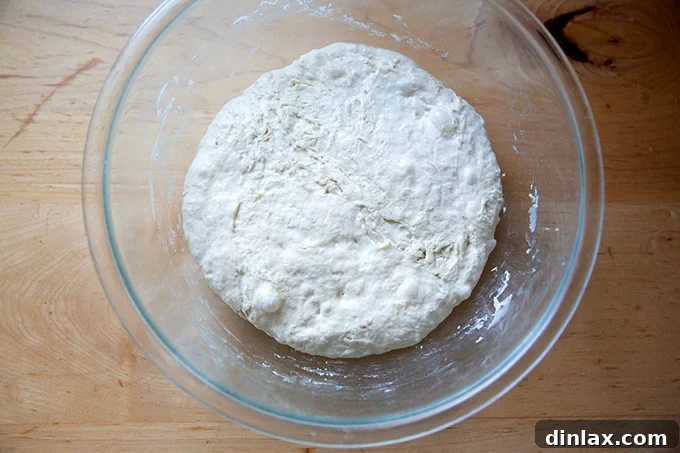
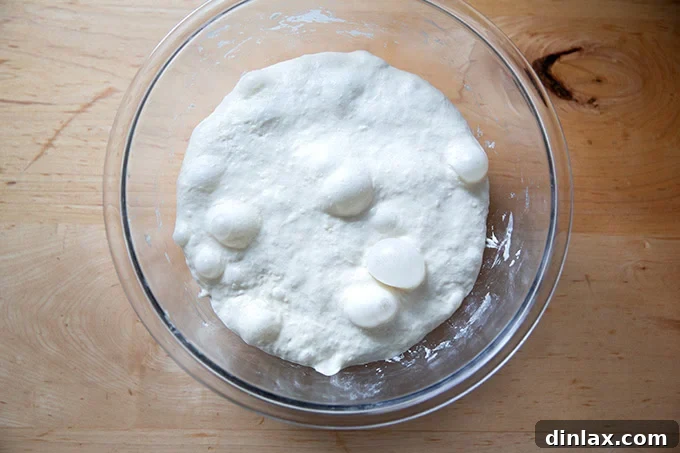
After the long rise, your dough will have expanded significantly, appearing bubbly and soft. Observe the difference between a dough that underwent no stretches and folds versus one that benefited from this simple technique.
Shaping and Second Proof: Preparing for the Oven
Once the initial fermentation is complete, gently turn the dough out onto a lightly floured work surface. Handle it as minimally as possible to preserve the precious gas pockets.
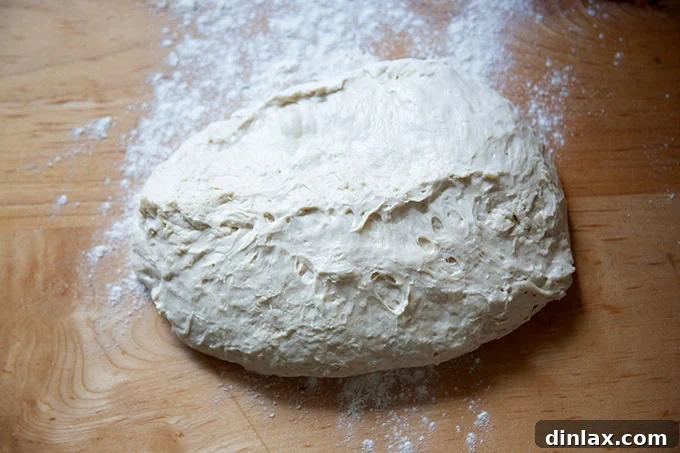
Lightly dust the top of the dough with a little more flour, then gently fold the edges in towards the center to create a rough ball shape. The goal is to build a little surface tension without deflating the dough too much.
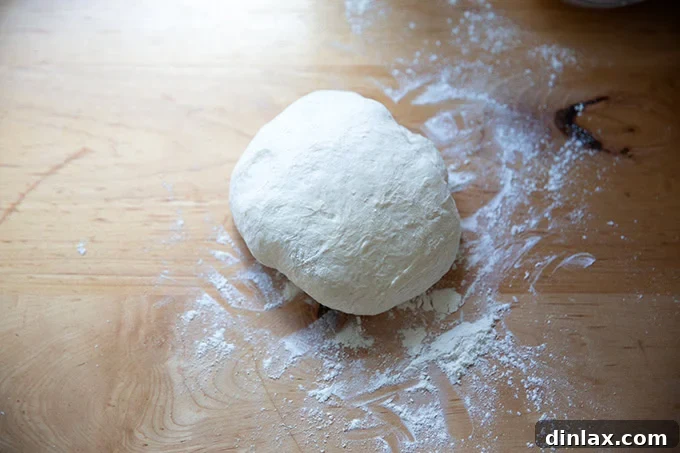
Prepare for the second rise (proofing) by lightly dusting a clean tea towel or a flour sack towel (avoid terry cloth, as it can stick) with cornmeal, wheat bran, or oat bran. Place your shaped dough round, seam-side down, onto the center of the dusted towel. Sprinkle the top with more cornmeal for an extra crusty finish.
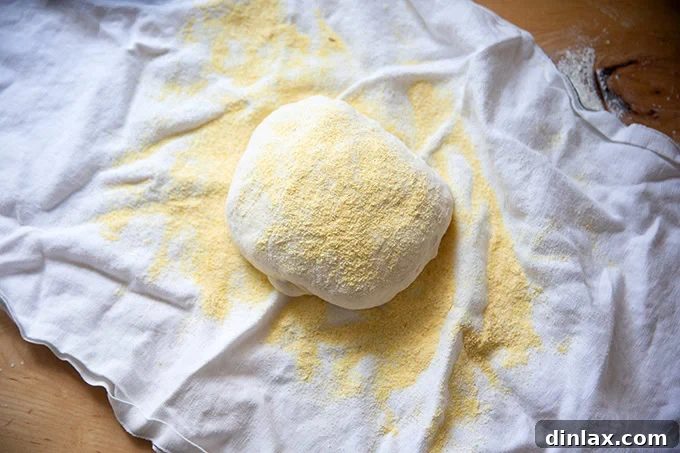
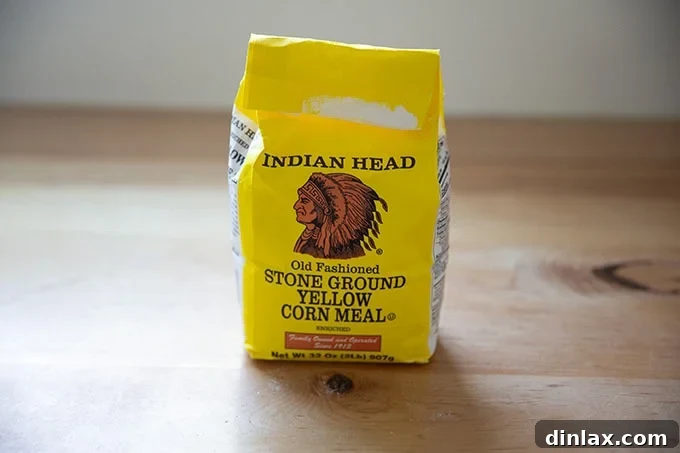
A note on cornmeal: many bakers prefer a fine-ground yellow cornmeal for dusting, which adds both flavor and texture.
Carefully wrap the towel around the dough, creating a snug bundle. Place this bundle into a small bowl, an 8-inch banneton, or any similar container to provide support during its final rise. Let it rest for another 2 hours at room temperature. This second proof allows the dough to relax and achieve its final structure before baking.
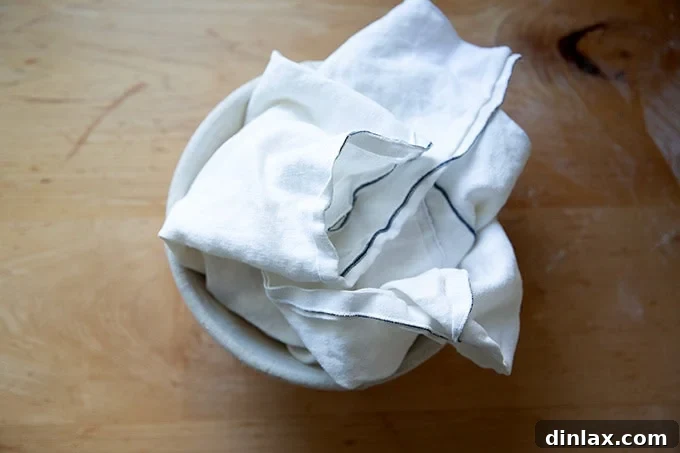
Preheating and Baking: The Dutch Oven Transformation
Approximately 45 minutes before your dough is ready for baking, place your Dutch oven (a 5 to 8-quart heavy-covered pot works best) into your oven and preheat both to a high temperature of 450ºF (230ºC). This ensures the Dutch oven is scorching hot, which is crucial for achieving the perfect oven spring and crust. Cast iron Dutch ovens like the Lodge 5-Qt or specialized bread pans such as the Challenger Bread Pan are excellent choices for their heat retention and even cooking.
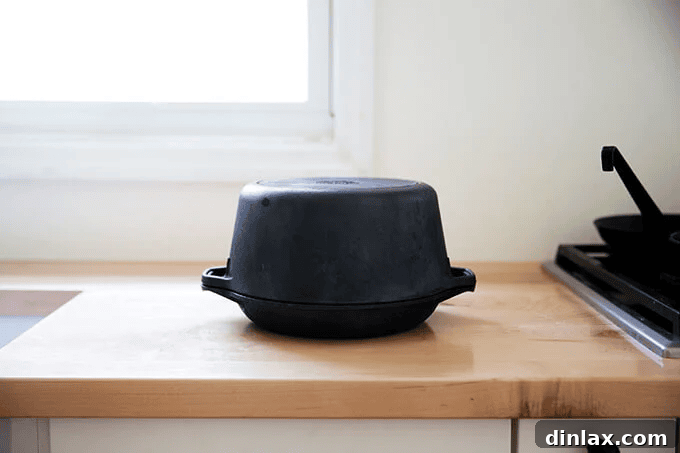
When the dough has finished its second rise and the oven is fully preheated, carefully open the towel and remove the dough from its bowl or banneton. It should look plump and ready.
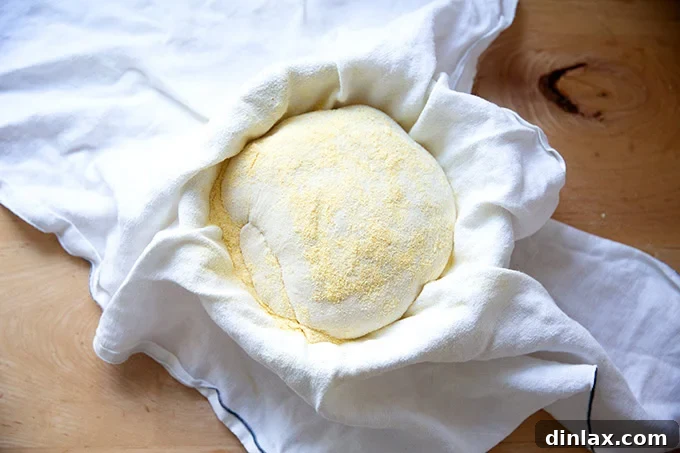
To transfer the dough safely and effectively, lay a round of parchment paper over the top of the dough. Place one hand on the parchment-covered dough. With your other hand, slide it underneath the towel and carefully flip the dough onto the parchment paper, so that the seam side is now facing up. This orientation allows the seam to open beautifully during baking, creating natural scoring. Don’t worry if some cornmeal spills; simply sweep it away. Parchment paper rounds are incredibly helpful for this step, making transfer much easier.
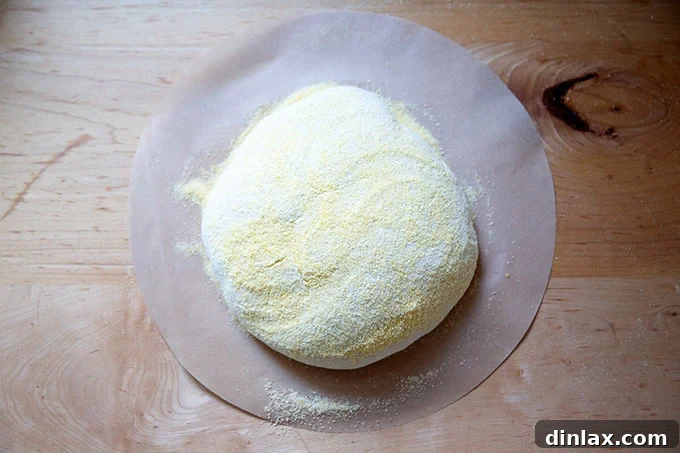
Carefully remove the blazing hot Dutch oven from the oven and place it on a heat-safe surface, like a cooling rack. Remove the lid. Using the parchment paper as a sling, gently lower the dough (parchment and all) into the hot pot. Be cautious as the pot is extremely hot.
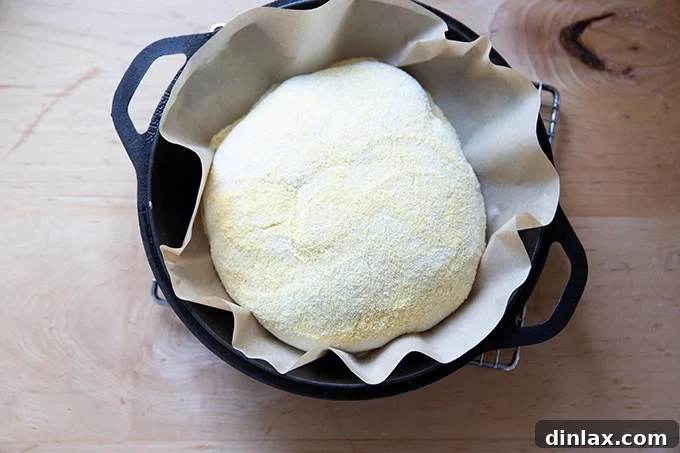
Cover the pot with its lid and immediately transfer it back to the preheated oven. Bake for 30 minutes. The lid traps steam, promoting incredible oven spring. After 30 minutes, carefully remove the lid. You’ll be greeted by a beautifully risen, pale loaf.
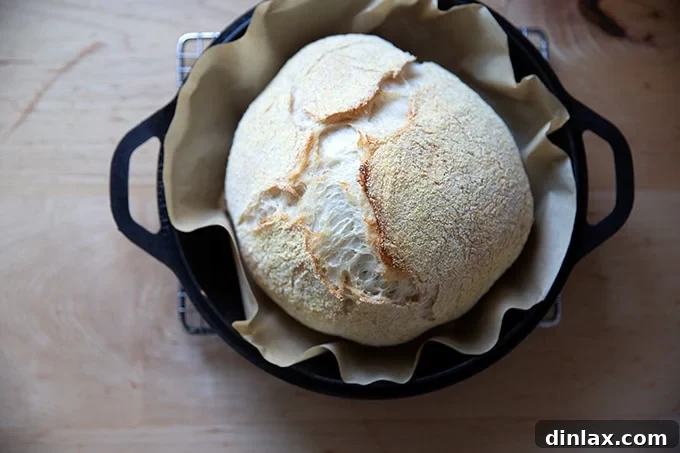
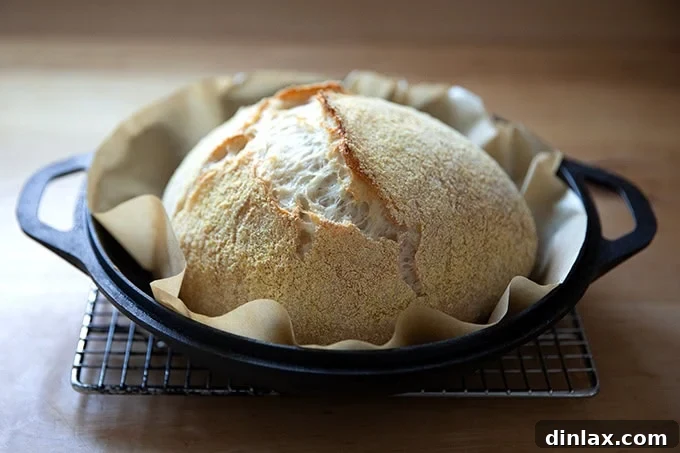
Return the uncovered pot to the oven for another 10 to 15 minutes, or until the crust reaches your desired level of golden-brown perfection. The exposed heat will now work to crisp up the crust beautifully.
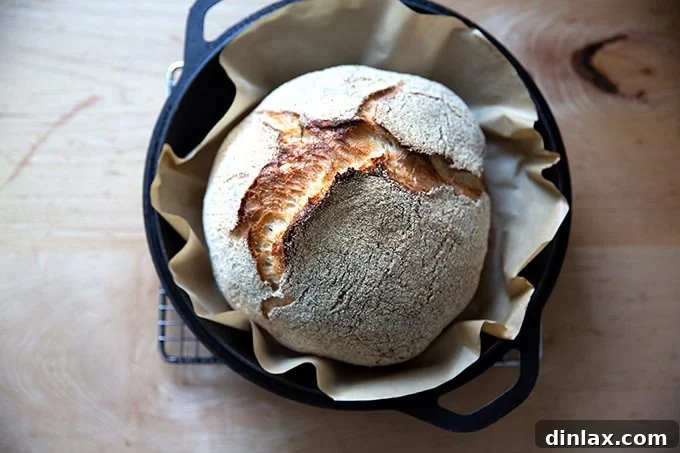
Cooling and Enjoying Your Masterpiece
Once baked to a deep golden hue, carefully remove the bread from the Dutch oven and transfer it to a wire cooling rack. This is a critical step: resist the urge to slice into it immediately! Allowing the bread to cool for at least 30 minutes (preferably longer) is essential for the internal structure to set properly. Slicing too early can result in a gummy texture.
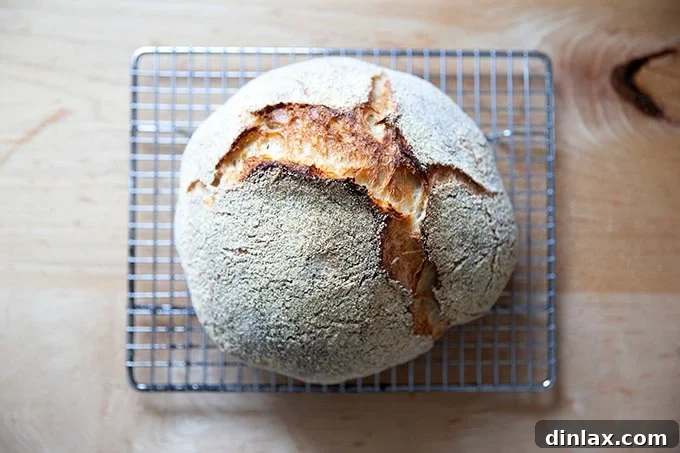
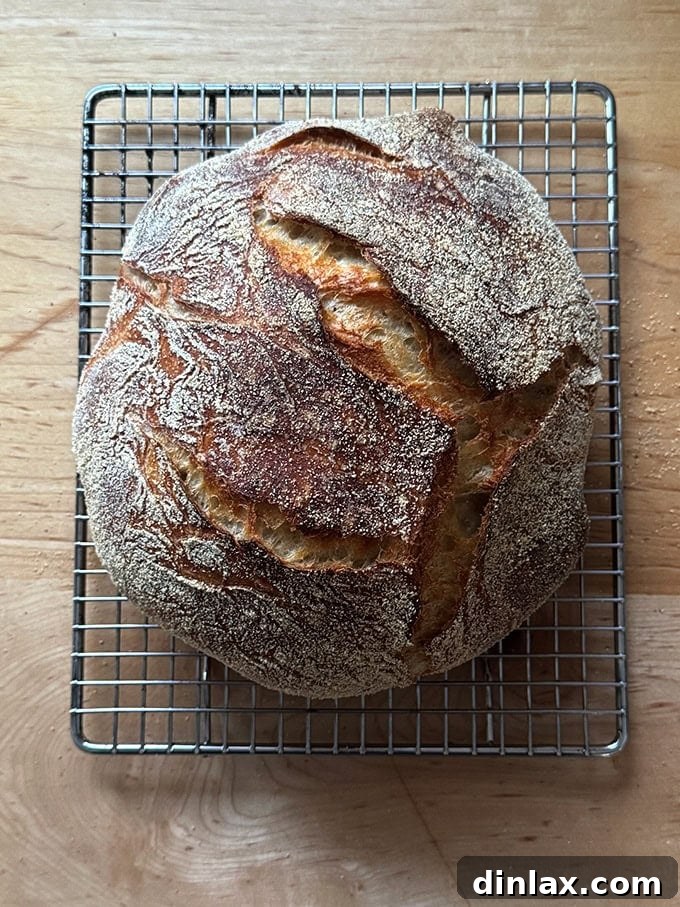
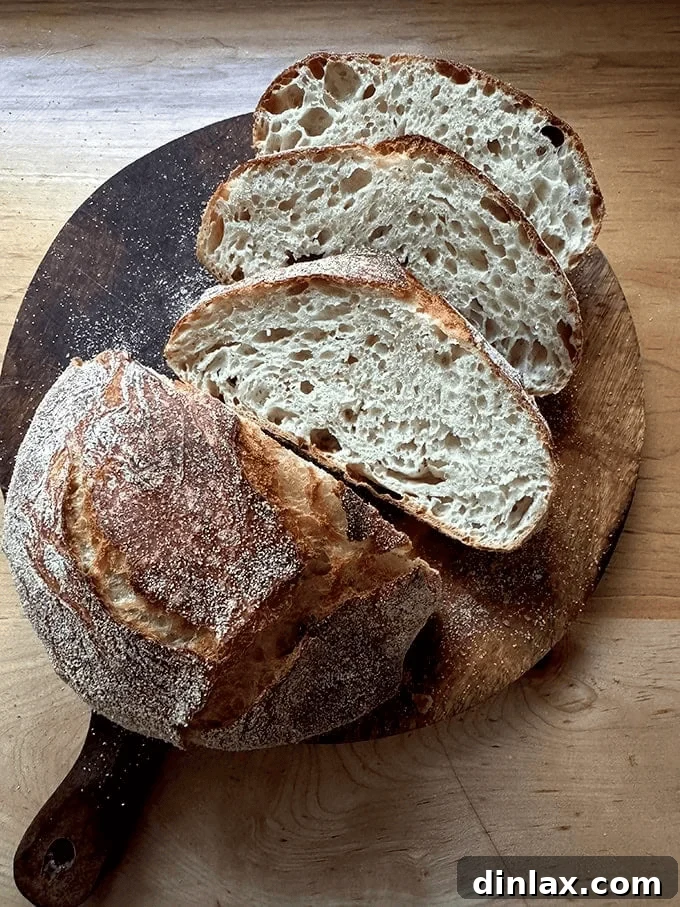
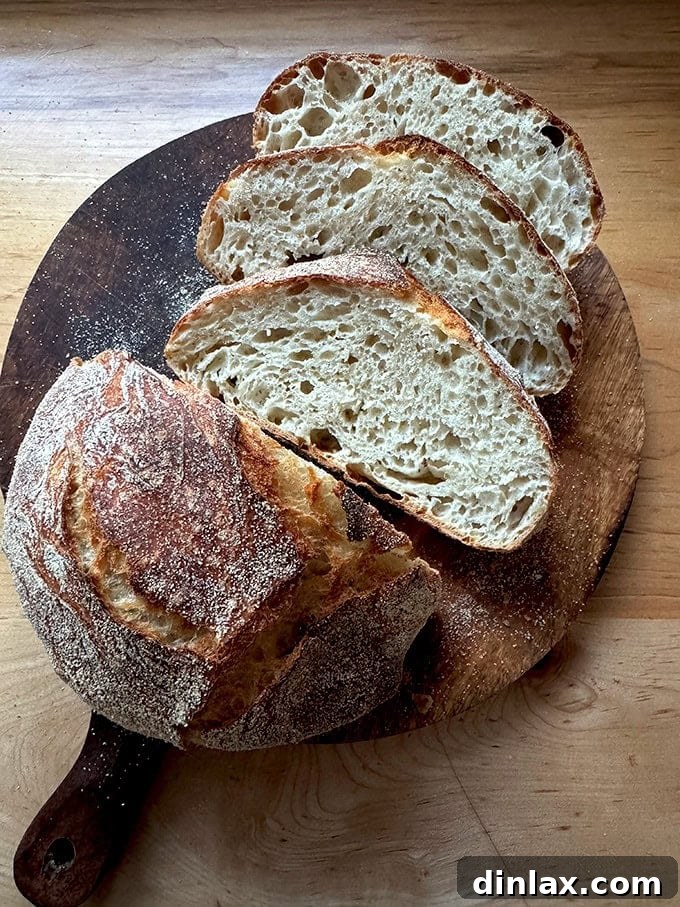
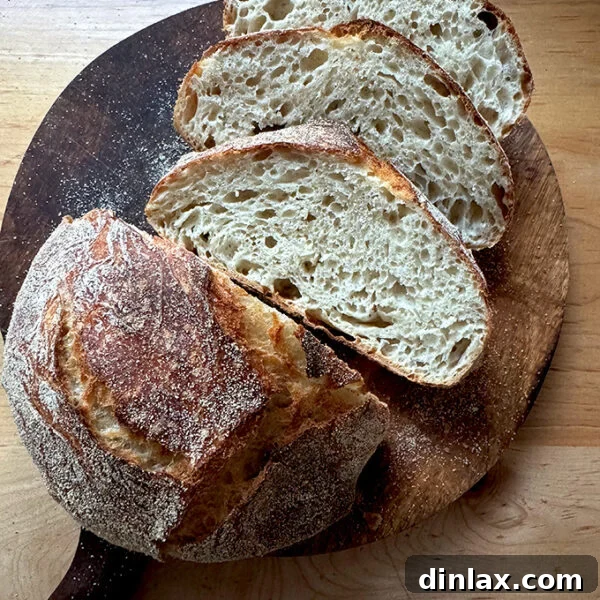
Once cooled, slice into your homemade artisan bread and marvel at its light, airy crumb. The irregular holes and tender texture are hallmarks of a well-fermented, perfectly baked no-knead loaf.
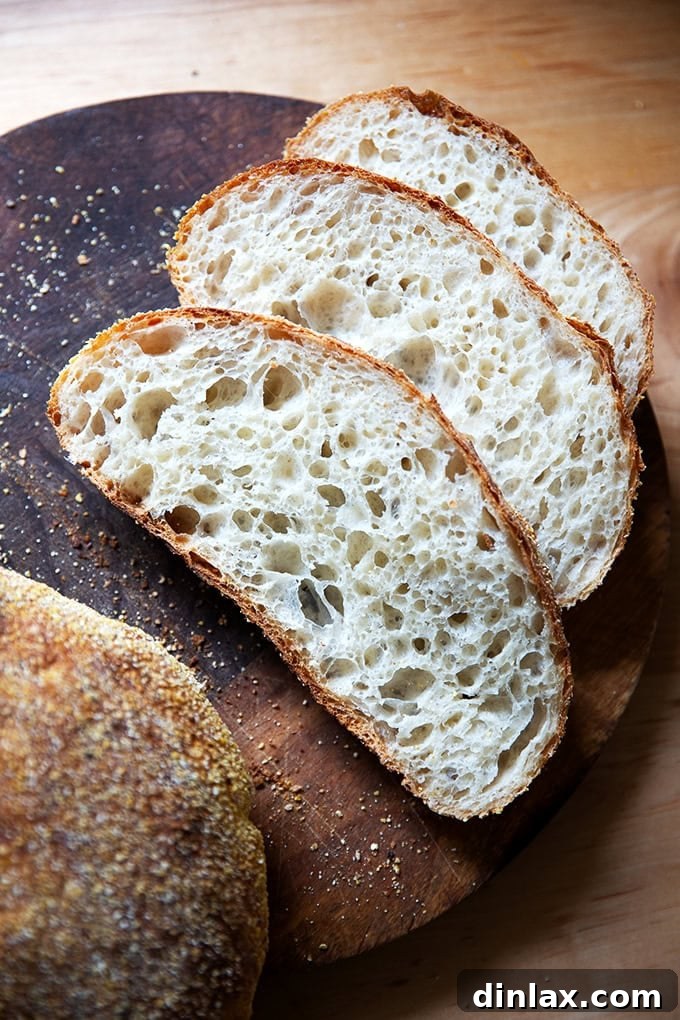
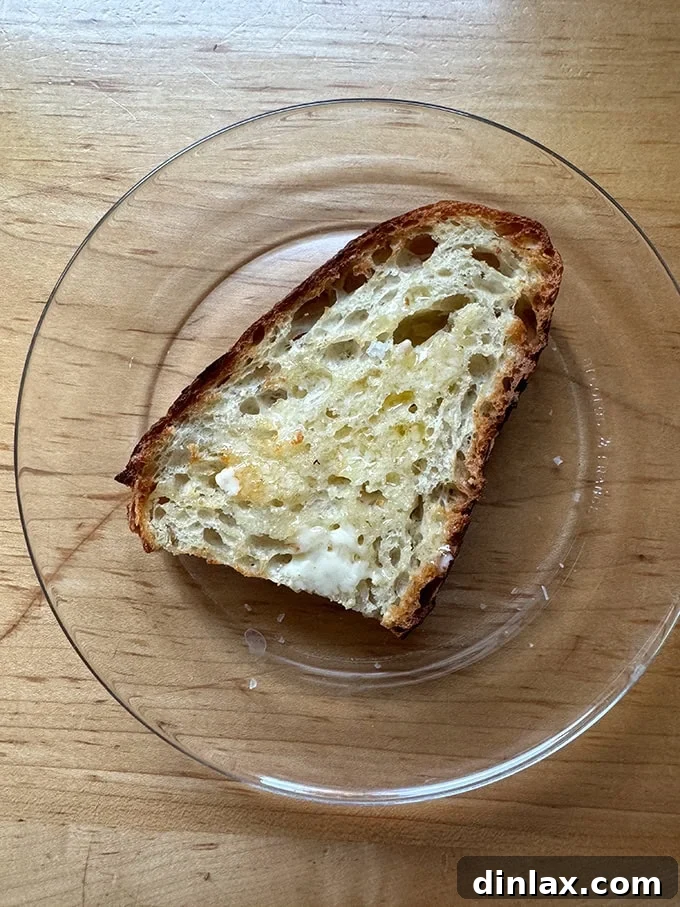
This generously sized no-knead loaf is perfect for feeding a crowd, but should you find yourself with any delightful leftovers, they make incredible toast. The robust crust and airy interior transform beautifully when toasted, ready for your favorite toppings. Furthermore, this bread freezes exceptionally well; simply slice and freeze, then toast directly from the freezer for a quick and easy treat anytime.
Jim Lahey’s No-Knead Bread
4.9 from 48 reviews
-
Author:
Alexandra Stafford - Total Time: 22 hours
- Yield: 1 loaf
Description
Crusty, airy, bakery-style bread in your home kitchen? Yes. You. Can. This dough takes 5 minutes to stir together, and from there, time does the work. If you love a rustic boule for dipping in your soup or toasting and slathering with butter and jam for breakfast, this recipe is for you.
Adapted from Mark Bittman’s “The Minimalist” column in The New York Times: Dining In November 8, 2006 / Recipe from Jim Lahey
Notes:
Flour/Salt: I’ve adjusted the recipe by adding a touch more salt than suggested in the article and converting the recipe to grams. The key here is to use roughly an 80% hydration dough, so regardless of how much flour you use, be sure the water amount is roughly 80% the amount of flour. Similarly, the salt should be roughly 2 to 3 % the weight of the flour, which for this recipe is 7 to 11 grams.
Time: Be sure to read the recipe through entirely before endeavoring to make this bread: you need 12-18 hours initially in rising time and 2 more hours subsequently for a second rise.
Equipment: You’ll need a lidded vessel to bake this loaf. I use my 5-qt Lodge Double Dutch Oven for this one. Parchment paper is helpful as well for transferring the dough from the towel to the preheated Dutch oven.
Ingredients
- 385 grams (about 3 cups) bread flour, plus more for dusting
- 1 gram (¼ teaspoon) instant yeast
- 11 grams (about 2 teaspoons) kosher salt
- 308 grams (about 1 5/8 cups) water
- Cornmeal, wheat bran, or oat bran as needed
Instructions
- In a large bowl, combine the flour, yeast, and salt. Add the water, and stir until blended. The dough will be sticky. Cover the bowl with plastic wrap and let rest for 12-18 hours at room temperature. (Note: Optional Step: If time permits, 15 to 20 minutes after you cover the bowl, perform one set of stretches and folds: simply grab an edge of the dough using a wet hand and stretch it up and in. Repeat this 8 to 10 times, grabbing a different edge each time. I find performing a set of stretches and folds gives my dough the teensiest bit more strength and ultimately a bit more loft. See photos in the post above.)
- After the 12 to 18 hours, or when the surface of the dough is dotted with bubbles, lightly flour a work surface and place the dough on it. Sprinkle a little more flour on the dough and fold it over on itself once or twice. Cover loosely with plastic wrap and let rest for about 15 minutes.
- Meanwhile, lay a clean kitchen towel (not terry cloth) on a counter or tabletop in a draft-free area. Generously coat it with cornmeal, wheat bran, oat bran, or any combination of the three. After the 15 minutes, using as much flour as necessary to keep the dough from sticking to your fingers and the work surface, quickly shape the dough into a ball and place seam side down in the center of the prepared towel. Dust with more cornmeal, wheat bran, or oat bran. If the towel is large enough, fold the sides up over the bread so that it is completely covered. Otherwise, cover it with another towel. Let rise for another 2 hours. (I like to set my towel-wrapped dough into a bowl or banneton to provide a little more support during these 2 hours.)
- Forty-five minutes before the dough is ready, preheat the oven to 450°F. Place a 6- to 8-quart heavy-covered pot (I use this Lodge Double Dutch Oven) in the oven while it heats. When the dough is ready, carefully remove the pot from the oven. Slide your hand under the towel and turn the dough over into the pot, seam side up. This is tricky — I find that parchment paper helps: open your towel, lay a sheet of parchment paper over the dough, place your hand on the parchment paper and carefully flip the dough over so that the seam side is up and the dough is resting on the parchment paper. Use the overhanging parts of the parchment paper as handles, then lay the bread, parchment paper and all, into the Dutch oven.
- Cover with the lid and bake for 30 minutes. Remove the lid and bake for another 10 to 15 minutes or until it sounds hollow when tapped. Remove from oven, and turn out onto a cooling rack.
- Prep Time: 5 minutes
- Cook Time: 45 minutes
- Category: Bread
- Method: Dutch Oven
- Cuisine: American