Homemade Faux Ciabatta Rolls: The Secret to the Perfect Prosciutto and Arugula Sandwich
Every culinary journey has its unexpected detours, and for me, a seemingly disastrous attempt at making gnudi led to one of the most delightful kitchen discoveries: incredibly easy, yet utterly delicious, ciabatta-like sandwich rolls. What began with an abundance of semolina flour in my pantry transformed into a quest for a new bread that could elevate simple meals into memorable experiences. These “faux ciabatta” rolls, born from a clever adaptation of a beloved peasant bread dough, promise a perfect balance of crispy exterior and tender, airy interior, ideal for any sandwich filling imaginable.
The Semolina Transformation: Crafting Superior Sandwich Rolls
The magic begins with a simple swap: replacing one cup of all-purpose flour in a standard peasant bread recipe with one cup of semolina flour. This seemingly minor adjustment yields remarkable results. The dough undergoes a subtle but significant transformation, developing a chewier texture and a lighter, more golden crumb. Semolina, with its fine granulation and high protein content, imparts a unique depth of flavor and a beautiful hue that distinguishes these rolls from their plain flour counterparts. The resulting bread isn’t just different; it’s distinctly better, offering a satisfying chew that’s hard to resist.
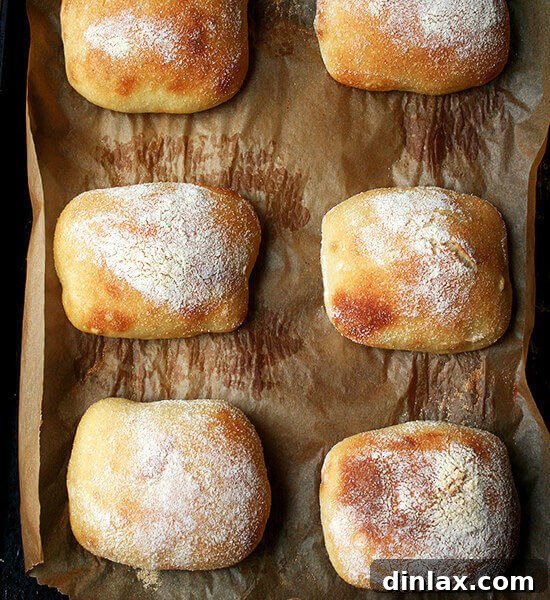
Instead of shaping the dough into traditional loaves, we portion it into individual roll-sized pieces. These are then generously sprinkled with semolina flour—much like the promising gnudi that initiated this adventure—and gently stretched into rustic squares or the classic elongated “slipper” shape that gives ciabatta its name. Baking them produces light sandwich rolls with a wonderfully crispy crust that crackles with every bite, perfectly complementing their soft, airy interior. This method brings the sophisticated texture of bakery-quality ciabatta right into your home kitchen, making gourmet sandwiches an everyday possibility.
The Art of Patience: Why Overnight Proofing Elevates Your Rolls
While these semolina rolls are delicious when baked immediately, a little extra patience yields truly exceptional results. Allowing the unbaked rolls to rest overnight in the refrigerator is a game-changer. This slow, cold fermentation process develops an even crispier exterior, a more intricately porous and open interior, and a gorgeously golden color. The rolls become feather-light, reminiscent in taste and texture of the finest artisan ciabatta. This extended proofing not only enhances their flavor but also contributes to that distinctive airy structure, making them incredibly well-suited for holding a variety of fillings, from delicate sliced meats and cheeses to hearty fried eggs and bacon, or classic mozzarella and tomato.
Upon halving these beautifully crafted rolls, one can observe an impressive web of craters stretching from crust to crust – a hallmark of perfectly proofed, artisanal bread. This open, airy structure is not only visually appealing but also contributes to the roll’s ability to absorb flavors from fillings without becoming soggy, ensuring a delightful eating experience every time.
Inspired by Excellence: Gabrielle Hamilton’s Prosciutto and Arugula Sandwich
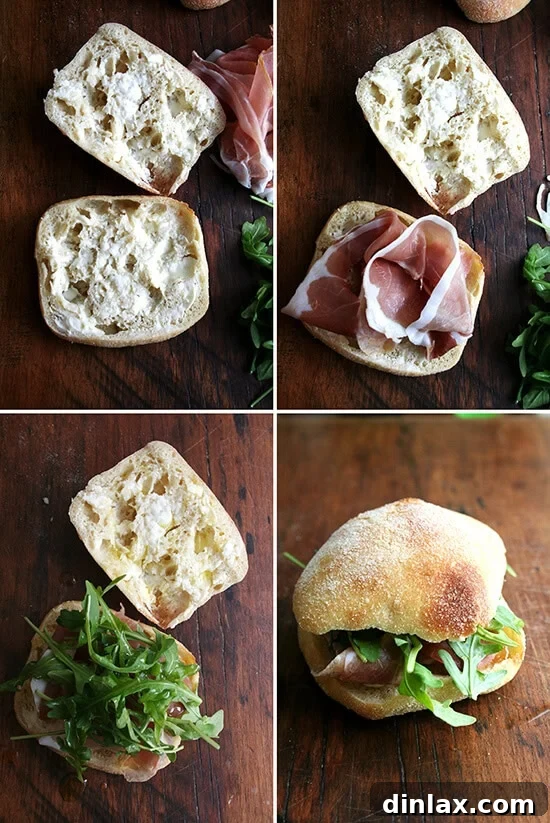
The moment I saw the beautiful, cavernous interior of these homemade ciabatta rolls, my mind immediately drifted to a sandwich I had yearned to recreate since reading Gabrielle Hamilton’s captivating memoir, Blood, Bones & Butter, last summer. Hamilton, renowned for her raw honesty and exquisite palate, describes a seemingly simple prosciutto and arugula sandwich prepared by her ex-husband during their courtship. At its core, it’s just these three components, drizzled with olive oil, nestled between good bread. Anyone could assemble this, and Michele, who even used oil pressed from his own Puglian orchards, certainly gave it a valiant effort.
However, as Hamilton eloquently explains, achieving perfection in this deceptively simple sandwich requires a profound understanding of flavor balance and texture. She famously articulated the success of this sandwich as relying on a delicate equilibrium: “the perfection of three fats together — butter, olive oil, and the white fat from prosciutto or lardo.” In her discerning view, Michele’s sandwich, while good, fell short. It needed “a smear of cool, waxy, butter,” and a more generous hand with the meat to achieve that sublime harmony she envisioned. This insight elevates the humble sandwich into an art form, demonstrating how thoughtful preparation and quality ingredients can transform the ordinary into the extraordinary.
The Culinary Symphony of Three Fats: Butter, Olive Oil, and Prosciutto Lardo
While my own palate may not be as refined as Gabrielle Hamilton’s to immediately discern the intricate interplay of these three fats, I deeply appreciate the philosophy behind it. The combination is a masterful study in synergy: the rich creaminess of slightly softened butter, the fruity pungency of good olive oil, and the delicate, savory melt of prosciutto’s inherent fat. Each contributes a subtle yet distinct layer of flavor and texture, culminating in a harmonious experience that is truly more than the sum of its parts. This isn’t about overpowering flavors with elaborate sauces or heavy condiments like pesto, creamy aioli, or spicy mustard. Instead, it’s a celebration of pure, unadulterated ingredients working in concert to create a profoundly satisfying taste.
My first bite of this elevated prosciutto and arugula sandwich was a revelation. The homemade ciabatta-style roll, with its crispy crust and airy crumb, provided the perfect canvas. The initial layers of savory prosciutto, peppery arugula, and the carefully balanced fats melted together, creating an explosion of flavor and texture. The first half of my sandwich disappeared quickly, a testament to its utter deliciousness. Yet, as I paused, a familiar thought echoed in my mind, a nod to Hamilton’s critique: despite my initially heavy hand, the sandwich yearned for even more meat. This pursuit of culinary perfection, even in simplicity, is what makes such recipes truly compelling.
Your Guide to Homemade Faux Ciabatta Rolls & The Signature Sandwich
Faux Ciabatta Rolls
No reviews yet.
- Author: Alexandra Stafford
- Total Time: Approximately 24 hours 20 minutes (including overnight proofing)
- Yield: 12 rolls
About This Recipe
This recipe offers an accessible approach to achieving ciabatta-like rolls without the complexities of traditional ciabatta dough. Traditional ciabatta, meaning “slipper” in Italian, is known for its highly porous and chewy texture, requiring a very wet dough, minimal yeast, and a long, slow rise, often with a pre-ferment (biga). Our “faux ciabatta” simplifies this by adapting a peasant bread dough with semolina flour, delivering similar incredible results with less fuss.
This recipe yields 12 generous rolls, which can be a lot to store in a fridge. I’ve found it convenient to bake half the batch on day one and the remaining half on day two after an overnight rest. While the rolls baked on day two will boast a dramatically lighter, airier, and crispier texture (more akin to true ciabatta), those baked on day one are still wonderfully delicious, just slightly less porous. If you have the fridge space, definitely opt for overnight proofing for the entire batch to experience the best possible texture. Otherwise, don’t hesitate to bake some on the first day.
Ingredients
For the Faux Ciabatta Rolls:
- About 3 cups (scant cups) (13 oz) all-purpose flour* (unbleached recommended)
- About 1 cup (a heaping cup) (5 oz) semolina flour, plus extra for dusting
- 2 teaspoons kosher salt
- 2 cups lukewarm water**
- 2 teaspoons sugar
- 2 teaspoons active-dry yeast***
Notes on Ciabatta Ingredients:
- * The combined weight of 13 oz all-purpose flour and 5 oz semolina flour (total 1 lb 2 oz) is crucial for the ideal dough consistency, mirroring the original peasant bread recipe. If using dry measuring cups, the ratio might vary slightly, but this recipe is forgiving.
- ** To achieve the perfect lukewarm water temperature for yeast activation, combine 1.5 cups cold water with 0.5 cup boiling water. This ensures the water is warm enough to activate the yeast without being too hot and killing it.
- *** I prefer Red Star active-dry yeast, purchased in bulk and stored in the freezer for longevity. If using standard packets (typically 2.25 teaspoons), a whole packet works perfectly. Both active dry, rapid rise, and instant yeasts have been successfully used. If you opt for instant yeast, you can mix it directly with the flour, skipping the proofing step, though proofing offers reassurance that your yeast is active and viable.
For the Ultimate Prosciutto and Arugula Sandwich:
- Good quality homemade ciabatta rolls (from the recipe above)
- Butter, slightly softened
- Prosciutto, thinly sliced (a generous amount)
- Fresh arugula
- Good quality olive oil (for drizzling)
Notes on Sandwich Ingredients:
The quality of your sandwich ingredients truly matters here. Seek out thinly sliced, flavorful prosciutto and fresh, vibrant arugula. A good extra virgin olive oil will lend a nuanced fruitiness, while slightly softened butter provides that essential creamy counterpoint, bringing Gabrielle Hamilton’s “perfection of three fats” to life.
Instructions
- In a large mixing bowl, whisk together the all-purpose flour, semolina flour, and kosher salt. Set this aside. Optionally, lightly grease a separate large bowl with butter or olive oil for the dough to rise in; however, the dough can also rise directly in the mixing bowl to simplify cleanup.
- In a smaller mixing bowl, dissolve the sugar into the lukewarm water. Gently sprinkle the active-dry yeast over the surface of the water; do not stir it yet. Allow this mixture to sit undisturbed for 10 to 15 minutes, or until you observe a foamy or slightly bubbling surface. This indicates your yeast is active and ready. Once proofed, stir gently and pour the yeast mixture into the large bowl with the flour. Using a spatula or a sturdy wooden spoon, stir thoroughly until all the flour is hydrated and a shaggy, wet dough forms. Scrape the dough into your prepared greased bowl (if using), or simply cover the mixing bowl.
- Cover the bowl tightly with plastic wrap or a clean tea towel. Place it in a warm, draft-free spot to rise for at least one hour. A simple trick for a warm spot: preheat your oven to its lowest setting (around 200ºF) for just one minute, then turn it off. The residual warmth creates an ideal environment for dough rising, without being too hot to harm the yeast.
- Once the dough has risen (it should be noticeably puffy), preheat your oven to 425ºF (220ºC). To “punch down” the dough, use two forks to gently scrape it away from the sides of the bowl, allowing it to deflate. Try to fold the dough over itself as you scrape to loosen it completely. Liberally sprinkle your clean work surface with semolina flour. Gently turn the sticky dough out onto the floured surface and sprinkle the top with more semolina if it feels too sticky. Using a sharp knife or a bench scraper (which you can also coat with semolina), divide the dough into twelve roughly equal pieces. A helpful method: divide the dough in half, then each half in half again, and finally, divide each quarter into thirds to get 12 pieces.
- Carefully roll each portion of dough into a loose ball. If you plan to store all the dough balls in the refrigerator overnight, arrange them on a parchment-lined baking sheet, ensuring adequate space between each. Sprinkle them with semolina flour, cover the pan tightly with plastic wrap, and refrigerate. If you’re baking some rolls immediately, let the balls rest on your work surface for 10 minutes. While they rest, line a baking pan with parchment paper. After 10 minutes, gently pick up a dough ball and stretch it carefully into a square or the traditional elongated “slipper” shape. Place it onto your prepared baking sheet. Repeat this with five more balls (six rolls is a good number per batch). Allow these rolls to rise on the baking sheet for an additional 20 minutes before baking. Place the baking sheet on the lower or middle rack of your preheated oven and bake for 15 minutes. Check their color; if they are browning too quickly, reduce the oven temperature to 375ºF (190ºC) and continue baking for another 5 minutes, or until golden brown. To test for doneness, carefully lift a roll; the bottom should be lightly browned, and it should sound hollow when tapped. Transfer the baked rolls to a cooling rack and let them cool for at least 15 minutes before enjoying.
- For the rolls that have rested overnight in the fridge: Lightly sprinkle the cold dough balls with more semolina flour. Gently lift each ball from the sheet pan and carefully stretch it into your desired shape (slipper or rectangle). Handle them delicately to avoid completely deflating the airy structure that developed overnight. Arrange them on a fresh parchment-lined baking sheet. Allow these rolls to rise for approximately 30 minutes at room temperature; they may not appear significantly puffed up, but this resting period is crucial. Bake as directed in step 5, appreciating the enhanced crispness and open crumb that the overnight rest provides.
- To make the ultimate prosciutto and arugula sandwich: Split a cooled ciabatta roll in half. Spread each half generously with softened butter – don’t be shy, as this contributes to the “three fats” perfection. Layer one half with several slices of thinly sliced prosciutto, more than you think you need, to ensure a satisfying bite. Top the prosciutto with a handful of fresh arugula. Drizzle both halves of the sandwich (the prosciutto-arugula side and the buttered top half) with good olive oil. Close the sandwich, press gently, and savor the symphony of flavors and textures.
- Prep Time: 24 hours
- Cook Time: 20 minutes
- Category: Bread
- Method: Oven
- Cuisine: American, Italian
Share Your Creations!
If you bake these delicious faux ciabatta rolls or craft the perfect Gabrielle Hamilton-inspired sandwich, we’d love to see your culinary artistry! Tag @alexandracooks on Instagram and use the hashtag #alexandracooks to share your homemade triumphs.
After a night in the fridge, the dough balls look like this, slightly flattened and beautifully developed:
The balls can then be gently stretched into their classic “slipper” shape or into any preferred form. I personally favor rustic rectangles for easy sandwich making: