Beyond Sushi: Discovering Morimoto’s Cha-Soba and a Flavorful Korean Flank Steak Recipe
When one mentions Morimoto, the immediate association for most gourmands is often unparalleled sushi and sashimi. Indeed, the establishment, spearheaded by the legendary Iron Chef Masaharu Morimoto and part of Stephen Starr’s esteemed culinary empire, frequently earns accolades for its exquisite raw fish preparations. Patrons willingly splurge for the delicate fatty tuna rolls or the melt-in-your-mouth tuna belly sashimi, recognizing the supreme quality and artistry that makes Morimoto a definitive destination for Japanese cuisine in the city.
A Culinary Secret: Morimoto’s Distinctive Cha-Soba
Yet, beyond the illustrious sushi counter, Morimoto harbors a less-known but equally captivating culinary treasure that often captivates those seeking a different kind of Japanese delicacy. For me, the true magnet is Morimoto’s cha-soba — a dish that transcends the ordinary. These aren’t just any noodles; they are chilled green tea soba noodles, served alongside a profoundly savory dipping sauce known as dashi-shoyu, a combination so unique it remains elusive elsewhere in the city. While many Japanese restaurants offer various hot and cold soba preparations, the distinct green tea variety, or cha-soba, is a rare find.
The Allure of Cha-Soba: Matcha, Buckwheat, and a Symphony of Flavors
The name “cha-soba” literally translates to “tea-soba,” a descriptor that hints at the very essence of the noodles themselves. Crafted from a harmonious blend of finely ground matcha (green tea powder) and robust buckwheat flour, these noodles offer an experience that is both visually stunning and gastronomically delightful. Part of the dish’s undeniable appeal lies in its elegant presentation: vibrant seaweed-green noodles are meticulously arranged on a bed of ice within a traditional bamboo box. This exquisite centerpiece is accompanied by a separate bowl of the rich dashi-shoyu dipping sauce, and a plate adorned with toasted sesame seeds, finely sliced scallions, and freshly grated wasabi – elements inviting the diner to customize their culinary journey.
However, beyond the aesthetic pleasure, it is the profound texture and unmistakable flavor that truly captivates. The noodles boast a wonderfully chewy, resilient bite, a perfect counterpoint to the subtle earthiness of the buckwheat and the distinct, slightly bitter, yet refreshing notes of green tea. Each strand is a testament to the meticulous preparation and thoughtful pairing of ingredients, creating a flavor profile that is both comforting and exhilarating.
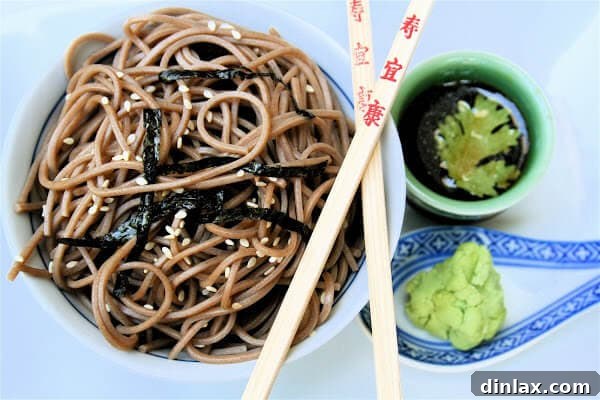
Chilled soba made with traditional buckwheat noodles, offering a glimpse into the classic preparation:
The Art of Dashi-Shoyu: A Perfect Pairing
The accompanying dashi-shoyu is not merely a sauce; it is the soul of the dish. Chef Masaharu Morimoto himself, through his exceptionally knowledgeable and attentive servers, suggests a specific ritual to fully appreciate the cha-soba. The experience begins with tasting the dashi on its own, savoring its complex umami notes, then seasoning it delicately with a touch of the fresh, vibrant wasabi. The final, crucial step is to dip the chilled noodles into this seasoned sauce before eating, rather than simply dressing them. This method ensures an impeccable ratio of sauce to noodle in every bite, allowing the delicate flavors of the noodles to shine while being perfectly complemented by the savory depth of the dashi.
The dashi itself is a masterpiece of Japanese culinary tradition, crafted from a robust stock of kombu (dried kelp seaweed) and delicate bonito shavings (dried, thinly flaked mackerel), which are steeped in a nuanced blend of mirin, soy sauce, and water. This combination yields an incredibly flavorful and aromatic broth, rich in umami, which forms the backbone of countless Japanese dishes. The chilled nature of the dashi-shoyu, combined with the sharp kick of fresh wasabi, elevates the cha-soba to a sublime level, making it a true delight for any sushi enthusiast or discerning diner.
At approximately $12 a serving, Morimoto’s cha-soba, while perhaps not the most budget-friendly noodle option in the city, offers exceptional value for its unique quality and intricate preparation. It serves as an ideal light and refreshing summer lunch on its own. Moreover, when thoughtfully paired with other offerings like exquisite sushi, grilled fish, or a perfectly seared steak, it transforms into an unforgettable side dish, perfect for sharing and enhancing a dinner experience. For me, much like a prized toro-stuffed maki roll might induce bliss for many of Morimoto’s regulars, the cha-soba evokes a culinary contentment unmatched by any other noodle dish in the entire city.
From Kobe to Grass-Fed: A Conscious Culinary Shift
Before my culinary philosophy began its subtle shift towards more sustainable and ethically sourced ingredients, one dish held a special place in my heart at Morimoto: the Kobe beef carpaccio. Thin, translucent slices of sumptuously tender and incredibly flavorful meat, expertly rubbed with ginger and garlic, then seared to perfection with a hot sesame-olive oil mixture – it was a dish I didn’t just enjoy, but adored. The richness and delicacy were unparalleled.
However, as my awareness grew regarding food sourcing and animal welfare, my perspective on Kobe beef evolved. Questions arose: Was it truly grass-fed? What were the conditions under which these cattle were raised? The answers, I realized, were not readily apparent, and my lack of knowledge on the treatment of Kobe beef cows became a point of ethical consideration. This shift led me to explore more transparent and sustainable options, particularly focusing on grass-fed beef.
Embracing Sustainability: The Livengood Farm Difference
This journey of conscious eating brought me to Livengood Farm in Lancaster, Pennsylvania, where I discovered the undeniable deliciousness of their grass-fed beef. Those who had the pleasure of savoring their grass-fed hamburgers during a recent Fourth of July celebration can undoubtedly attest to its superior flavor and quality. The commitment of farms like Livengood to raising animals on their natural diet not only results in a more flavorful and nutrient-dense product but also supports more ethical and environmentally friendly farming practices. It’s a choice that resonates deeply with a growing number of consumers who value knowing the origin and story behind their food.
This quest for quality and ethics directly inspired my exploration of new recipes. The following marinade for flank steak — specifically, the superb grass-fed variety purchased from Livengood’s at the South and Passyunk Farmers’ Market — is a prime example. This versatile marinade is also perfectly suited for other flavorful cuts like skirt or hanger steak, ensuring a delicious outcome every time.
Grass-fed cows grazing peacefully at the picturesque Livengood Family Farm in Lancaster, PA:
Creating a Perfect Pairing: Korean-Style Flank Steak
Much like Morimoto’s unforgettable Kobe beef carpaccio, this Korean-style flank steak recipe embraces a bold and aromatic flavor profile, featuring generous amounts of fresh ginger and pungent garlic. The sugar in the marinade plays a crucial role, caramelizing beautifully on the grill to create a delicious, slightly charred exterior. This sweetness is perfectly balanced by the savory depth of the soy sauce, resulting in a complex and utterly addictive flavor. The distinct Asian influences in this Korean-style flank steak make it an ideal entrée, perfectly complementing the subtle elegance of the chilled cha-soba for a truly memorable meal that balances richness with freshness.
Korean-Style Flank Steak
Serves 4
Ingredients:
- ¼ C. granulated sugar
- ¼ C. + 2 T. soy sauce (or tamari for a gluten-free option)
- 1 T. + 1 tsp. mirin (Japanese sweet cooking wine)
- 6 large cloves garlic, minced finely
- 6 scallions, white part only, minced
- 1-inch knob fresh ginger, finely chopped or grated
- 1 T. + 1 tsp. sesame oil
- 1½ lbs. flank steak (preferably grass-fed)
- Light oil for greasing grill grates (e.g., canola, grapeseed)
- Kosher salt to taste (use sparingly if marinating overnight)
Instructions:
- In a medium bowl, whisk together the sugar, soy sauce, mirin, minced garlic, minced scallions, fresh ginger, and sesame oil until the sugar is fully dissolved and the mixture is smooth.
- Carefully transfer the marinade to a resealable plastic storage container or a heavy-duty Ziploc bag. Place the flank steak into the marinade, ensuring it is fully coated. Seal the container or bag, pressing out any excess air.
- Allow the meat to marinate in the refrigerator for a minimum of 3 to 4 hours, or for optimal flavor and tenderness, marinate overnight (up to 12-18 hours).
- When ready to cook, preheat your grill to high heat.
- Remove the steak from the marinade, discarding the remaining marinade. If the steak has marinated overnight, season it very lightly with kosher salt, or omit salt altogether as the marinade provides ample seasoning. If marinated for only a few hours, a light seasoning of salt will enhance the flavor.
- Clean and generously grease the hot grill grates with oil to prevent sticking.
- Place the flank steak on the hot grill. For a flank steak approximately 1-inch thick, grill for about 4 minutes on one side.
- Flip the steak and grill for an additional 3 minutes on the second side for a perfect medium-rare doneness. Adjust cooking time for desired doneness (e.g., 2-3 minutes per side for rare, 4-5 minutes per side for medium).
- Remove the steak from the grill and let it rest on a cutting board for at least 10 minutes before slicing. This allows the juices to redistribute, ensuring a tender and flavorful cut.
- Slice the steak thinly against the grain to maximize tenderness. Serve immediately.
Chilled Soba Noodles with Dashi-Shoyu
Adapted from Sally Schneider, A New Way To Cook (Artisan, 2001)
Serves 6
Ingredients:
- ½ oz. dried kombu (kelp seaweed)
- 2½ C. cold water
- ½ oz. dried bonito shavings (katsuobushi)
- ½ C. mirin
- ½ C. soy sauce or tamari
- 12 oz. soba noodles or green tea soba noodles (cha-soba)
- Wasabi powder (for making fresh paste)
- 1 bunch scallions, thinly sliced (green parts and some white)
- Toasted sesame seeds
- 1 sheet nori (dried seaweed), cut into thin strips
Instructions:
- Prepare the Dashi: Place the kombu and 2½ cups of cold water in a small saucepan. Bring the mixture to a gentle simmer over medium-low heat. Just as small bubbles begin to form and before it reaches a rolling boil (after about 1 minute), remove the kombu and discard it. Immediately remove the pan from the heat, add the bonito shavings, and do not stir.
- Allow the bonito shavings to steep and sink to the bottom of the pan, which will take about 1 to 2 minutes. Once settled, carefully strain the broth through a fine-mesh strainer, pressing gently on the bonito shavings with a spatula to extract all the flavorful liquid. Discard the spent bonito.
- Finish the Dashi-Shoyu: In a separate small saucepan, bring the mirin to a boil over medium-high heat to cook off the alcohol. Once boiling, reduce the heat and add the prepared kombu-bonito broth and the soy sauce. Simmer this mixture gently for 4 minutes to allow the flavors to meld.
- Remove the saucepan from the heat, let the dashi-shoyu cool completely at room temperature, then transfer it to an airtight container and refrigerate until thoroughly chilled.
- Cook the Noodles: Bring a large pot of salted water to a rolling boil. Add the soba noodles and cook according to package directions, typically until al dente, which is usually about 4 minutes. Soba noodles cook quickly, so watch them carefully.
- Immediately drain the cooked noodles in a colander. Rinse them thoroughly under cold running water to stop the cooking process and remove excess starch, or plunge them into an ice bath for a truly chilled effect. Drain them well again and set aside.
- Assemble and Serve: When you are ready to serve, prepare the garnishes. Mix wasabi powder with a tiny amount of water to create a thick paste, and set aside. Arrange all of your chosen garnishes—thinly sliced scallions, toasted sesame seeds, nori strips, and the freshly prepared wasabi paste—in separate small bowls.
- Divide the chilled soba noodles among six individual plates or shallow bowls. Pour the chilled dashi-shoyu into 6 small dipping bowls. Ensure these bowls are large enough to comfortably accommodate a serving of chopsticks-full noodles dipped inside, as instructed by Chef Morimoto (they should be much larger than what might be pictured in some traditional single-serving images).
- Present each diner with a bowl of noodles and a bowl of the dipping sauce, allowing them the pleasure of garnishing their noodles precisely to their liking. Encourage them to dip the noodles into the seasoned dashi-shoyu for the authentic cha-soba experience.