Embarking on the journey of homemade bread has never been easier, thanks to revolutionary methods like “Artisan Bread in Five Minutes a Day.” We’re thrilled to share an update on our latest bread-making adventures, focusing on a recent batch that introduced a significant proportion of whole-wheat flour. This particular experiment marked our third foray into this wonderfully simple bread-making technique, and the results were nothing short of spectacular. We integrated nearly 50-percent whole-wheat flour into the dough, curious to see if it would maintain the same impressive rise and structural integrity as its 100-percent all-purpose flour counterparts.
Effortless Artisan Bread: Mastering Whole Wheat & Dutch Oven Baking
The “Artisan Bread in Five Minutes a Day” method has transformed the landscape of home baking, making the dream of daily fresh bread an achievable reality for even the busiest individuals. Its core philosophy revolves around a super-wet, no-knead dough that can be mixed in mere minutes and then stored in the refrigerator for up to two weeks. This innovative approach means you can pull off a piece of dough at a moment’s notice, bake it, and enjoy a warm, crusty loaf without the laborious kneading or complex schedules traditionally associated with artisan bread. It’s a game-changer for those who crave the taste and aroma of professional bakery bread right from their own kitchen, offering unparalleled convenience and delicious results.
The Whole-Wheat Experiment: A Healthier, Flavorful Twist
Our latest batch pushed the boundaries by incorporating a substantial amount of whole-wheat flour. While many bread recipes stick to all-purpose flour for consistency, we decided to experiment with a nearly 50-percent whole-wheat blend. The motivation behind this was twofold: to introduce more nutritional value and to explore the deeper, more complex flavor profiles that whole grains impart. Whole wheat flour brings a hearty texture and a nutty undertone that can elevate the overall sensory experience of homemade bread. It’s also rich in fiber and essential nutrients, making each slice a bit more wholesome.
The results of this whole-wheat experiment were incredibly encouraging. The dough, despite the higher whole-wheat content, rose just as beautifully and robustly as the previous batches made with 100-percent all-purpose flour. Its aeration and structure were perfectly maintained, a testament to the versatility of the “Artisan Bread in Five Minutes a Day” technique. Furthermore, the dough held up exceptionally well during its week-long storage in the fridge, proving that introducing whole grains doesn’t compromise the method’s inherent convenience or the dough’s long-term viability. This successful adaptation opens up a world of possibilities for incorporating various flours and grains into your homemade bread, encouraging further culinary exploration.
Elevating the Crust: The Jim Lahey-Mark Bittman No-Knead Method
Beyond the dough itself, the baking method plays a crucial role in the final product’s texture and appearance, particularly the coveted crispy crust of artisan bread. On a recent whim, we decided to combine the “Artisan Bread in Five Minutes a Day” dough with the highly acclaimed Jim Lahey-Mark Bittman No-Knead Bread cooking method. This technique, popularized by The New York Times, involves baking the bread in a pre-heated, covered ceramic pot, such as a Dutch oven. The principle behind this method is ingenious: the sealed pot traps steam released from the dough as it bakes, mimicking the steam-injected ovens used by professional bakeries. This steamy environment allows the crust to expand fully and achieve an incredible crispness and golden-brown hue before it sets.
The transition to the Dutch oven method was a resounding success. After precisely 30 minutes in our pre-heated Emile Henry Dutch oven, the bread emerged with an utterly irresistible, crispy, and perfectly golden crust. This “steam-injected-oven effect” is precisely what yields that desirable professional-bakery crust, transforming a simple loaf into a masterpiece of texture. For those who, like us, don’t own a dedicated pizza stone or a steam-injection oven, baking in a heavy-duty pot like a Dutch oven is undeniably the best alternative for achieving such exceptional results. The consistent, high heat combined with the trapped steam creates an ideal baking environment that is hard to replicate otherwise in a standard home oven.
Dutch Oven vs. Pyrex: A Tale of Two Crusts
While the Dutch oven excels at creating that signature crispy crust, it’s worth noting the versatility of the “Artisan Bread in Five Minutes a Day” dough. We’ve also successfully baked this delicious bread in a simple buttered Pyrex bowl. While the Pyrex method doesn’t yield the same professional-bakery-style crust – it tends to be softer rather than cracklingly crisp – the internal flavor and texture of the bread remain just as delicious. This highlights a fascinating distinction: the baking vessel primarily influences the crust’s characteristics, not the inherent flavor profile of the dough.
Choosing between a Dutch oven and a Pyrex bowl often comes down to personal preference and convenience. If a shatteringly crisp, deep golden crust is your top priority, investing in a good quality Dutch oven is highly recommended. The way it conducts and retains heat, coupled with its ability to trap steam, is simply unmatched for crust development. However, if ease and minimal fuss are your primary concerns, and you’re content with a softer, chewier crust, then baking in a buttered Pyrex bowl is an incredibly convenient and perfectly viable option. It still delivers that wonderful homemade bread flavor with minimal effort, making it ideal for everyday baking.
The Journey from Dough to Loaf: A Visual Guide
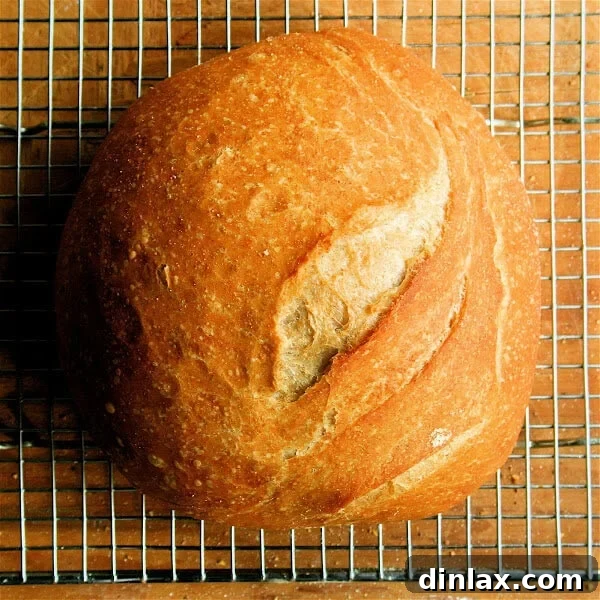
A loaf of 50-percent whole-wheat artisan bread in five minutes a day baked in a pot:
The transformation from a simple, unbaked dough to a magnificent loaf is truly one of the most rewarding aspects of bread making. Above, you can see the culmination of our efforts: a beautifully formed loaf of 50-percent whole-wheat artisan bread, baked to perfection in a pre-heated pot. Observe the rich, golden-brown hue of the crust, the subtle patterns formed during its expansion, and the inviting shape that promises a delightful interior. This image serves as an inspiration for what can be achieved with minimal active time, highlighting the success of our whole-wheat adaptation and the efficacy of the pot-baking method.
View of the 50-percent whole-wheat dough after rising overnight in the fridge.
The magic truly begins long before the baking. Pictured above is the 50-percent whole-wheat dough after rising overnight in the fridge. Notice the intricate network of bubbles and the slightly expanded volume, clear indicators of successful yeast activity and fermentation. This cold fermentation process is key to developing the complex flavors characteristic of artisan bread, even with the “five minutes a day” approach. It’s this patient, overnight rise that builds the internal structure and contributes to the fantastic texture you’ll find in every slice, setting the stage for a truly remarkable loaf.
Essential Resources for Your Bread-Making Journey
To truly master the art of “Artisan Bread in Five Minutes a Day,” having access to reliable resources is invaluable. We previously omitted a crucial link to the official Artisan Bread book’s blog and website, which serves as an incredible hub for enthusiasts. This site is not just a collection of recipes; it offers a wealth of tips, troubleshooting advice, and a vibrant community where bakers can share their experiences and ask questions. From tackling common issues to exploring innovative uses for the versatile dough, it’s an indispensable companion for anyone serious about elevating their home baking. For instance, their grilled fruit pizza recipe is a testament to the dough’s adaptability beyond traditional loaves, inspiring creativity in the kitchen.
For those eager to dive into the specific recipe for this delicious bread, you can find it here. Furthermore, to perfect the baking method, especially if you’re aiming for that professional-bakery crust, we highly recommend following the technique detailed in Mark Bittman’s influential NY Times article. Titled “The Secret of Great Bread: Let Time Do The Work,” this piece not only provides step-by-step instructions for the no-knead method but also beautifully articulates the philosophy behind slow fermentation. It underscores how patience and minimal intervention can yield extraordinary results, aligning perfectly with the ethos of both the “Artisan Bread in Five Minutes a Day” and Jim Lahey’s techniques. These resources, when combined, offer a comprehensive guide to achieving consistently delicious and impressive homemade bread.
Tips for Aspiring Artisan Bakers
For anyone looking to embark on or continue their artisan bread-making journey, a few key tips can make all the difference. Firstly, always measure your ingredients accurately, especially the flour and water, as proper hydration is critical for the dough’s texture and rise. Secondly, embrace patience; the beauty of these no-knead methods lies in allowing time and fermentation to do the heavy lifting, developing flavor and structure naturally. Don’t rush the rising or resting periods. Thirdly, don’t be afraid to experiment with different flours, like our successful whole-wheat integration, or various baking vessels to discover what works best for your taste and equipment.
Finally, preheating your oven and baking vessel (like a Dutch oven) to the correct temperature is paramount for achieving that desirable crispy crust. A well-calibrated oven and a scorching hot pot create the ideal environment for the dough to spring and crust to form beautifully. With these simple principles in mind, you’re well on your way to enjoying the unparalleled satisfaction of baking your own artisan bread at home.
The world of homemade artisan bread, once thought to be complex and time-consuming, has been wonderfully demystified by innovative techniques. Whether you’re experimenting with whole grains or perfecting that coveted crispy crust in a Dutch oven, the journey is incredibly rewarding. Embrace the simplicity, savor the flavors, and enjoy the aroma of fresh bread filling your home. Happy baking!