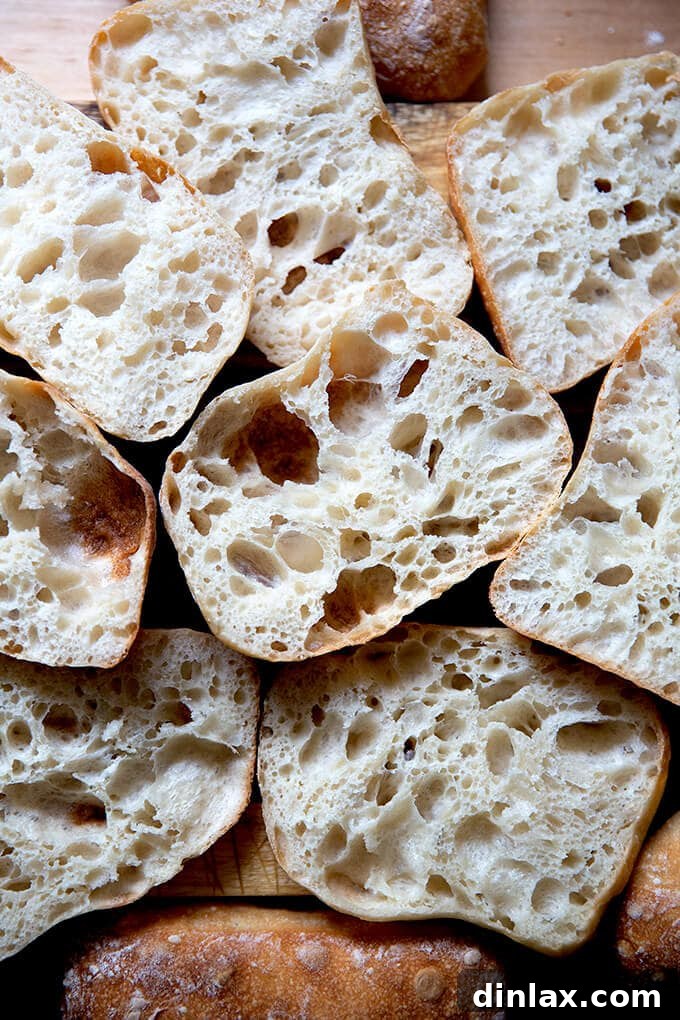
Unlock the secrets to baking the perfect ciabatta bread right in your own kitchen! This detailed guide will walk you through every step, from crafting a bubbly poolish to achieving that signature crusty exterior and glorious, open-crumbed interior. Whether you’re a seasoned baker or new to the world of artisan bread, our tips and tricks will help you create a light, airy loaf with a crisp, golden finish that rivals any Italian bakery. Get ready to elevate your home baking with this authentic ciabatta recipe!
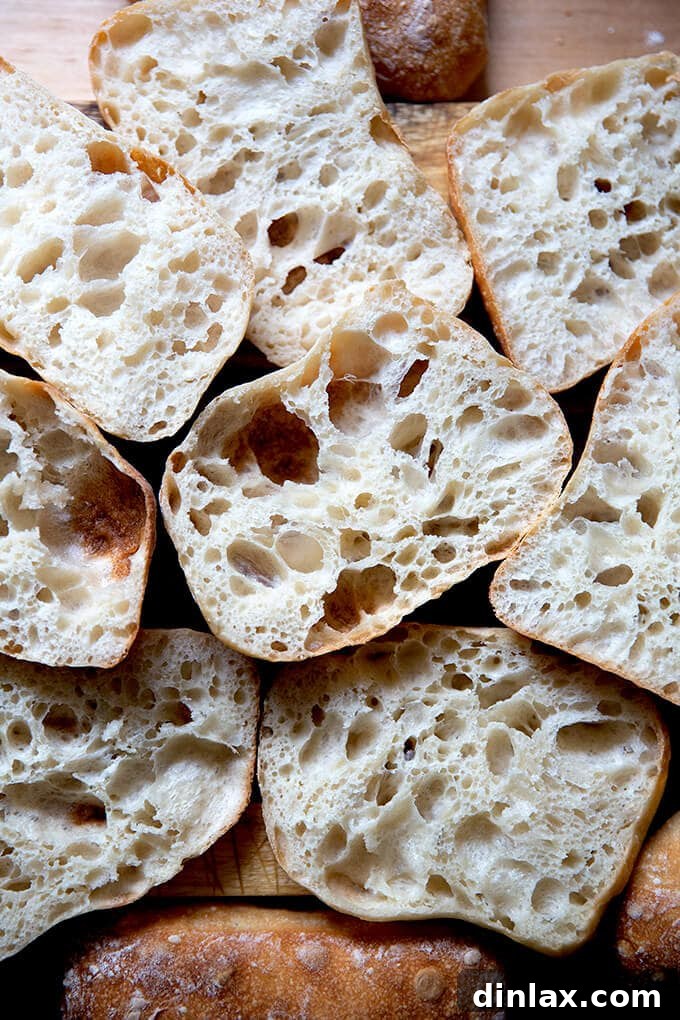
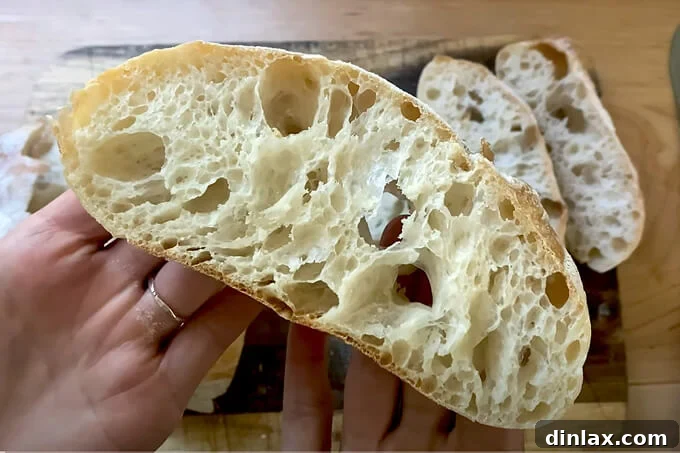
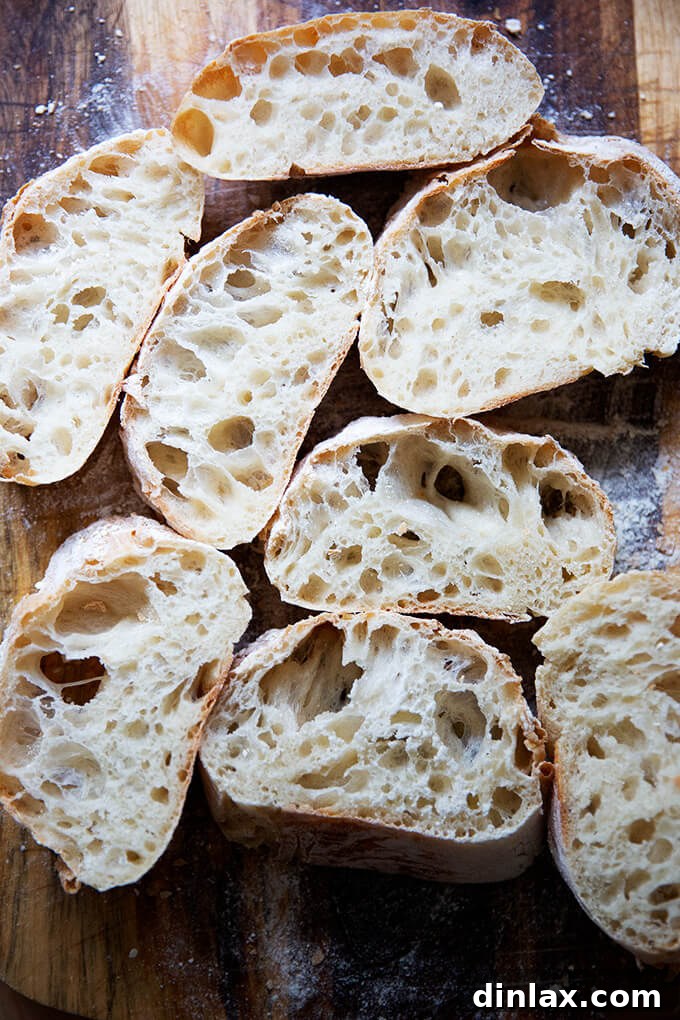
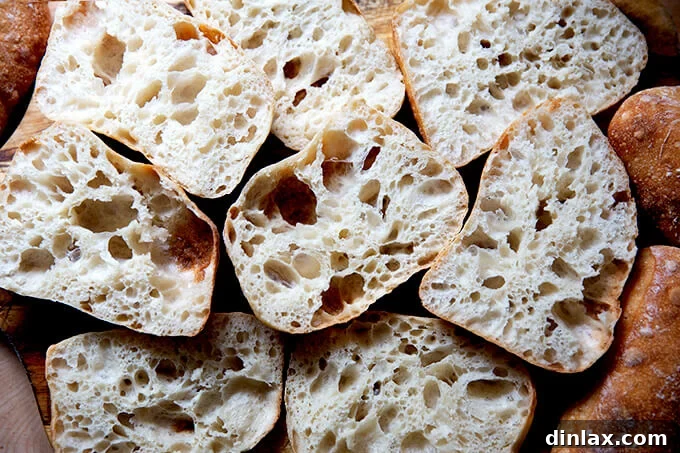
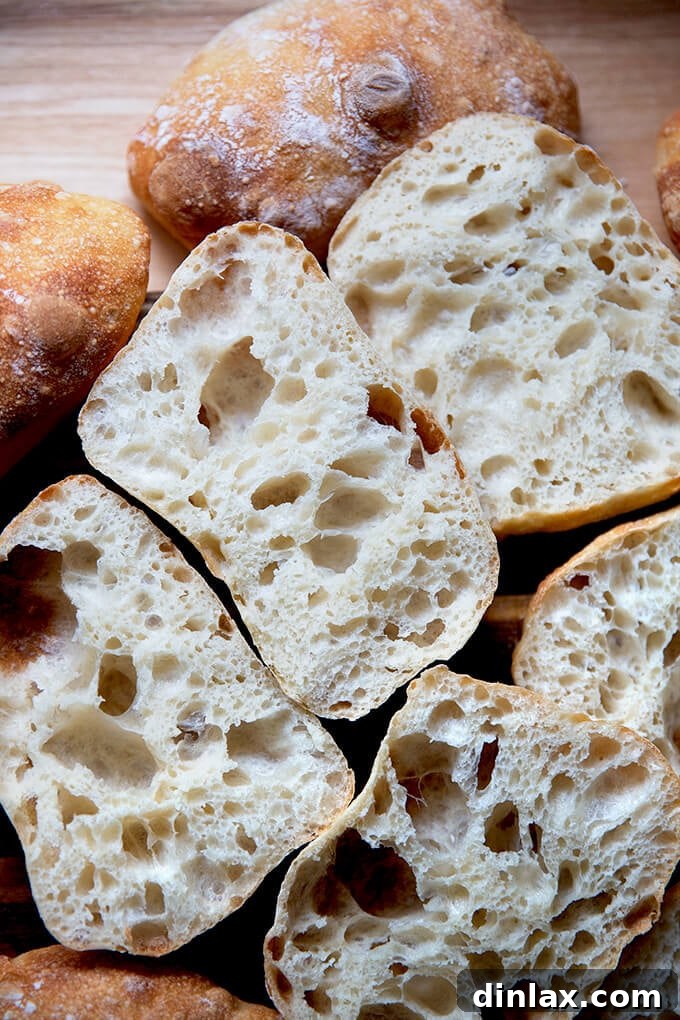
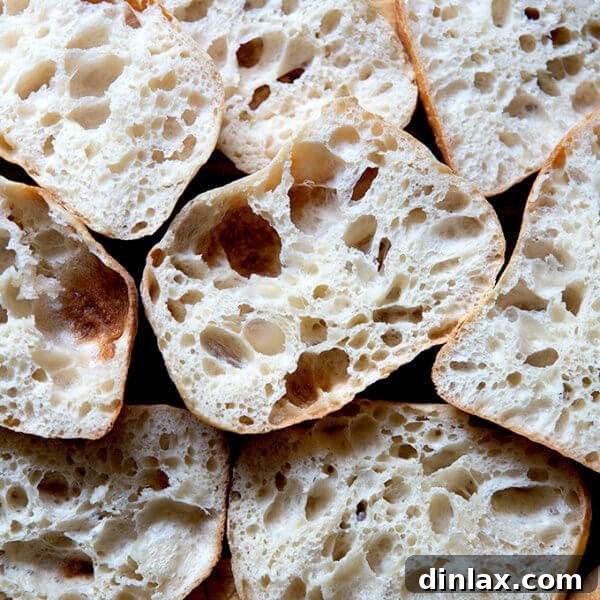
Hailing from the picturesque Lake Como region of northern Italy, ciabatta, which charmingly translates to “slipper” in Italian, is far more than just a loaf of bread. It’s a culinary icon, celebrated for its unique rustic appeal: a wonderfully crusty exterior that gives way to an irresistibly porous and chewy interior. This distinctive texture, often described as an “open crumb” with irregular, amorphous holes, is what sets ciabatta apart and makes it so incredibly satisfying.
Traditionally, the secret to ciabatta’s complex flavor and structure lies in its preferment, known as a poolish or biga. These are small, active starters made from a simple mixture of flour, water, and a leavening agent (like yeast), allowed to ferment for a specific period before being incorporated into the main dough. This crucial step not only develops a richer flavor profile but also enhances the dough’s extensibility, contributing to that desirable airy crumb. Ciabatta dough is notoriously wet and sticky, often boasting hydration levels of 80% or higher, a characteristic that further aids in creating its signature open texture.
Our recipe embraces this traditional approach, utilizing a poolish that ferments for a precise 3 to 4 hours, resulting in an overall dough hydration of a generous 82%. While high-hydration doughs might seem intimidating to beginners, a few gentle sets of stretches and folds transform the sticky mixture into a surprisingly manageable and elastic dough. The reward for your efforts is truly magnificent: loaves emerging from the oven with a perfectly crisp crust and an unbelievably light, airy crumb brimming with beautiful, irregular holes – the hallmark of authentic ciabatta.
This versatile bread is an absolute dream for crafting sandwiches of all kinds. Its robust crust ensures it holds up beautifully, preventing fillings from making it soggy, making it an ideal companion for a beach picnic or a hearty hike. Beyond sandwiches, ciabatta shines as an exquisite dinner bread. Imagine serving it warm, accompanied by a generous pool of high-quality olive oil for dipping, perhaps with a sprinkle of sea salt and freshly cracked black pepper. It’s also fantastic for bruschetta, garlic bread, or simply torn and enjoyed with a meal.
PS: If you’re keen to explore an alternative, check out our Simple Sourdough Ciabatta recipe for a tangy twist on this Italian classic!
Crafting the Perfect Ciabatta: A Detailed Step-by-Step Guide
Baking ciabatta is a journey that requires patience and attention to detail, but the results are profoundly rewarding. Follow these steps closely to achieve an extraordinary loaf.
Step 1: Preparing the Poolish (The Flavor Catalyst)
The first and foundational step of this recipe is creating the poolish. This preferment is essential for developing the complex flavors and open structure characteristic of ciabatta. To begin, gather your ingredients: flour, water, and instant yeast. For optimal results, a high-quality instant yeast like SAF Instant Yeast is highly recommended for its reliability and consistent performance.
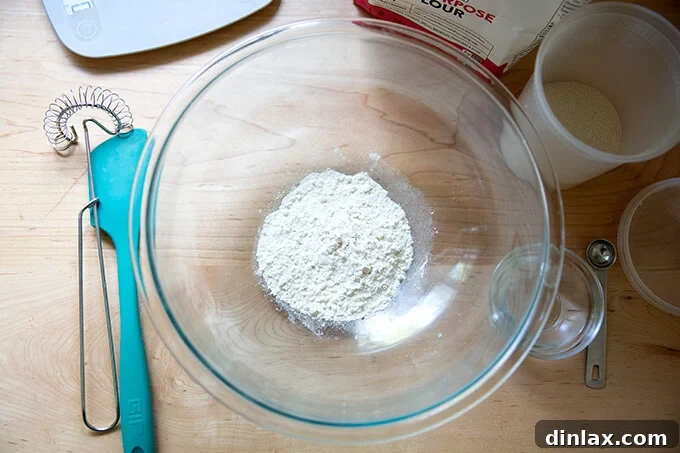
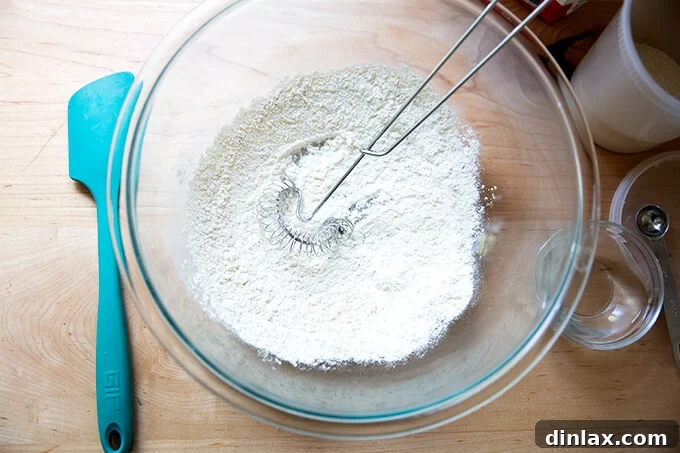
In a medium-sized bowl, combine 50 grams of flour with 1/2 teaspoon of instant yeast. Whisk them together thoroughly to ensure the yeast is evenly distributed throughout the flour. This initial dry mix prevents clumps and helps the yeast activate uniformly.
Next, pour in 50 grams of water. The temperature of the water should be lukewarm or room temperature, as excessively hot or cold water can shock the yeast and hinder its activity.
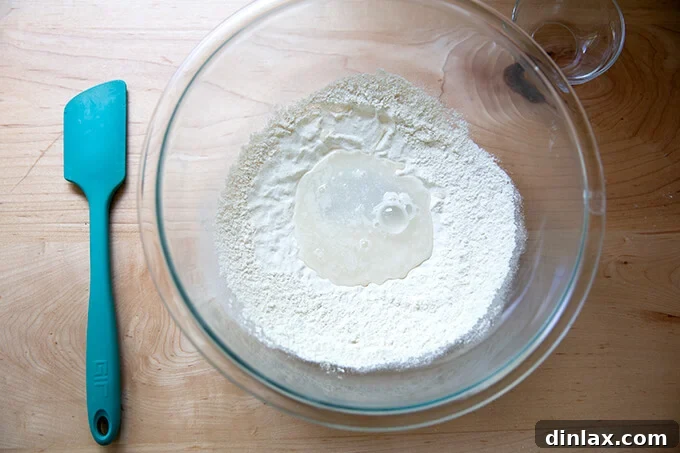
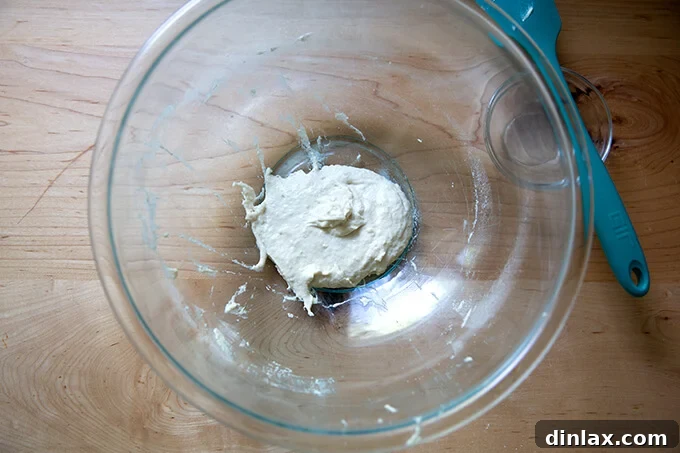
Stir the mixture with a spatula until all the ingredients are fully combined and you have a smooth, thin batter. Cover the bowl loosely with a tea towel or a lid and let it sit at room temperature for 3 to 4 hours. During this time, the yeast will become active, consuming sugars in the flour and producing carbon dioxide, which creates a myriad of air pockets. You’ll know your poolish is ready when its surface is visibly dimpled with these small air pockets, indicating robust fermentation.
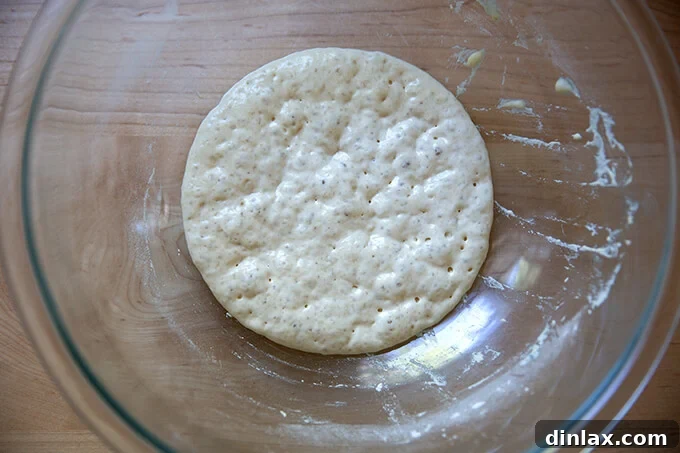
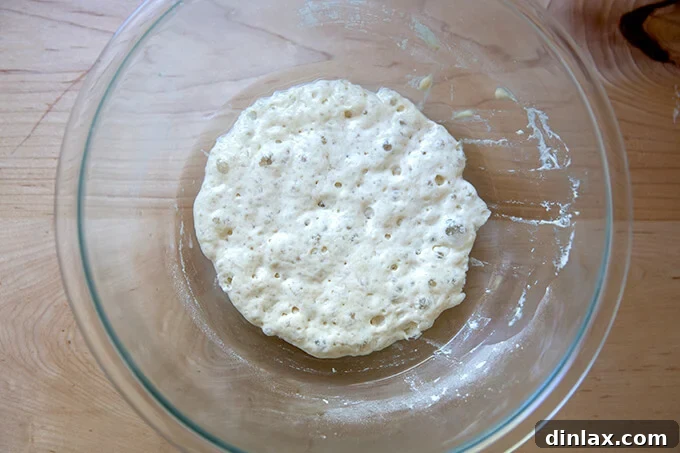
… After 3 to 4 hours, the surface of your poolish should be actively dimpled with numerous air pockets, signaling it’s alive and ready for the next stage.
Step 2: Mixing the Main Ciabatta Dough
Now it’s time to build the main dough around your vibrant poolish. To the bowl containing the fermented poolish, add 360 grams of water. This is an exciting moment as the poolish, lightened by fermentation gases, will often bubble up and float on top of the added water—a clear sign of its vitality! This interaction helps to distribute the active yeast throughout the new liquid.
Stir briefly to combine the water with the poolish. Then, add 12 grams of salt and stir again until it’s fully dissolved. Salt is not just for flavor; it also plays a crucial role in controlling yeast activity and strengthening the gluten structure, which is vital for ciabatta’s texture.
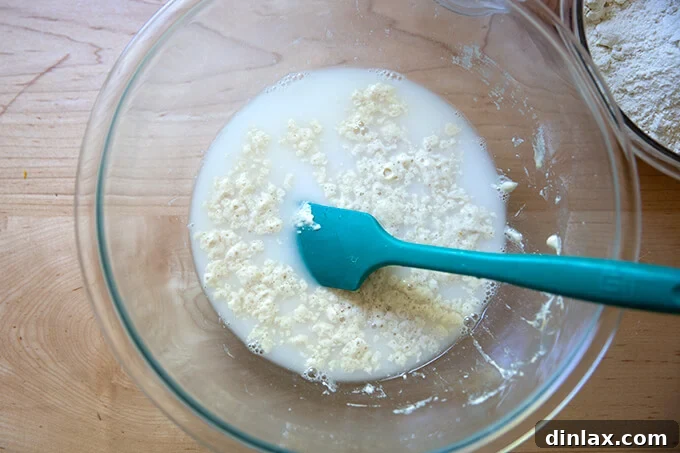
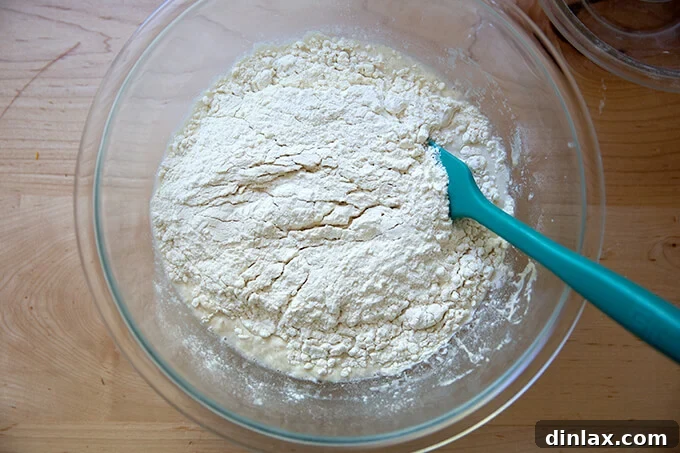
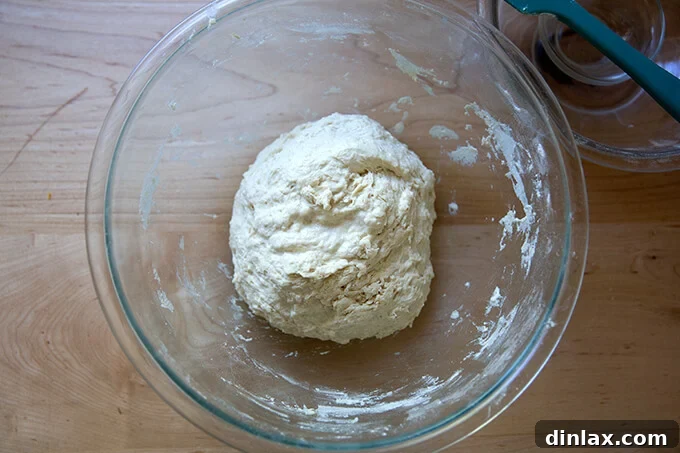
Finally, incorporate 450 grams of flour. While all-purpose flour can work, bread flour is highly recommended due to its higher protein content, which contributes significantly to stronger gluten development and, consequently, a more open and chewy crumb. Gently stir with a spatula until all the flour is hydrated and you have a very wet, sticky dough ball. Do not overmix at this stage; simply combine until no dry flour remains. Cover the bowl and let the dough rest for 30 minutes. This resting period, often called an autolyse, allows the flour to fully hydrate and enzymes to start breaking down starches, which helps in gluten development later.
Step 3: Developing Gluten with Stretches and Folds
Unlike traditional kneading, ciabatta dough benefits immensely from a series of gentle stretches and folds. This technique is perfect for high-hydration doughs, developing gluten strength without the need for vigorous kneading. To perform a set, wet your hands slightly to prevent sticking. Grab one side of the dough, gently pull it upwards, stretching it as far as it will go without tearing, then fold it over to the center of the bowl. Rotate the bowl a quarter turn and repeat this grabbing, pulling, and folding motion. Continue until you’ve completed a full circle around the bowl, typically 4-6 folds. This action gently aligns the gluten strands and incorporates air into the dough. For a visual demonstration, watch the accompanying video, where I often employ a “slap and fold” technique, which is particularly effective with very wet doughs like ciabatta. After the first set, cover the bowl again.
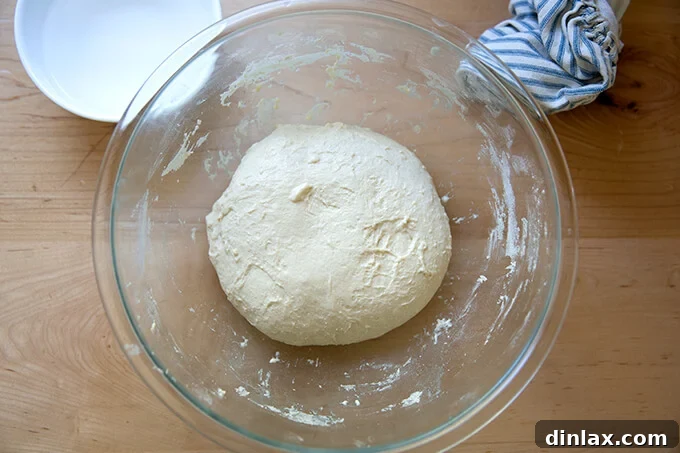
Thirty minutes later, repeat the stretching and folding process. You will notice the dough becoming progressively smoother, more elastic, and easier to handle with each set. The stickiness will gradually decrease as the gluten network strengthens.
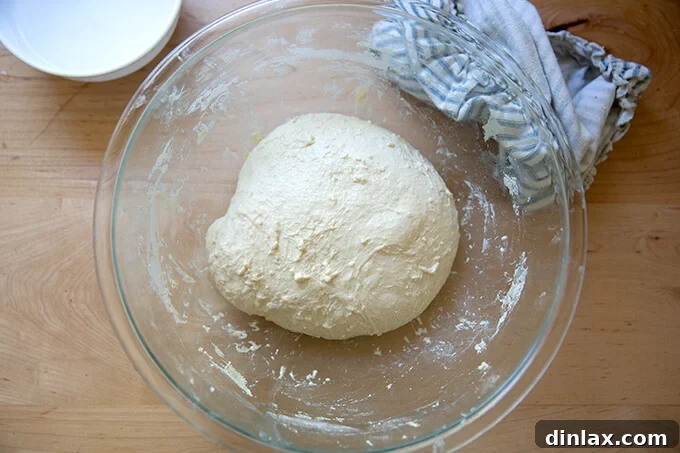
If time permits, perform two more sets of stretches and folds at 30-minute intervals. This progressive strengthening significantly contributes to the characteristic open crumb of ciabatta. Here’s what the dough looks like after the third set:
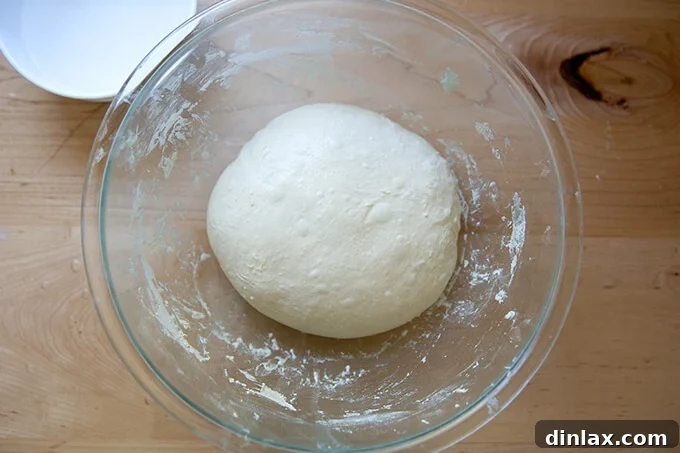
And this is the dough after the fourth and final set of stretches and folds. It’s truly a fascinating transformation to witness, as the dough transitions from a messy, sticky ball into a smooth, supple, and elastic mass. This tactile change is a clear indicator of well-developed gluten.
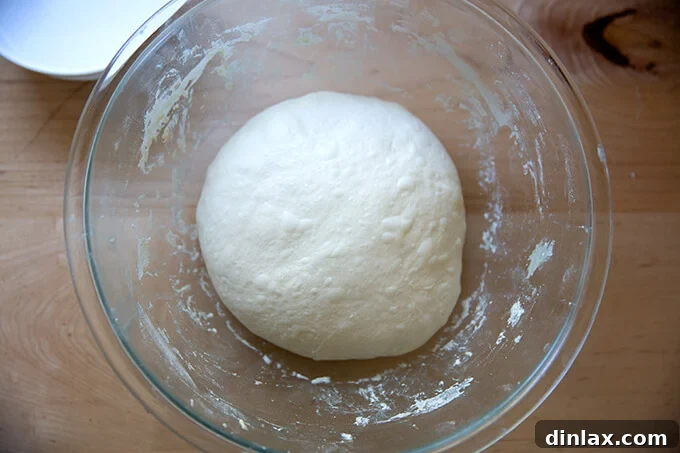
Step 4: Bulk Fermentation (First Rise)
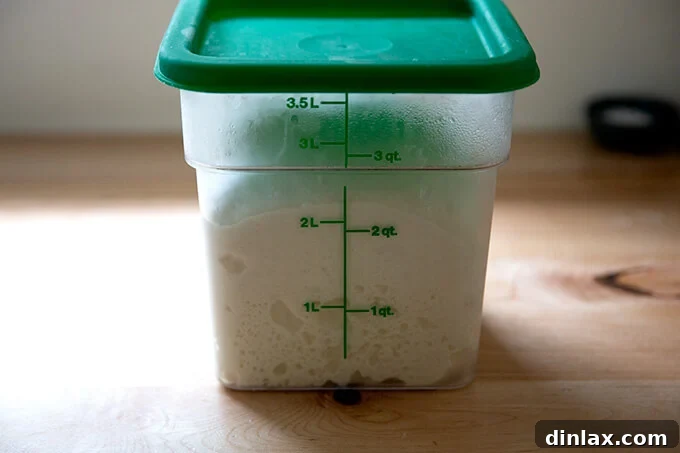
Once the stretches and folds are complete, transfer the dough to a straight-sided vessel if you have one. These containers are excellent for visually tracking the dough’s rise. If you don’t have one, leaving the dough in its original bowl works perfectly fine. Cover the container or bowl and let the dough rise at room temperature until it has visibly doubled in volume. This bulk fermentation phase is where significant flavor development and gas production occur, creating the internal structure of your bread.
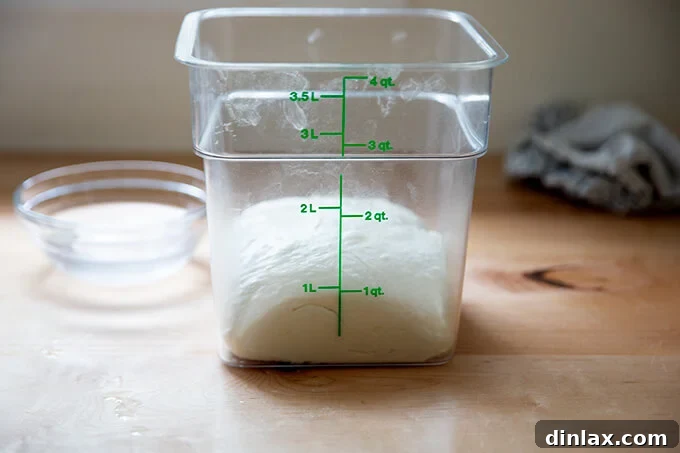
… The dough is perfectly proofed when it has clearly doubled in volume, exhibiting a domed, airy appearance. (Note: If you don’t have a straight-sided vessel, you can simply let the dough rise in a bowl, using visual cues to determine when it has doubled.)
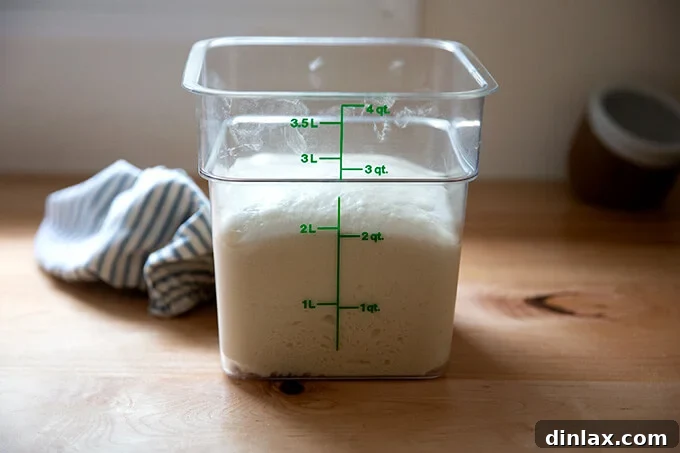
Step 5: Deflating and Cold Fermentation
Once the dough has doubled, it’s time to “punch down” or deflate it. This step redistributes the yeast and sugars, evening out the dough temperature and preparing it for a slower, colder fermentation. I find it easiest to gently remove the dough from the vessel onto a lightly floured work surface.
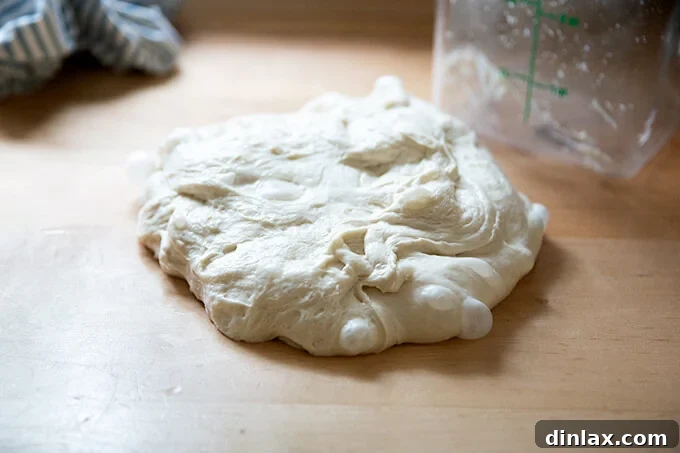
Using wet hands (to prevent sticking), gently ball up the dough. The goal is to gently gather it into a cohesive, somewhat round shape, not to remove all the air. This reshaping creates some surface tension and helps prepare it for chilling.
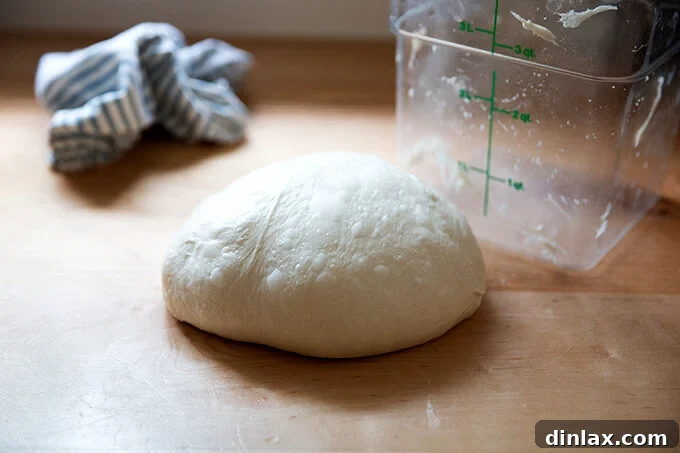
Return the gently balled dough to its vessel, ensuring it’s covered with an airtight lid, then transfer it to the fridge. The cold fermentation, lasting at least 12 hours (and up to 48 hours), is transformative. It significantly deepens the bread’s flavor profile, making it more complex and nuanced, and also makes the high-hydration dough much easier to handle when shaping.
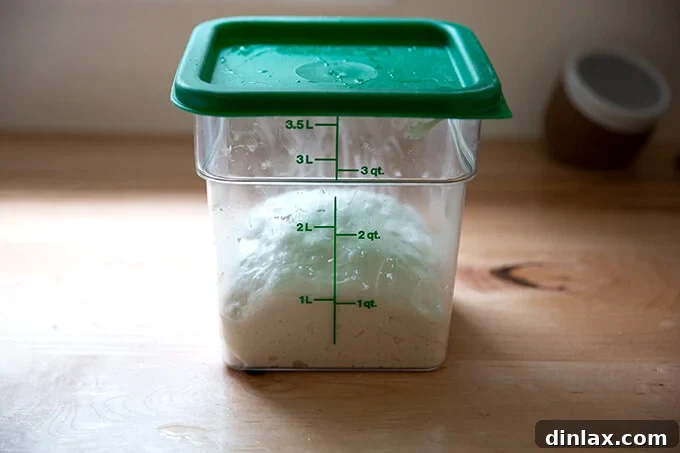
The dough will likely continue to double in volume overnight in the fridge, albeit at a much slower pace due to the cold temperature. This slow rise contributes immensely to flavor development.
Step 6: Portioning, Shaping, and Final Proof (Ciabatta Loaves)
The next morning (or after at least 12 hours), remove the dough from the fridge. Turn it out onto a work surface. For ciabatta, I prefer to work with minimal or no flour at this stage, as it helps create better tension on the dough surface. However, if the dough is too sticky, a light dusting of flour is absolutely acceptable to make it manageable.
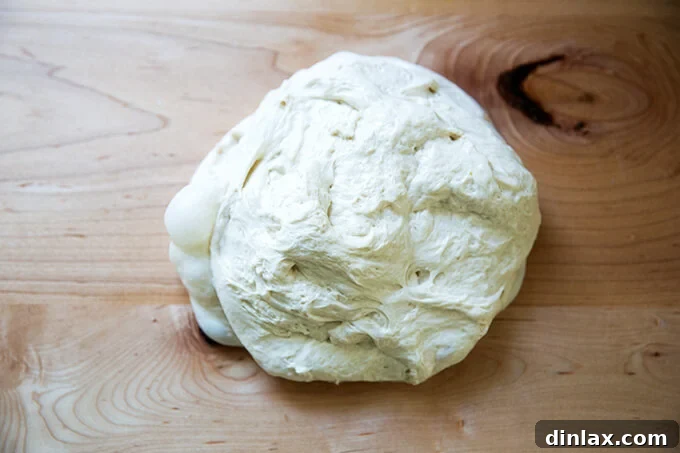
Gently ball up the dough again. The goal here is to create some surface tension without degassing it too much. Use a bench scraper or your hands to gently coax it into a round.
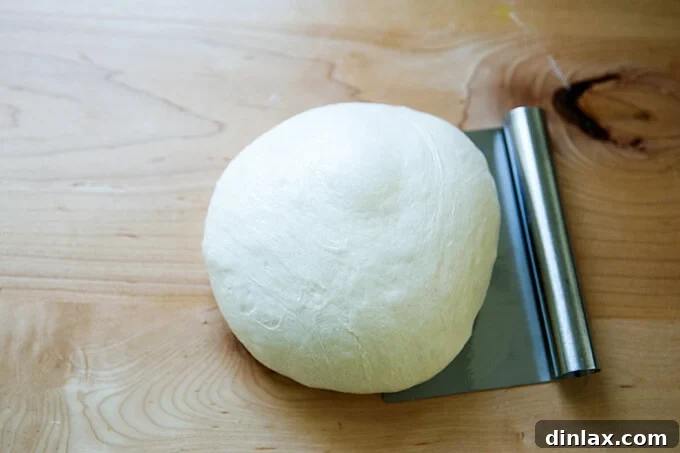
Now, divide the dough into two equal portions, using a bench scraper for a clean cut. Each portion should weigh approximately 455 grams if you’re aiming for perfectly even loaves. Gently ball up each portion again, creating a tight surface tension. As mentioned, I prefer very little or no flour during this step, as it helps achieve superior tension and a better final shape.
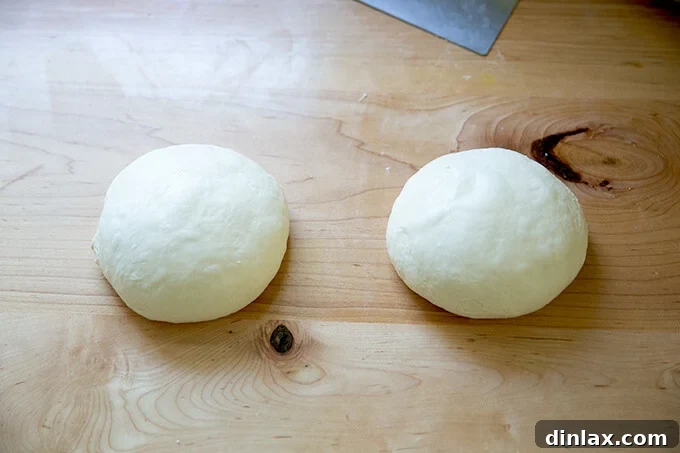
Liberally sprinkle your work surface with flour. Place the dough balls top-side down (the smooth, tensioned side facing the flour). The seam-side will now be on top, and it’s perfectly fine if it splits open slightly during proofing. Generously sprinkle the exposed top surface of the balls with more flour. This flour prevents sticking and helps form the rustic, floured crust of ciabatta. Cover with a tea towel and let them rest and proof for 2.5 hours at room temperature. Meanwhile, line a large sheet pan with parchment paper in preparation for baking.
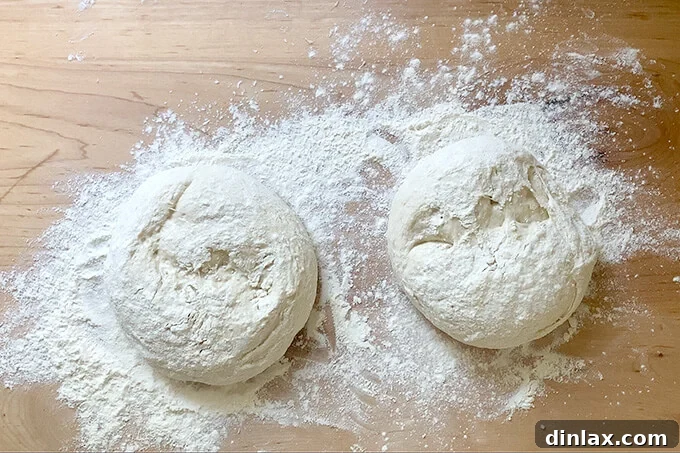
After the 2.5 hours, your dough balls will have relaxed and spread out significantly, showcasing their characteristic “slipper” shape. They should look visibly airy and expanded, indicating a successful final proof:
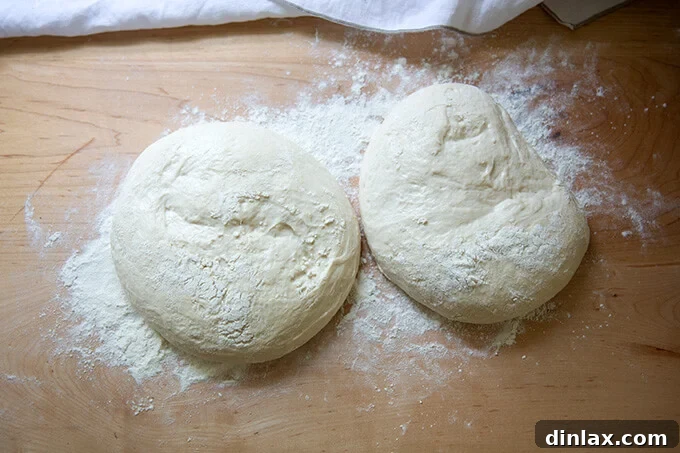
Gently turn the proofed balls back over, revealing their smooth, floured tops. This careful handling helps maintain their delicate airy structure.
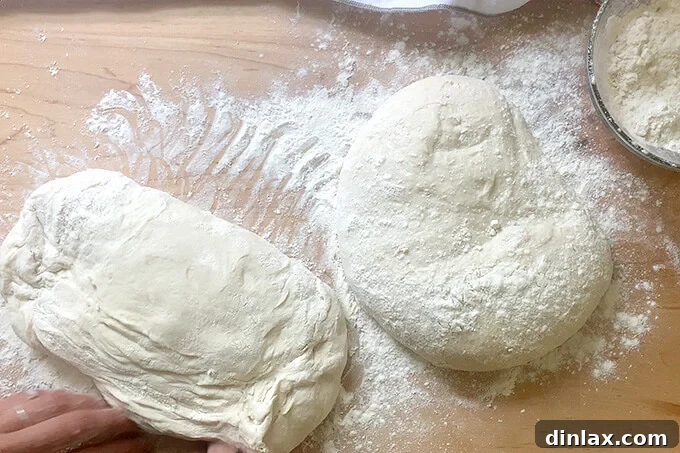
Carefully transfer them to the parchment-lined sheet pan, leaving ample space between them for expansion during baking. At this point, you can gently stretch each ball into its desired rectangular “slipper” shape if it hasn’t already naturally formed one.
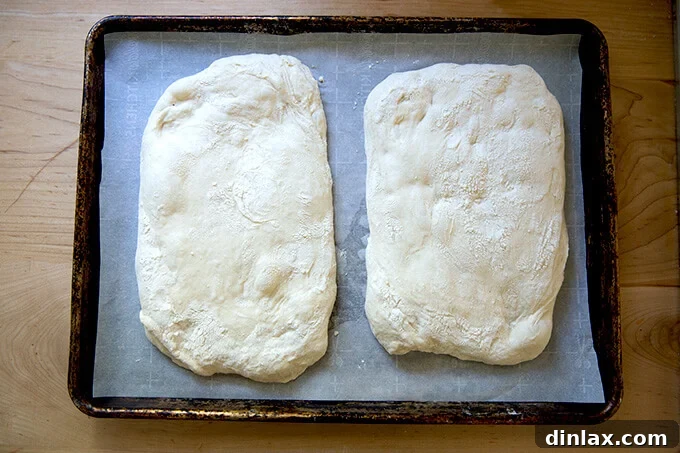
Step 7: Baking Your Ciabatta Loaves
Transfer the sheet pan with your ciabatta loaves into the preheated oven. Bake at 425ºF (220ºC) for 20-25 minutes. The loaves are perfectly baked when they achieve a rich, golden-brown exterior and sound hollow when tapped on the bottom. The high heat creates a beautiful, crisp crust and helps the interior achieve its signature open crumb.
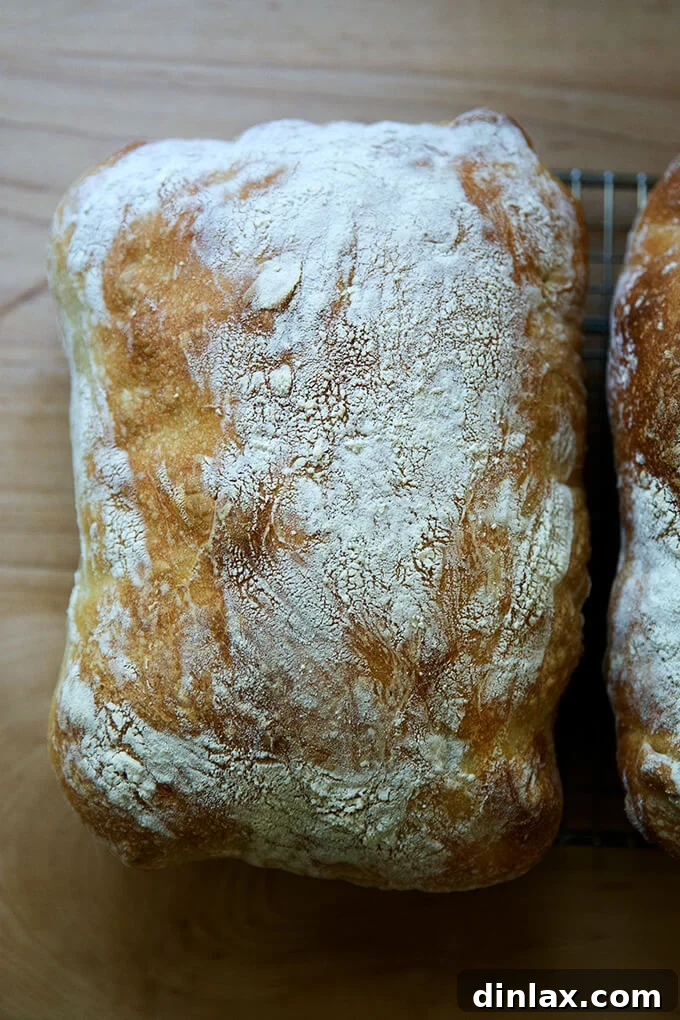
Once baked, immediately transfer the ciabatta loaves to a wire cooling rack. Allow them to cool for at least 20-30 minutes before attempting to slice them. This cooling period is crucial, as it allows the internal structure to set and any residual steam to escape, preventing a gummy interior and ensuring the perfect airy texture.
How to Make Ciabatta Rolls
If you prefer individual servings or smaller portions, turning your ciabatta dough into rolls is a fantastic option. The process is very similar to making loaves, with a slight deviation in the shaping stage. Follow the main ciabatta recipe in the recipe box below, including the poolish, main dough mixing, stretches and folds, bulk fermentation, and cold fermentation. The shaping process begins when you remove the dough from the refrigerator after its overnight chill.
Once you’ve removed the dough from the refrigerator, sprinkle a work surface liberally with flour. Turn the cold, firm dough out onto this floured surface. Sprinkle the top surface of the dough with a bit more flour, and then gently pat it out into a large rectangle. Aim for an even thickness, taking care not to aggressively degas the dough.
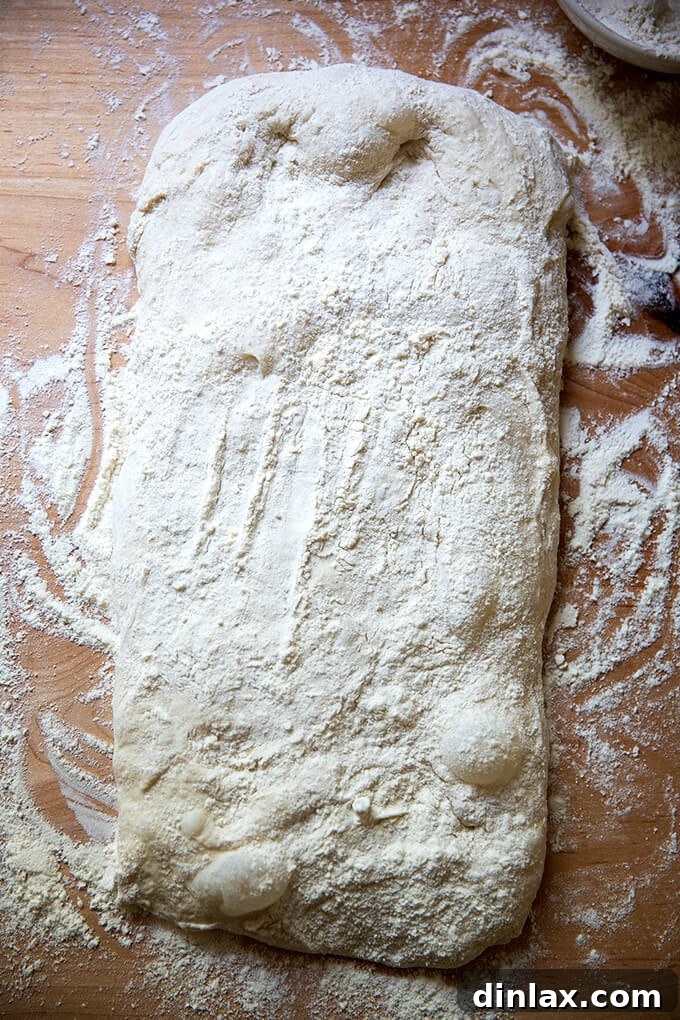
Using a bench scraper, divide the large rectangle into 8 equal portions. These will be your individual ciabatta rolls. You can shape them into rustic squares or rectangles, or gently tuck the edges underneath to create a more oval shape if desired.
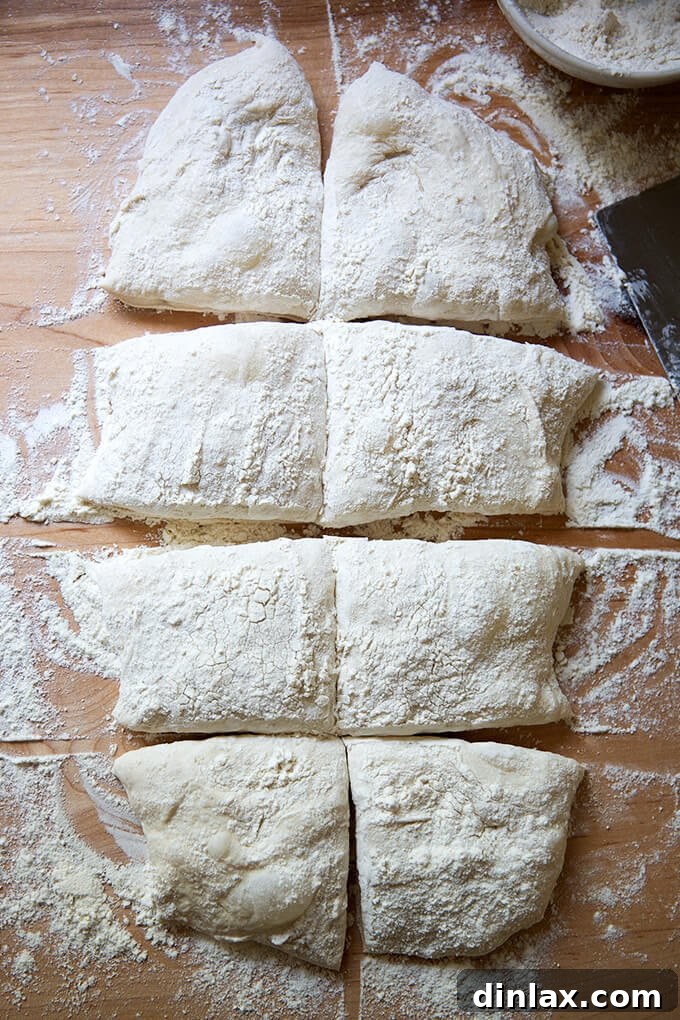
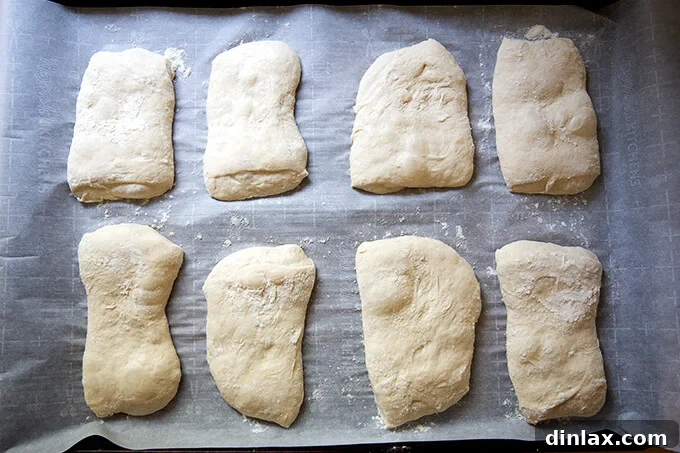
Carefully transfer each portion to a parchment-lined sheet pan, ensuring enough space between them for expansion. Cover the pan with a tea towel and let the rolls stand and proof for 2 to 2.5 hours at room temperature. They will puff up and relax, becoming light and airy.
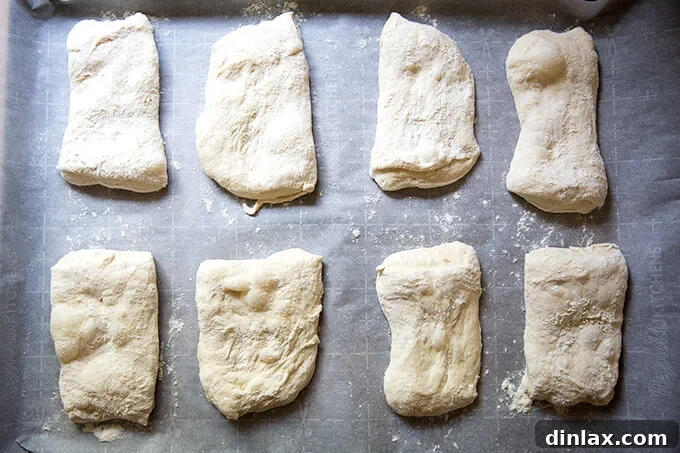
Once proofed, transfer the pan of rolls to a preheated oven and bake at 425ºF (220ºC) for 20 to 25 minutes, or until they are beautifully golden brown and sound hollow when tapped. The baking time might be slightly shorter for rolls compared to full loaves, so keep a close eye on them for that perfect golden hue.
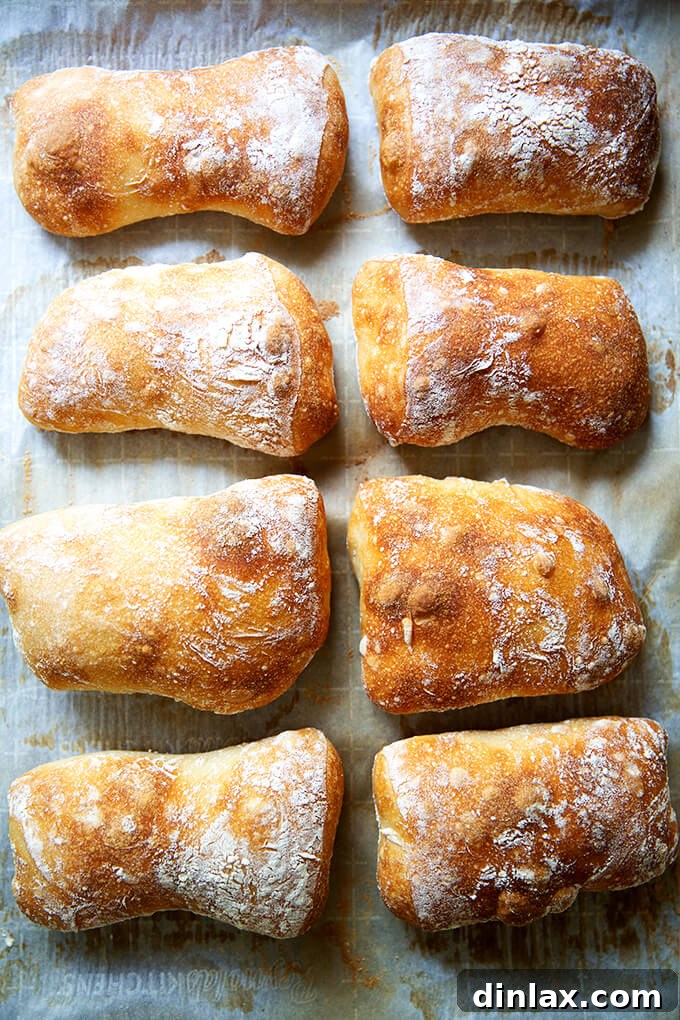
Just like with loaves, let the ciabatta rolls cool for at least 20-30 minutes on a wire rack before halving or slicing. This waiting period is crucial for the internal crumb structure to stabilize and for the flavor to fully develop. Enjoy these delightful rolls as sandwich bases, side dishes, or simply with a smear of butter!
Print Recipe Card
How To Make Fresh Homemade Ciabatta Bread
5 Stars 4 Stars 3 Stars 2 Stars 1 Star
5 from 141 reviews
- Author: Alexandra Stafford
Total Time: 24 hours 20 minutes
Yield: 8 rolls 1x
Diet: Vegan
Description
This comprehensive guide will teach you how to make an incredibly crusty, open-crumbed loaf of authentic ciabatta bread. Follow our detailed, step-by-step instructions, complete with expert tips and tricks, to achieve a loaf with a crisp, golden exterior and a beautifully light, airy interior. Visual learners can also find helpful video guidance within the post.
Notes & Expert Tips for Success:
- Precision is Key with a Digital Scale: As always in baking, especially with high-hydration doughs, precise measurements are paramount. For the best and most consistent results, always use a digital scale to measure your flour and water. Volume measurements (cups) can be inaccurate due to varying compaction of flour.
- Your Best Friend, the Bench Scraper: This recipe involves sticky dough, and a bench scraper will prove to be an invaluable tool. It helps to handle, divide, and shape the dough with minimal sticking and damage to the delicate gluten structure.
- The Power of a Straight-Sided Vessel: For monitoring your dough’s rise accurately during bulk fermentation and cold proofing, a straight-sided container (preferably with a matching lid) is highly recommended. It provides a clear visual indicator of how much the dough has risen.
- Water Content – A Crucial Variable: Ciabatta is a very high-hydration dough. The exact amount of water your flour can absorb can vary based on the type of flour you use, its protein content, and even the humidity in your environment. If you live in a very humid climate, for example, you might find you need to reduce the water by 50 to 60 grams to achieve a manageable dough. A great tip is to start by adding most of the water, then slowly incorporate the remaining amount while mixing, stopping when the dough resembles the texture shown in the video. If your dough never forms a cohesive ball during stretches and folds, consider reducing the water slightly next time.
- Flour Choice Makes a Difference: While you can achieve good results with quality all-purpose flour, using a high-protein bread flour (such as King Arthur Flour Bread Flour, which typically has 12.7% protein) is ideal for ciabatta. The higher protein content develops stronger gluten, crucial for trapping gases and creating that signature open, airy crumb. Remember, all flours absorb water differently. Bakers in regions like Canada or abroad often find they need to reduce water slightly compared to US recipes.
- Troubleshooting Tunneling: A common challenge with ciabatta is “tunneling” – the formation of large, gaping holes or tunnels running through the center of the loaf. This usually occurs when the dough is under-proofed. When under-proofed dough enters a hot oven, the yeast, still highly active, produces a rapid burst of gas. This explosive gas production can break down the nascent gluten structure, leading to a large void instead of an evenly distributed open crumb. If you encounter tunneling, try extending your final proofing time by an additional 30-60 minutes next time.
Ingredients
For the Poolish (Preferment):
- 50 grams (about 1/3 cup) all-purpose or bread flour
- 2 grams (1/2 teaspoon) instant yeast, SAF is my preference
- 50 grams (about 1/4 cup) water, lukewarm or room temperature
For the Ciabatta Dough:
- 360 grams (about 1.5 cups) water, lukewarm or room temperature
- 12 grams (about 2 teaspoons) salt, kosher or fine sea salt
- 450 grams (about 3.5 cups) bread flour, see notes above for flour recommendations
Instructions
- Make the Poolish: In a large bowl, thoroughly whisk together the 50 grams of flour and the 2 grams (1/2 teaspoon) of instant yeast. Add the 50 grams of lukewarm or room temperature water and stir with a spatula until all ingredients are fully combined into a smooth, thin batter. Cover the bowl loosely with a tea towel or a cloth bowl cover and set aside at room temperature for 3 to 4 hours, or until the surface of the poolish is actively dimpled with small air holes, indicating robust fermentation.
- Prepare the Main Dough: To the bowl containing your active poolish, carefully add the 360 grams of lukewarm or room temperature water. Observe as the light, fermented sponge may release from the bowl and portions of it, or even the whole unit, might float on the water – a sign of a vibrant poolish. Add the 12 grams (about 2 teaspoons) of salt and stir briefly to dissolve it. Finally, add the 450 grams of bread flour. Stir vigorously with a sturdy spatula until all the flour is hydrated and you have a very wet, sticky, shaggy dough ball. Avoid overmixing. Cover the bowl with a tea towel or cloth bowl cover and let the dough rest for 30 minutes. This rest allows the flour to fully hydrate before gluten development begins.
- Perform Stretches and Folds: To begin gluten development without kneading, use wet hands to prevent sticking. Gently grab one side of the dough from the bottom of the bowl, stretch it upwards without tearing, and fold it over towards the center of the dough mass. Rotate the bowl a quarter turn and repeat this grabbing, stretching, and folding action. Continue this process until you’ve completed a full circle around the bowl, typically 4-6 folds. For visual guidance on this technique, including a “slap-and-fold” method often employed for wet doughs, refer to the accompanying video. Cover the bowl. If your schedule allows, repeat this stretching and folding process three more times at 30-minute intervals, for a total of 4 sets over two hours. If time is limited, even one or two sets will significantly benefit the dough’s structure.
- Bulk Fermentation (First Rise): Gently transfer the dough to a straight-sided vessel if you own one, as it helps monitor the rise. Otherwise, leave it in the mixing bowl. Cover the vessel or bowl with a towel and let it rise at room temperature until it has visibly doubled in volume. Once doubled, gently “punch down” (deflate) the dough. If your dough is still in the bowl, you can deflate it using wet hands directly in the bowl. If it’s in a straight-sided vessel, you might find it easier to turn the dough out onto a lightly floured work surface and gently ball it up using wet hands to prevent excessive sticking. Return the dough to the vessel, cover it with an airtight lid, and immediately transfer it to the refrigerator for at least 12 hours. The dough can remain in the fridge for up to 48 hours, which further enhances its flavor and makes it easier to handle.
- Portion, Shape, and Final Proof:
- For Ciabatta Loaves: Turn the cold, firm dough out onto a work surface. For optimal tension, I prefer to do this step with minimal or no flour; however, feel free to sprinkle your surface lightly with flour if the dough is too sticky to manage. Using a bench scraper or your hands, gently shape the dough into a cohesive ball. Then, use the bench scraper to divide the dough exactly in half. For perfectly even loaves, each portion should weigh approximately 455 grams. Again, use the bench scraper or wet hands to gently ball up each portion into a tight, round shape – refer to the video for precise guidance. Liberally sprinkle your countertop with flour. Place the dough balls top-side (the smooth, tensioned side) down onto the flour. The seam-side will now be on top, and it’s normal if it appears to split slightly during proofing. Generously sprinkle the top surface of the balls with additional flour. Cover them with a tea towel and let them rest and proof at room temperature for 2.5 hours.
- For Ciabatta Rolls: Instead of balling and dividing, sprinkle a work surface with flour. Turn the dough out onto this floured surface, sprinkle the top with more flour, and gently pat it into a large rectangle of even thickness. Using a bench scraper, divide the rectangle into 8 equal portions. Carefully transfer each portion to a parchment-lined sheet pan, ensuring they have enough space to expand. Cover with a tea towel and let them stand and proof for 2.5 hours.
- Preheat the Oven: After the dough (either loaves or rolls) has proofed for about 2 hours (leaving 30 minutes of proofing time remaining), preheat your oven to 425ºF (220ºC). This ensures the oven is at the correct temperature when the dough is ready.
- Bake to Perfection:
- For Ciabatta Loaves: When the dough has finished proofing (after 2.5 hours), gently flip each dough ball over using a bench scraper, revealing its floured top. Then, using both hands, gently stretch each ball out into a rectangular, “slipper” shaped loaf. Carefully transfer these shaped loaves to a parchment-lined sheet pan, leaving enough space between them. Transfer the pan to the preheated oven and bake for 20 – 25 minutes, or until the loaves are beautifully golden brown all around and sound hollow when tapped on the bottom.
- For Ciabatta Rolls: When the rolls have finished proofing (after 2.5 hours), remove the tea towel. Transfer the sheet pan directly to the preheated oven and bake for 20 – 25 minutes, or until the rolls are golden all around and cooked through.
- Cool for Optimal Texture: Remove the pan from the oven. Immediately transfer the ciabatta loaves or rolls to a wire cooling rack. Allow them to cool for at least 20 to 30 minutes before attempting to slice or halve them. This crucial cooling period allows the internal crumb structure to set and steam to escape, preventing a gummy texture and ensuring that coveted open, airy crumb.
- Prep Time: 24 hours
- Cook Time: 20 minutes
- Category: Bread
- Method: Yeast
- Cuisine: American, Italian