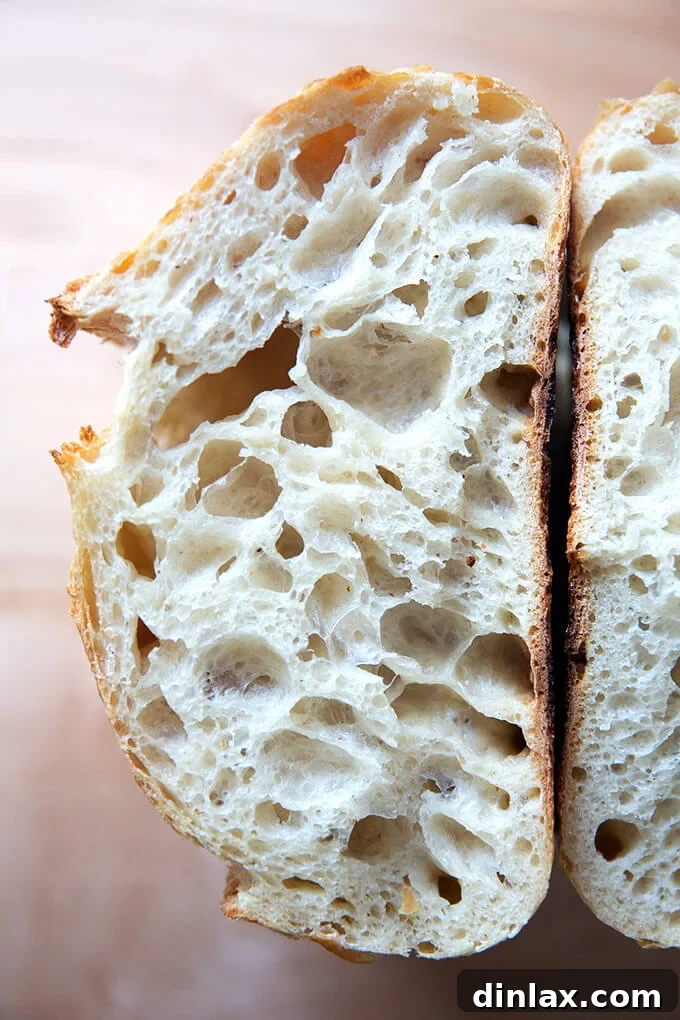
If you dream of baking fresh, crusty sourdough bread at home but feel intimidated by complex recipes, you’ve come to the right place. This guide simplifies the art of homemade sourdough, providing you with a straightforward recipe that yields consistently delicious results: a golden, crisp crust encasing a light, airy crumb. What makes this recipe truly stand out is its simplicity, requiring only about 25 minutes of active, hands-on work and cleverly skipping time-consuming steps like autolyse or preferment. Get ready to embark on a rewarding baking journey with comprehensive guidance for every single step. 🍞
Featured Review
“Absolutely the best sourdough recipe EVER! I have been baking bread for years, including sourdough, and it has always been hit or miss. Not with your recipe. You nailed it. I thank you!“
– Rosemary Patterson
Read more reviews
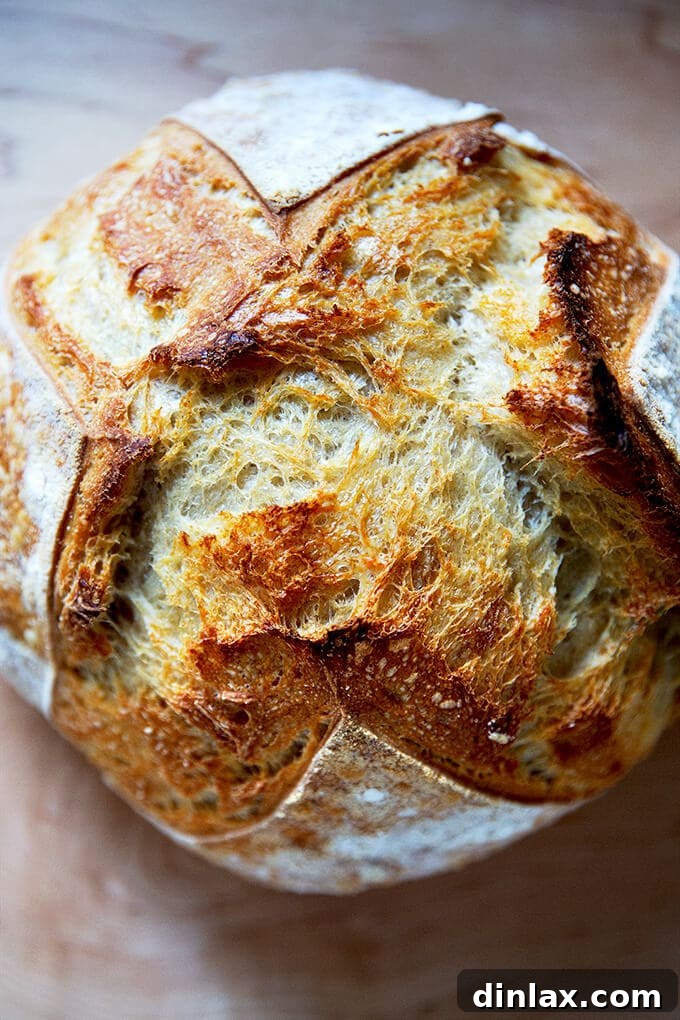
This comprehensive guide is designed to empower you to bake the simplest sourdough bread imaginable. By eliminating an autolyse and preferment stage, the dough preparation itself can be completed in less than five minutes of active work, making it incredibly accessible even for the busiest bakers.
For anyone new to the world of sourdough bread baking, or those who might have found it daunting in the past, this recipe is your ideal starting point. Alongside this, we highly recommend trying our simple sourdough focaccia recipe. Both are celebrated for their ease of preparation and outstanding flavor profiles. If you’re looking to broaden your baking repertoire beyond sourdough, don’t miss our overnight, refrigerator focaccia or my mother’s simple peasant bread recipe, both of which deliver spectacular results with minimal effort.
Table of Contents: Your Journey to Perfect Sourdough
- What is Sourdough Bread?
- What is a Sourdough Starter?
- How to Feed and Maintain a Sourdough Starter
- When is My Sourdough Starter Ready to Be Used?
- Essential Sourdough Baking Equipment
- How to Make Sourdough Bread: A 5-Step Overview
- How This Sourdough Bread Recipe Differs From Others
- Simple Sourdough Bread: A Detailed Step-by-Step Guide
- The #1 Sourdough Bread Baking Tip: Harnessing Your Refrigerator
- Troubleshooting: Where Sourdough Can Go Wrong and How to Fix It
- Additional Sourdough Baking Resources
- More Sourdough Bread Recipes to Explore
- Mastering Your Sourdough Bread Baking Schedule
What is Sourdough Bread? Understanding Natural Leavening
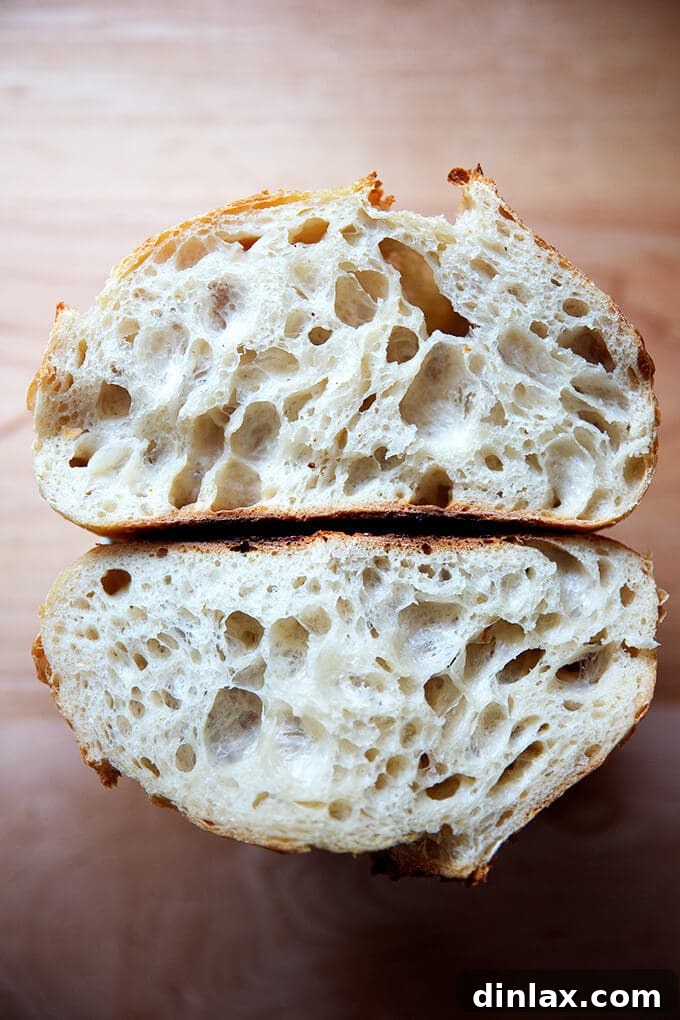
Sourdough bread is a distinct type of bread characterized by its natural leavening process. Unlike commercial breads that rely on baker’s yeast or chemical leavening agents like baking powder or soda, sourdough is leavened by a “sourdough starter.” This starter is a living culture of wild yeast and beneficial bacteria, which ferments the dough, creating its unique tangy flavor, complex aroma, and signature open, airy crumb. This ancient method of bread making not only imparts superior taste and texture but also offers potential benefits such as improved digestibility due to the breakdown of gluten and phytic acid during the long fermentation.
What is a Sourdough Starter? The Heart of Your Bread
At its core, a sourdough starter is a dynamic, fermented mixture of flour and water that hosts a thriving community of wild yeast and lactobacilli bacteria. These microorganisms work in synergy to consume the sugars in the flour, producing carbon dioxide that makes the bread rise, along with a host of organic acids that contribute to sourdough’s characteristic flavor. An active and healthy starter is absolutely crucial for successful sourdough baking; it’s the engine that drives the entire process.
You can certainly create a sourdough starter from scratch in about a week. While incredibly satisfying, I typically recommend this approach primarily during warmer months when ambient temperatures naturally support starter activity. For consistent results and to jumpstart your baking journey with confidence, I’m a strong advocate for purchasing a robust, vigorous starter from a reputable source. This ensures you begin with a strong foundation, allowing you to focus on the baking process without the initial challenge of nurturing a new culture.
Here are two excellent online sources where you can acquire reasonably priced, high-quality sourdough starters:
- Breadtopia Sourdough Starter
- King Arthur Baking Company Classic Fresh Sourdough Starter
How to Feed and Maintain a Sourdough Starter
Think of your sourdough starter as a very low-maintenance pet – it needs to be fed to stay alive and active. While it can survive in the refrigerator with feeding only every two to three weeks, it requires more frequent feedings if you plan to bake regularly. Consistent feeding is key to maintaining a strong, vibrant starter.
When I’m not baking frequently, I store my starter in the fridge, usually in a straight-sided jar with a lid. It can comfortably rest there for several weeks without attention. To “wake up” or activate it for baking, I like to perform two feedings. For instance, I might remove it from the fridge in the evening and feed it: this involves discarding most of the starter (leaving just a few tablespoons or about 50 grams) and replenishing it with equal parts by weight of flour and water. This “discard and feed” ratio is crucial for balancing the starter’s acidity and promoting strong yeast activity.
I then repeat this process the following morning: discard down to the same amount, and feed with fresh flour and water. By midday, or when the starter has visibly doubled in volume and is full of bubbles, it’s typically at its peak activity and ready for use in your bread recipe. For a more in-depth explanation on activating, feeding, and maintaining your starter, please consult this detailed post on sourdough starter care.
To put your starter back into hibernation, feed it as usual, allow it to rise until it nearly doubles, then cover it tightly and place it back in the refrigerator. It will happily wait there for another 2 to 3 weeks until your next baking adventure.
When is My Sourdough Starter Ready to Be Used? Identifying Peak Activity
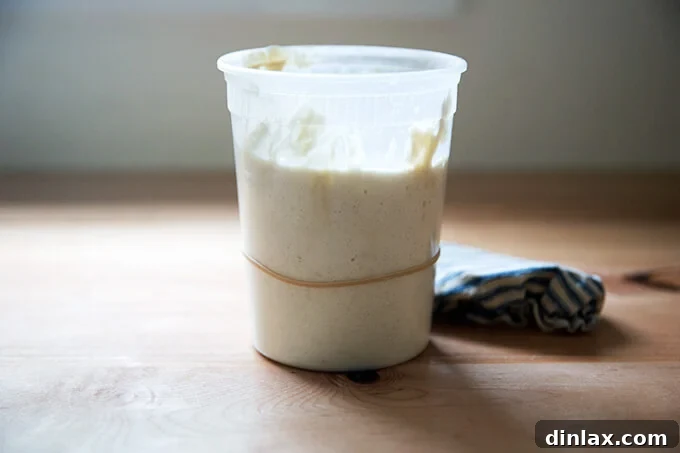
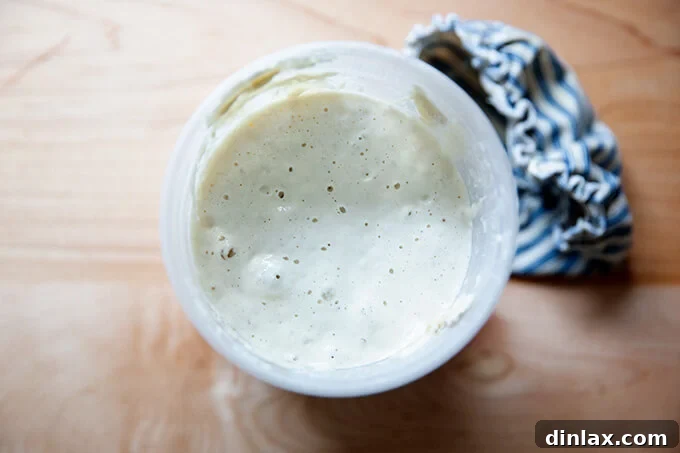
Knowing when your sourdough starter is at its prime is a fundamental skill for successful baking. The most reliable indicator is volume increase: if your starter doubles (or even triples!) in volume within 4 to 8 hours after a feeding, it’s typically vigorous and ready for action. Ideally, you want to use your starter when it has just reached its peak rise, usually within this 4 to 8-hour window after feeding. To help monitor this, I always place a rubber band around the jar to mark the starter’s initial height immediately after feeding. This visual cue makes it easy to track its expansion and determine when it has doubled and is at its optimal strength.
If your starter isn’t showing signs of doubling within the 4 to 8-hour timeframe, it’s a clear signal that it needs strengthening. Don’t be shy about discarding; aggressively reduce the starter down to a few tablespoons and replenish it with equal parts by weight of fresh flour and water. Repeating this feeding process twice a day for several days will typically rejuvenate a sluggish starter, bringing it back to a robust and active state, ready to leaven your bread with power and precision.
Essential Sourdough Baking Equipment
While sourdough baking might seem to require a lot of specialized tools, you can get started with just a few basic items. However, having the right equipment can significantly enhance your experience and the quality of your bread.
At a minimum, you’ll need:
- An active sourdough starter (as discussed above, crucial for leavening).
- High-quality bread flour (King Arthur Flour is my personal preference for its consistent protein content, which contributes to better gluten development).
- Fine sea salt or kosher salt (essential for flavor and dough structure).
- Water (preferably filtered, as chlorine can inhibit starter activity).
For the best results and a smoother baking process, you’ll also ideally have:
- Digital Scale: This is perhaps the most important tool. Sourdough baking relies on precise measurements, and weighing ingredients ensures accuracy far beyond volumetric measurements (cups).
- Straight-Sided Vessel (like a clear food container): Critical for accurately monitoring the dough’s volume increase during bulk fermentation. A rubber band can mark the starting point to easily track a 50-75% rise.
- Bench Scraper: Invaluable for dividing, shaping, and cleaning your work surface without sticking to the dough.
- Flour Sack Towels: These lint-free towels, dusted with rice flour, prevent dough from sticking to your proofing basket during its final rise.
- Banneton (Proofing Basket): Provides support and helps the dough hold its shape during cold proofing, contributing to a beautiful final appearance. Consider this round one or this oval one for different loaf shapes.
- Razor Blade or Lame: Used for scoring the dough just before baking, allowing for controlled expansion and creating beautiful patterns.
- Heavy Lidded Vessel (Dutch Oven): Crucial for trapping steam, which creates that desirable crisp crust and excellent oven spring. Options include this classic Dutch oven or the specialized Challenger Bread Pan.
- Parchment Paper: Makes transferring the delicate proofed dough to the hot Dutch oven much safer and easier.
What is the Best Dutch Oven for Sourdough Bread?
Choosing the right Dutch oven is a game-changer for sourdough. My trusted companion for years has been the Lodge Pre-Seasoned Cast Iron Double Dutch Oven. It offers incredible value, typically around $49, and performs exceptionally well for round loaves. However, if you’re looking to expand into baking batards, baguettes, or other oblong-shaped loaves, I cannot recommend the Challenger Bread Pan enough. While it’s a more significant investment at $299, its thoughtful design, particularly the placement of its handles, makes lid removal and closure remarkably easy. This design consistently produces stunning, beautifully crusty loaves with minimal fuss.
How to Make Sourdough Bread: A Simplified 5-Step Overview
Making sourdough bread might seem like a complex process, but it can be broken down into five fundamental, manageable steps. Understanding this overview will help you grasp the flow of the entire recipe before diving into the details. Each of these steps is explained in greater detail below.
- Mix the Dough: This initial step involves simply combining your water, active sourdough starter, salt, and flour in a bowl. A quick stir is all it takes to form a sticky, shaggy dough ball – no elaborate kneading required at this stage.
- Bulk Fermentation (First Rise): This is the crucial first rise where the yeast and bacteria in your starter begin their work, developing flavor and strength. During the initial two hours of this period, you’ll perform a series of gentle “stretches and folds.” These actions are vital for building the dough’s gluten structure, enhancing its elasticity, and incorporating air, all without heavy kneading.
- Shape & Bench Rest: This step marks the end of the bulk fermentation. You’ll gently shape the dough into a cohesive round, allow it a short period of rest on the counter (the “bench rest”), and then perform a final shaping to build tension and prepare it for proofing.
- Proofing the Dough (Second Rise): In this recipe, we utilize a cold proof, typically performed in the refrigerator. This slow, cool fermentation, ideally lasting 24 to 48 hours, is instrumental in developing a more complex flavor profile and contributing to a lighter, more open, and airy crumb. While a longer proof is recommended, you can still achieve good results with a shorter duration if time is a constraint.
- Scoring & Baking the Dough: Once the dough has completed its proof, you’ll gently turn it out onto a piece of parchment paper. Using a sharp razor blade, you’ll score the surface, allowing for controlled expansion during baking. Finally, the dough is carefully transferred to a preheated baking vessel (like a Dutch oven) and baked to perfection, achieving that sought-after crisp crust and beautiful rise.
How This Sourdough Bread Recipe Differs From Others: Simplified for Success
While many sourdough recipes can be complex, ours adopts a simplified approach, making it ideal for beginners without compromising on quality. This recipe distinguishes itself in three key ways, aiming to reduce complexity and improve consistency:
- No Autolyse: Many traditional sourdough recipes advocate for an “autolyse” step, where flour and water are mixed and allowed to rest for several hours before adding salt and starter. This technique is believed to aid in gluten development and increase dough extensibility. However, through extensive testing, I’ve found that omitting the autolyse makes a negligible difference in the final texture of the bread, while adding an unnecessary layer of complexity and time to the process. By skipping this step, we streamline the dough mixing, allowing you to get your dough together in minutes.
- 50-75% Increase in Volume for Bulk Fermentation: If you’re accustomed to baking with commercial yeast, you’re likely used to letting your dough double in volume during its first rise. When I first started with sourdough, I applied this same principle and often found myself over-fermenting the dough, leading to a diminished “oven spring” (the final burst of rise in the oven). I discovered that stopping the bulk fermentation when the dough has increased by approximately 50% to 75% in volume yields a significantly better oven spring and a more desirable crumb structure. This precise monitoring of volume increase is a game-changer for beginners.
- Long Cold Proof (24-48 Hours): After the initial bulk fermentation and shaping, this recipe calls for a prolonged cold proof in the refrigerator, ideally for 24 to 48 hours (though even longer is often fine). This extended cold fermentation is not just about convenience; it plays a crucial role in developing profound flavor complexities, breaking down starches for easier digestibility, and contributing significantly to a lighter, more open, and airy crumb. For comparison, a shorter proof (12 hours or less) will result in a tighter, denser crumb. A key advantage of the cold proof is that the dough goes directly from the fridge to the oven – there’s no need for an additional room-temperature proof, saving you time and reducing guesswork on baking day.
Simple Sourdough Bread: A Detailed Step-by-Step Guide
Follow these visual and detailed instructions to bake your perfect loaf of homemade sourdough.
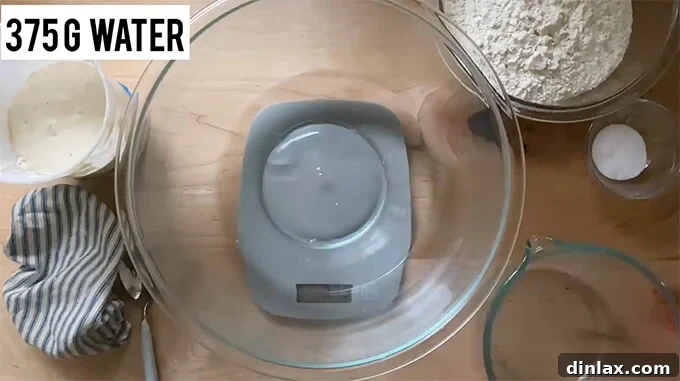
To begin, accurately measure 375 grams of warm water into a large mixing bowl:
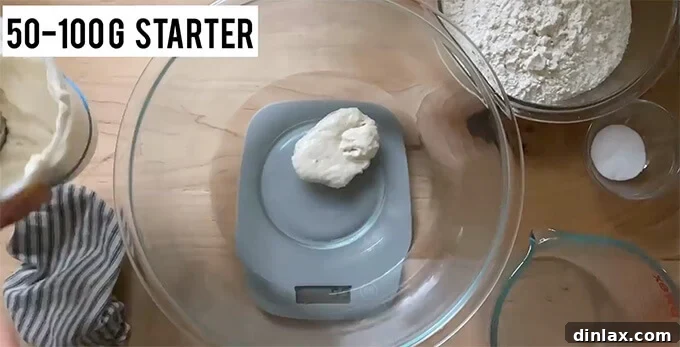
Next, add 50 to 100 grams of active, bubbly sourdough starter to the water. The amount can vary based on your kitchen temperature and desired fermentation speed (see notes below).
Stir the starter and water together until well combined. Then, add 11 grams of salt:

Finally, incorporate 500 grams of high-quality bread flour into the mixture:
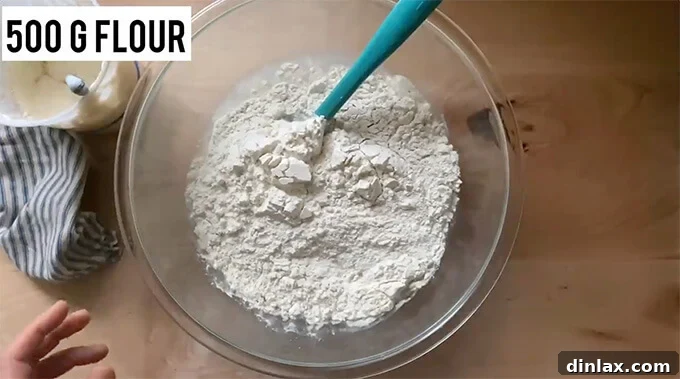
Stir all ingredients thoroughly until a shaggy, cohesive dough forms. It will be sticky, but resist the urge to add more flour at this stage. Ensure all dry patches are hydrated.
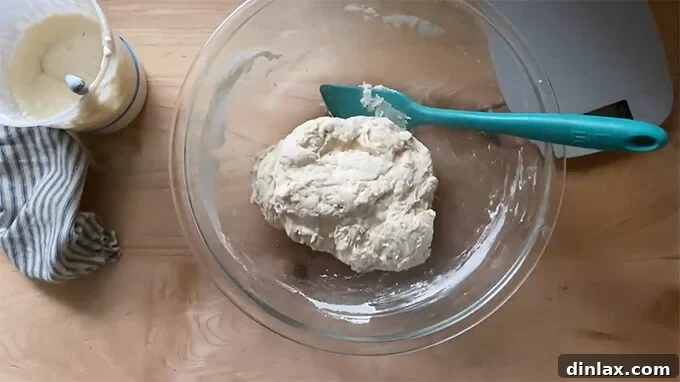
Transfer the freshly mixed dough to a straight-sided vessel. This is crucial for monitoring its rise accurately. Cover the vessel and let the dough rest for 30 minutes to allow the flour to fully hydrate.
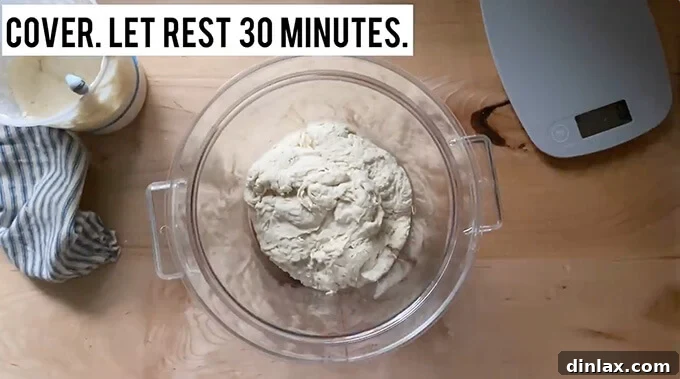
After the rest, perform your first set of stretches and folds. This technique gently develops gluten without intensive kneading.
Ideally, perform four total sets of stretches and folds, with 30-minute intervals between each set, during the first 2 hours of bulk fermentation. You’ll observe the dough gradually gaining strength and elasticity with each successive set. Here’s a demonstration of the fourth and final set:
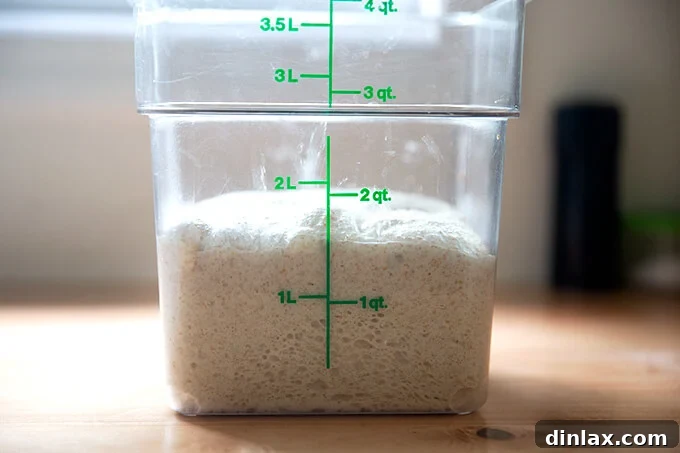
Once all stretches and folds are complete, cover the vessel tightly and allow the dough to continue its bulk fermentation until it increases in volume by 50% to 75%. This is a crucial visual cue, as the exact timing will vary based on your starter’s activity and kitchen temperature.
The accompanying video shows the dough nearly doubling (100% increase), but for optimal oven spring and crumb, I consistently achieve better results by stopping the bulk fermentation when the dough has increased by 50% to 75%. This might require some experimentation to find what works best in your environment. Remember, sourdough baking is about observing and adapting.
Gently turn the fermented dough out onto a lightly floured work surface. Be careful not to deflate it too much.
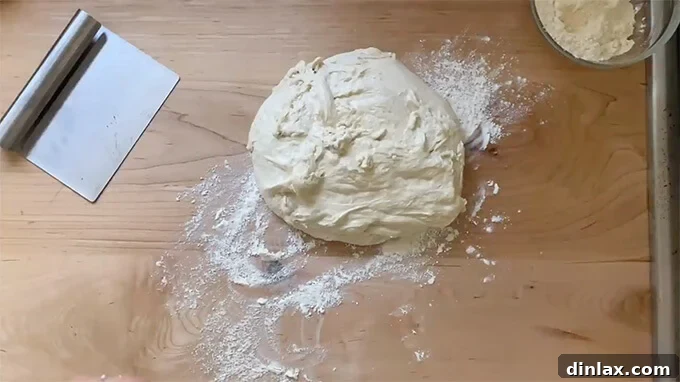
Gently preshape the dough into a round, then let it rest for 20-40 minutes. This period, known as the bench rest, allows the gluten to relax, making the dough easier to handle for final shaping.
While the dough rests, prepare a bowl or banneton for proofing. Line it with a flour sack towel and dust generously with rice flour to prevent sticking.
After the bench rest, perform the final shaping of the round, creating surface tension. Then, carefully place it into your prepared proofing bowl, seam-side up. Transfer the bowl to the fridge for 12 to 48 hours for its cold proof.
Once ready to bake, remove the proofed dough from the fridge and gently turn it out onto a sheet of parchment paper. There’s no need to let it come to room temperature first.
Using a sharp razor blade or lame, score the dough with your desired pattern. Scoring allows the bread to expand beautifully during baking.
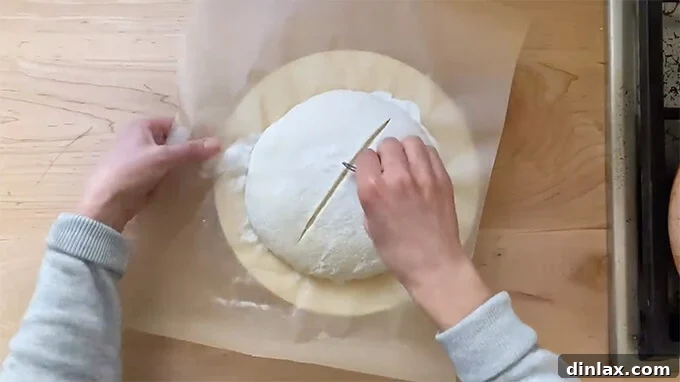
Carefully lift the parchment paper with the dough and transfer it into a preheated Dutch oven. Bake covered at 450ºF (230ºC) for 30 minutes. Then, remove the lid, lower the temperature to 400ºF (200ºC), and continue baking for another 15 minutes until golden brown.
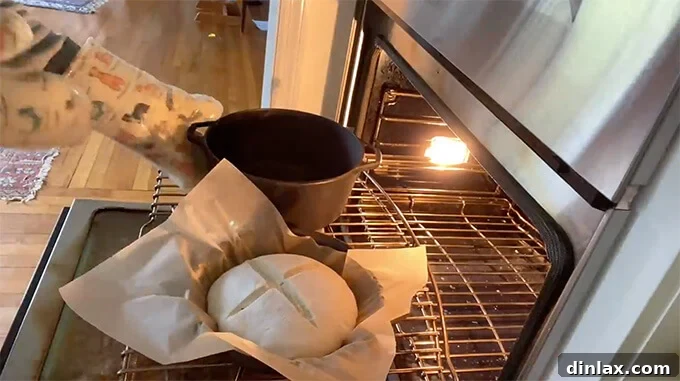
Once baked, remove the fragrant loaf from the oven and transfer it to a wire rack. It’s essential to let it cool for at least one hour before attempting to slice, allowing the internal structure to set and preventing a gummy texture.
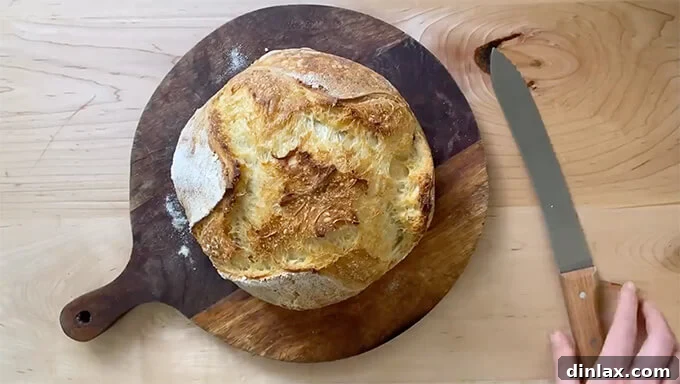
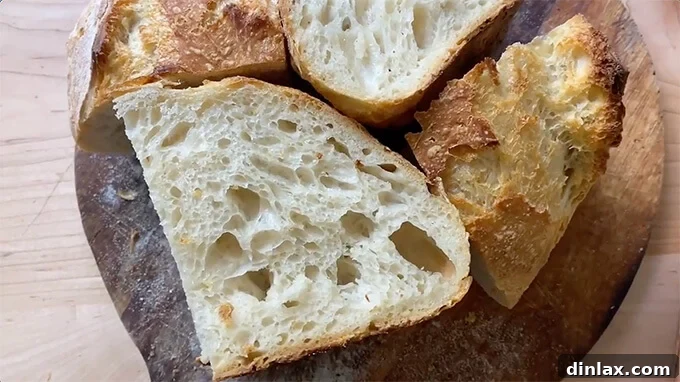
When it’s finally time to enjoy your masterpiece, ensure you have a sharp serrated knife, such as this bread knife or this other excellent option, to effortlessly slice through the crust and reveal the beautiful crumb.
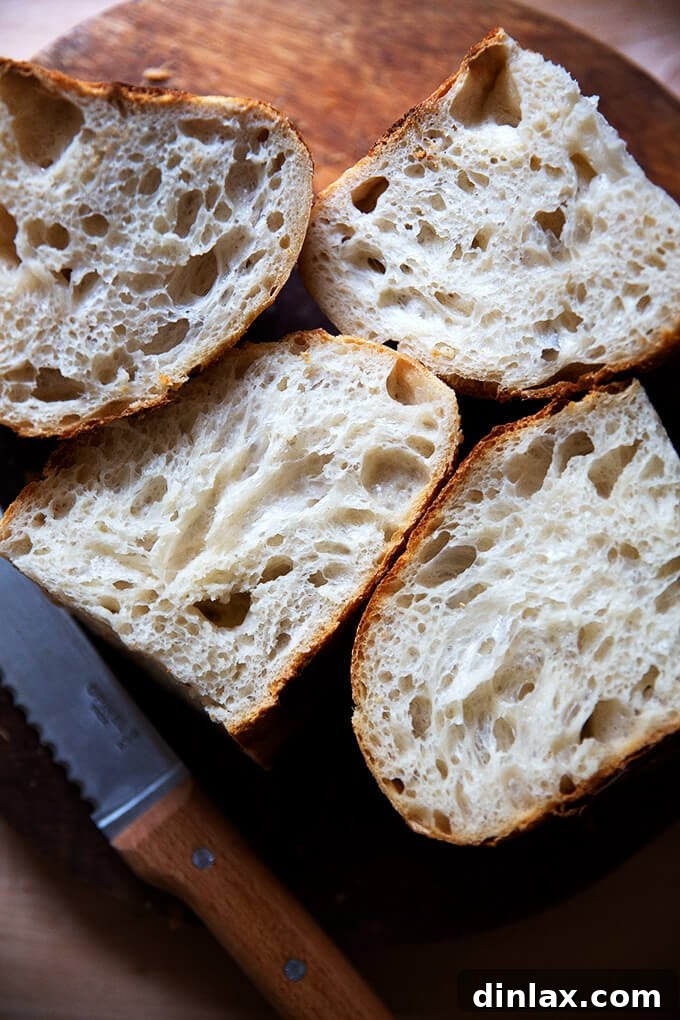
The #1 Sourdough Bread Baking Tip: Harnessing Your Refrigerator
The single most crucial piece of advice for any sourdough baker, especially beginners, is this: the refrigerator is your invaluable ally. Learn to use it strategically to control your dough’s fermentation and fit baking into your busy schedule.
One of the most common pitfalls I observe in new sourdough bakers is over-fermentation during the bulk rise. This often happens when bakers mix their dough in the evening, intending for an overnight rise, only to wake up to an overproofed, sticky, and difficult-to-handle dough that has tripled in volume.
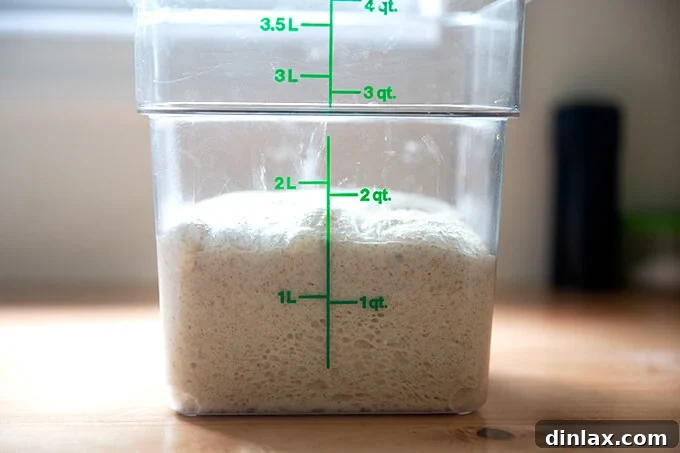
To expertly prevent over-fermentation, integrate your refrigerator into your process. At any point after you’ve completed your 4 sets of stretches and folds, if you feel tired or need to step away, simply transfer your dough in its straight-sided vessel directly into the fridge. The cold temperature will dramatically slow down fermentation. You can then resume your baking the next morning (or even the day after!). Remove the dough from the fridge and allow it to continue rising at room temperature until it reaches the target 50-75% volume increase. This flexibility is a game-changer for fitting sourdough baking into a modern lifestyle.
To accurately gauge when your dough has risen by approximately 50-75% in volume, I cannot emphasize enough the benefit of a straight-sided vessel like a 4-quart Cambro container (or this BPA-free alternative!). While monitoring dough rise in a curved mixing bowl can be deceptive and challenging, a straight-sided vessel with marked increments (or a rubber band marker) provides an unambiguous visual reference, eliminating guesswork and ensuring you hit the perfect fermentation window every time.
Troubleshooting: Where Sourdough Can Go Wrong and How to Fix It
Even experienced bakers encounter challenges with sourdough. If you’ve struggled to achieve that perfect loaf, your issues likely stem from one of these four common areas. Understanding these potential pitfalls can save you a lot of frustration and lead to consistent success:
- Using a Weak Starter or Not Using Starter at Its Peak: A sluggish starter won’t provide the necessary lift for your bread. Ensure your starter is active, bubbly, and has doubled or tripled in volume after feeding before incorporating it into your dough. If it’s weak, feed it consistently for a few days to strengthen it.
- Using Too Much Water Relative to the Flour (High Hydration Issues): While high-hydration doughs can lead to an open crumb, too much water makes the dough incredibly sticky and hard to handle, preventing proper gluten development and shaping. Especially for beginners, it’s better to start with a slightly lower hydration (around 70-75% hydration as in this recipe) and increase it as you gain experience.
- Over-Fermentation: Letting the Bulk Fermentation (First Rise) Go Too Long: This is arguably the most common mistake. Over-fermented dough will lose its structure, become gassy, sticky, and difficult to shape, leading to a dense or flat loaf with poor oven spring. Rely on visual cues (50-75% volume increase) rather than strict time, and use the refrigerator as your friend to slow down fermentation if needed.
- Using Too Much Whole Wheat Flour, Rye Flour, or Freshly Milled Flour: While these flours add incredible flavor and nutrition, they also contain less gluten-forming protein or different types of proteins compared to bread flour. Using too high a percentage can lead to a denser crumb and a less extensible dough, making it harder to achieve an open structure. Start with mostly bread flour and gradually introduce smaller percentages of whole grain flours as you become more comfortable.
I delve deeper into each of these issues, offering practical solutions and answers to frequently asked questions, in this dedicated post: Why is my sourdough so sticky? Plus fixes to 4 common sourdough mistakes and FAQs. I highly recommend reading it if you’ve encountered any difficulties with your sourdough baking.
Additional Sourdough Baking Resources
To further support your sourdough journey, explore these helpful resources:
- Sourdough Troubleshooting: A comprehensive guide addressing common mistakes and FAQs.
- The Nutritional Benefits of Sourdough Bread + 6 Healthy Toast Topping Ideas: Discover why sourdough is good for you and creative ways to enjoy it.
- Feeding Your Sourdough Starter: Detailed instructions on keeping your starter vibrant.
- Essential Equipment For Sourdough Bread Baking: A complete list of recommended tools for success.
- Looking for a more open crumb? Consider shaping a batard (oval loaf) instead of a round boule. Batards often yield a more elongated, open crumb structure.
More Sourdough Bread Recipes to Explore
Once you’ve mastered this basic recipe, expand your sourdough repertoire with these exciting variations:
- Simple Sourdough Focaccia: A delicious, airy flatbread perfect for sharing.
- Sourdough Bread, Whole Wheat-ish: A healthier twist with a touch of whole wheat flour.
- Simple Sourdough Pizza: Elevate your homemade pizza night with a naturally leavened crust.
- Simple Sourdough Sandwich (or Toasting) Bread: Perfect for everyday use, with a softer crumb ideal for sandwiches.
- Sourdough Ciabatta: Achieve that classic rustic Italian bread with a chewy interior and crisp crust.
- Sourdough Discard Recipes: Don’t let your discard go to waste! Explore creative ways to use it.
Mastering Your Sourdough Bread Baking Schedule
For newcomers to sourdough, the timing of the entire process can often feel overwhelming. Questions like: “How can I possibly bake this without staying up until midnight?” are perfectly valid. As highlighted earlier, your greatest ally in managing this schedule is your refrigerator. It grants you the flexibility to pause fermentation and resume when it suits you best.
If, for instance, after completing your stretches and folds, you find yourself too tired to wait for the dough to finish bulk fermenting, simply place the dough in its vessel directly into the fridge. You can then pick up exactly where you left off the following morning, or even a day or two later! Just remove the dough from the cold, allow it to continue rising at room temperature until it reaches its 50-75% volume increase, and then proceed with shaping.
Here’s a sample schedule that many bakers find effective. Feel free to adapt it to fit your personal routine:
- Wednesday Evening: Remove your sourdough starter from the fridge. Discard most of it (leaving 50-100g) and feed it with equal parts by weight of fresh flour and water. Cover and leave at room temperature overnight.
- Thursday Morning: Your starter should be bubbly and active. Discard most of it again and replenish with equal parts flour and water. Let it rise until it doubles in volume (typically 4-8 hours).
- Thursday Afternoon: Once your starter is at its peak, mix your dough. Perform the recommended stretches and folds over the next 2 hours.
-
Thursday Evening (Flexible Point): Monitor your dough. When it has increased in volume by 50-75%, gently shape it and place it in a prepared banneton or bowl. Transfer it directly to the fridge for its cold proof (12-48 hours).
(Important Note: If the dough hasn’t completed its bulk fermentation by evening, don’t force it. Place the entire vessel in the fridge. The next day, remove it, let it warm up slightly, and continue bulk fermenting until it reaches the 50-75% increase before shaping and cold proofing.) - Friday Evening or Saturday Morning: Your dough is ready! There’s no need to bring it to room temperature. Simply remove it from the fridge, turn it out onto parchment, score it, and bake it immediately in your preheated Dutch oven. Enjoy your fresh sourdough!
Homemade Sourdough Bread, Step by Step
Author: Alexandra Stafford
Total Time: 18 hours 45 minutes (primarily passive time)
Yield: 1 loaf
Rating: 5 from 1818 reviews
Description
If you love fresh sourdough bread with a golden, crisp crust and a light, airy crumb, this recipe is for you. It’s one of the simplest homemade sourdough bread recipes, and one of the best, too. It requires only 25 minutes of hands-on work and no autolyse or preferment. Below you will find guidance for every step of the way. 🍞🍞🍞
Inspired by The Clever Carrot
If you are new to sourdough, watch the step-by-step video here: Simple Sourdough Bread or in the post above.
Troubleshooting: If you have issues with your dough being too sticky, please read this post: Why is my sourdough so sticky? The 4 common mistakes.
Notes
- You need an active sourdough starter. I have had success activating starters from:
- King Arthur Flour
- Breadtopia
- As always, I highly recommend investing in a digital scale before beginning any bread baking adventure.
- This is the Dutch Oven I use for sourdough bread. I used this Dutch oven for years, and it’s a great one, too.
- Flour sack towels are a great investment because they ensure your dough will not stick while it is proofing.
- I love using rice flour for dusting (as opposed to all-purpose or bread flour) because it doesn’t burn. When you use a flour sack towel, however, you don’t need to use any flour.
- Find all of my sourdough essentials here: Essential Equipment For Sourdough Bread Baking
- I love a high-hydration dough, and I have great success using 380 grams of water in this recipe, so feel free to play around and push the hydration here.
- Salt: I have had success using both kosher salt and fine sea salt here. When I use kosher salt, I use the Diamond Crystal brand. When I use sea salt, I use the Baleine Fine brand. Regardless of the brand, I use 12 grams.
- Shaping: If you’re looking to get a more open crumb, try shaping a batard (as opposed to a round). Watch this video for guidance. Also: The recipe below follows the traditional shape once, rest, then shape again method. I often skip the preshape now and simply shape the dough once. I still get a nice open crumb.
- Adding Other Ingredients: See this post on adding “inclusions”: Rosemary-Olive Sourdough Bread (+ A Better Way to Add Inclusions to Your Sourdough Bread)
How much Sourdough Starter to Use?
- Because my kitchen is cold for much of the year, I like using 100 g (1⁄2 cup) of starter as opposed to 50 g (1⁄4 cup). When determining how much starter to use, consider a few things: If you live in a warm, humid environment, 50 g should suffice. If you plan on doing an overnight rise, 50 g also should suffice. If you want to speed things up or if you live in a cold environment, consider using 100 g starter. Note: If you use 100 g of starter, your dough may rise more quickly, so keep an eye on it. As always, rely on the visual cues (increasing in volume by 50-75%) when determining when the bulk fermentation is done.
- A straight-sided vessel makes monitoring the bulk fermentation especially easy because it allows you to see when your dough has truly increased in volume by 50%.
Ingredients
- 50 – 100 g (1⁄4 – 1/2 cup) bubbly, active sourdough starter (I always use 100 grams, see notes above)
- 375 g (1 1/2 cups plus 1 tbsp) warm water, or more, see notes above
- 500 g (4 cups plus 2 tbsp) bread flour
- 9 to 12 g (1.5 – 2.5 teaspoons) fine sea salt, see notes above
Instructions
- Make the dough: In a large bowl, whisk the active sourdough starter and warm water together with a fork or spatula until well combined. Add the bread flour and salt. Mix thoroughly, using your hands if necessary, until a shaggy, rough dough forms and no dry flour remains. Cover the bowl with a damp towel or an airtight lid and let the dough rest at room temperature for 30 minutes. This rest period, called autolyse (though not a true one here as salt is added), helps the flour hydrate.
- Perform stretches and folds: After the 30-minute rest, begin the first set of stretches and folds. Lightly dampen your hand, grab a portion of the dough from the edge of the bowl, stretch it upwards, and fold it over to the center. Rotate the bowl a quarter turn and repeat this action until you’ve stretched and folded the dough 4 to 5 times around the circumference of the bowl. Cover the dough and let it rest for another 30 minutes. Repeat this stretching and folding process two more times for a total of 4 sets over 2 hours. This gentle action builds gluten strength and elasticity. (Note: Even if you can only complete one or two sets, your dough will still benefit significantly. Don’t worry if you need to step away after mixing.)
- Bulk Fermentation (first rise): After the final set of stretches and folds, cover the bowl again with a damp towel or an airtight lid to prevent the dough from drying out. Allow the dough to ferment at room temperature. The duration will vary, typically 8 to 10 hours at 70°F (21°C), but it could be less in warmer environments (e.g., 6 hours at 78°F). The most important indicator of readiness is visual: the dough should have increased in volume by 50-75%, show a few bubbles on the surface, and gently jiggle when you move the bowl. (Update: While I previously recommended doubling, I’ve found that stopping at a 50-75% increase yields better oven spring. Adjust based on your observations. A straight-sided vessel is highly recommended for accurate monitoring.)
- Shape the dough (Preshaping): Gently coax the fermented dough onto a lightly floured work surface. Using a bench scraper or your hands, gently form the dough into a loose round. To do this, fold the top edge of the dough down to the center, rotate the dough a quarter turn, and repeat this folding motion until you’ve come full circle, creating a taut surface.
- Bench Rest and Final Shaping: Let the dough rest seam-side up on the counter for 20-40 minutes (the bench rest) to allow the gluten to relax. Meanwhile, prepare your proofing vessel: line an 8-inch (20-cm) bowl or banneton with a clean flour sack towel and dust generously with rice flour (which prevents sticking and burning). After the rest, reshape the dough once more, building good surface tension. Place the shaped dough into your lined bowl, seam-side up.
- Cold Proof (second rise): Cover the bowl with plastic wrap or place it in a loosely tied plastic bag (like a produce bag) to prevent drying. Refrigerate the dough for a minimum of 12 hours, and ideally 24 to 48 hours. This long cold proof significantly develops flavor and contributes to an open, airy crumb. (Note: If you have had success with a shorter 1-hour rise, continue with that method, but be aware it will result in a denser crumb.)
- Preheat Oven & Dutch Oven: Approximately 45-60 minutes before you plan to bake, place your Dutch oven (with its lid) inside your oven. Preheat the oven to a blazing 550°F (290°C). Meanwhile, cut a piece of parchment paper to fit the size of your Dutch oven.
- Score the dough: Remove the proofed dough from the fridge. Place your parchment paper over the top of the bowl and invert the bowl to release the dough onto the parchment. Using a small, sharp knife or a razor blade (lame), score the dough creatively – a simple “X” cut works wonderfully. The scoring allows the bread to expand predictably in the oven.
- Bake the bread: Carefully use the parchment paper to transfer the scored dough into the preheated Dutch oven. Immediately lower the oven temperature to 450ºF (230ºC). Cover the pot with its lid and bake for 30 minutes. After 30 minutes, remove the lid, lower the temperature to 400ºF (200ºC), and continue to bake for an additional 10-15 minutes, or until the crust is deeply golden brown and sounds hollow when tapped. If you desire an even crisper bottom crust, you can carefully lift the loaf out of the pot and bake it directly on the oven rack for the last 5-10 minutes.
- Cool & Store: Remove the baked loaf from the Dutch oven and transfer it to a wire rack to cool completely for at least 1 hour before slicing. This cooling time is crucial for the internal structure to set. Once completely cool, the loaf will stay fresh for up to 3 days when stored at room temperature in an airtight plastic bag or container. It also freezes beautifully for longer storage.
Recipe Notes & Adaptations
- This recipe is an adaptation of Artisan Sourdough Made Simple, with several adjustments for enhanced results and simplicity:
- Increased salt to 11-12g from 9g for improved flavor and structure.
- Incorporation of 4 sets of stretches and folds during the first 2 hours of bulk fermentation to build superior dough strength.
- Emphasis on a cold proof of at least 24 hours (up to 48+) before baking, which demonstrably produces a lighter, airier, and more flavorful crumb. The video illustrates the distinct crumb difference between a 6-hour and 24-hour proof.
- Preheating the Dutch oven is a key modification to achieve a much crisper crust.
- Prep Time: 18 hours (mostly passive)
- Cook Time: 45 minutes
- Category: Bread
- Method: Oven
- Cuisine: American
Did you make this delicious sourdough bread?
Tag @alexandracooks on Instagram and share your creation using the hashtag #alexandracooks!