Embracing Local Flavors: A Farmers’ Market Fresh Pasta Journey
There’s an undeniable allure to the farmers’ market—a vibrant tapestry of colors, aromas, and the promise of fresh, seasonal ingredients. For me, this weekly ritual has blossomed into a cherished Sunday dinner tradition: pairing the exquisite, handcrafted pasta from Delaney’s Culinary Fresh with whatever tantalizing produce catches my eye that morning. It’s a journey that celebrates the joy of discovery and the profound satisfaction of creating a meal that connects us to our local food system.
My immersion into this tradition, however, began with a rather humbling lesson. Just last week, I found myself drawn to a display of stunning, wild mushrooms. Their intricate forms and earthy appeal were simply irresistible, despite a somewhat vague explanation from the vendor regarding their origin. This seemingly minor detail would soon unravel into a significant learning experience about the importance of truly understanding where our food comes from.
Fortunately, I’ve had the pleasure of connecting with Melanie Lytle, an incredibly insightful “cyber friend” and the passionate author of the blog, Livin’ the Vida Local. Melanie has quickly become an invaluable guide in my ongoing quest to embrace more local food. Her dedication is remarkable; she’s currently on a year-long mission to consume food primarily grown within the San Diego foodshed. This ambitious endeavor has led her to extensively research local food producers, from the passionate individuals setting up booths at bustling farmers’ markets to the dedicated purveyors selling sustainably raised meat, fish, and dairy products in local shops. Melanie’s blog is a profound resource, offering a wealth of information and fostering a deeper appreciation for the local food movement, and it has already proven instrumental in shaping my shopping habits.
It was through an eye-opening article Melanie shared that the true story of those wild mushrooms came to light. The revelation that they might have been shipped across the globe, potentially all the way from Japan, left me feeling genuinely deceived. This moment was a significant turning point, reinforcing the critical understanding that on our vast West Coast, becoming a truly savvy and discerning farmers’ market shopper is absolutely essential. It’s about more than just buying fresh produce; it’s about engaging with vendors, asking pertinent questions, and fostering a genuine connection with the people who grow our food, ensuring that “local” genuinely means what it implies.
A Bounty of Greens: Swiss Chard and Michael Pollan’s Enduring Wisdom
Despite the initial misstep with the mushrooms, my subsequent choices at the farmers’ market last Sunday were both prudent and deeply inspired. Among my triumphant purchases were eight—yes, a generous eight!—lush bundles of Swiss chard, acquired from the friendly Eli’s Ranch stand, a dedicated farm located in picturesque Fallbrook. While I readily admit this might seem a tad excessive, my enthusiasm was undeniably fueled by a recent, immersive reading of Michael Pollan’s groundbreaking book, In Defense of Food: An Eater’s Manifesto. Pollan eloquently articulates the profound importance of prioritizing leafy greens in our diet, drawing a stark contrast between a food chain rooted in green plants and one predominantly based on seeds—a fundamental shift that defines the modern Western Diet. He meticulously argues how this dietary evolution has unfortunately led to detrimental consequences for our health. This book has significantly reshaped my perspective on eating and shopping, and I eagerly anticipate dedicating a more in-depth entry to its powerful message in the near future.
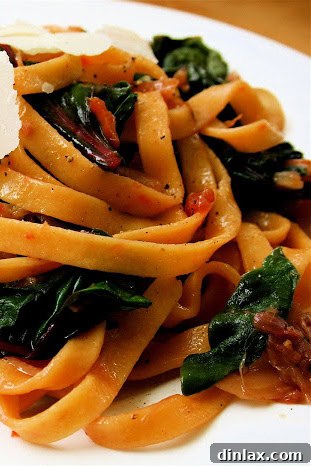
I must confess, my earlier statement about Delaney’s Culinary Fresh pasta being merely a “Sunday night tradition” was a slight fib. It has, in fact, rapidly evolved into a delightful bi-weekly dinner affair. This culinary strategy not only provides us with consistently fresh, wholesome, and delicious evening meals but also generously yields enough leftovers for at least two satisfying lunches throughout the week. The true magic of Delaney’s fresh linguini lies in its exceptional quality, which allows it to transform simple, seasonal ingredients into an extraordinary dining experience. My current favorite, and perhaps the most straightforward and utterly delicious, preparation involves a few simple steps: I begin by gently sautéing thinly sliced onions and fragrant fennel over medium heat until they achieve a rich, golden caramelization. These sweet, aromatic vegetables are then transferred to a bowl. In the very same pan, I quickly wilt the vibrant Swiss chard with a generous amount of minced garlic and a pinch of red pepper flakes, adding this flavorful mixture to the bowl. The fresh pasta, requiring only a fleeting two minutes to cook to al dente perfection, is then combined with the colorful array of vegetables. A final flourish of freshly grated Parmigiano Reggiano ties everything together, creating a symphony of flavors and textures. My partner, Ben, has become a true devotee of this combination, often expressing particular delight in the appealing “toothsomeness” of the pasta and the satisfying, tender texture of the chard.
Decoding “In Defense of Food”: Simple Rules for Healthier Eating
As I hinted earlier, a comprehensive exploration of Michael Pollan’s In Defense Of Food is certainly in the works. For now, however, I’m delighted to offer a captivating preview of his brilliantly straightforward philosophy on eating. In the culminating fifty pages of his profoundly insightful book, Pollan distills years of meticulous research and keen observation into a set of eminently practical, easy-to-remember guidelines. These rules are designed to empower readers to confidently navigate the often-bewildering modern food landscape, encouraging a return to more traditional eating patterns and gently steering us away from the ubiquitous processed, industrial “food products” that increasingly dominate supermarket shelves. They are not rigid dictates, but rather common-sense principles for a healthier, more connected relationship with what we eat.
Here are a few of his most impactful rules, which profoundly resonate with my own evolving culinary journey and philosophy:
1. Don’t eat anything your great grandmother wouldn’t recognize as food. This remarkably simple yet profoundly effective rule serves as an immediate and powerful filter. It instantly eliminates a vast array of highly processed items that have subtly infiltrated modern diets, such as “Go-Gurt Portable Yogurt tubes” or overly sweetened, artificially fortified breakfast cereals. The core essence of this guideline is to foster a reconnection with whole, unprocessed, and intrinsically wholesome foods—ingredients that have sustained humanity for countless generations. It reminds us that nature’s own pantry offers a far superior and more nourishing bounty than any engineered creation from a food science laboratory.
2. Avoid products that make health claims. Pollan astutely observes that when a food product feels the need to aggressively advertise its health benefits, it often signals a red flag. Authentically whole and nutritious foods rarely, if ever, feature bold, front-of-package declarations like “heart-healthy” or “rich in omega-3s.” Industrial food companies frequently employ these claims as a marketing tactic, designed to distract consumers from a product’s overall lack of nutritional integrity or the presence of less desirable, highly processed ingredients. For instance, even seemingly innocuous items like corn oil can boldly proclaim, “One tablespoon of corn oil daily may reduce the risk of heart disease,” subtly shifting focus away from a balanced, whole-food diet towards isolated, often industrially extracted, components.
3. Have a glass of wine with dinner. This rule, perhaps surprisingly to some, beautifully encapsulates Pollan’s broader, holistic philosophy: eating should transcend mere nutrient delivery; it should be a joyful, communal, and culturally enriching experience. A glass of wine, consumed in moderation, symbolizes the deep pleasure of sharing a meal, the importance of slowing down, and the art of savoring each moment. It encourages us to appreciate food not just as fuel, but as an integral part of a larger life experience, fostering vital connections and promoting a sense of contentment that is as crucial to our overall well-being as the nutrients on our plate.
Here’s yet another excellent and highly relevant rule from Pollan, one that holds particular significance when considering the delightful fresh linguini recipe I am sharing today:
4. Avoid food products containing ingredients that are A.) unfamiliar, B.) unpronounceable, and C.) more than five in number. This guideline provides an incredibly practical litmus test for discerning truly wholesome and minimally processed foods. As a small, yet highly illuminating experiment, I recently retrieved a bag of conventional egg noodles from my cupboard. The ingredient list was quite an exercise in pronunciation and recognition: semolina, durum flour, egg yolks, niacin, ferrous sulfate, thiamine mononitrate, riboflavin, and folic acid. While some of these are indeed vitamins, their presence in such a list often indicates a highly refined product that has been stripped of its natural nutrients and subsequently “fortified” back with synthetic versions. Contrast this starkly with Delaney’s Culinary Fresh red pepper linguini. Its ingredient list is refreshingly simple, transparent, and instantly recognizable: semolina flour, red bell pepper, egg, and sea salt. These are ingredients we all intrinsically understand and know how to pronounce, unequivocally reflecting a commitment to purity, natural goodness, and honest food that perfectly aligns with Pollan’s timeless principles.
Delaney’s Culinary Fresh: A Testament to Simplicity and Quality
The unwavering dedication to quality, authenticity, and simplicity embodied by Delaney’s Culinary Fresh pasta is truly inspiring. Each delicate strand of pasta stands as a testament to the belief that the most exceptional meals inherently begin with the finest, most honest ingredients. I wholeheartedly encourage you to explore the Delaney’s Culinary Fresh Web site. There, you can delve into owner Jordan Stone’s compelling and inspiring entrepreneurial story, discover additional retail locations where you can conveniently purchase this outstanding handmade pasta, and access a wealth of other creative and simple ideas for effortlessly preparing a wonderful, nutritious dinner in minimal time. By supporting such dedicated producers, you not only bring superior, artisanal ingredients to your own table but also actively reinforce a food system that prioritizes integrity, exquisite flavor, and community well-being.
Recipe Spotlight: Farmers’ Market Linguini II
This recipe for Farmers’ Market Linguini II is a perfect culinary manifestation of the principles we’ve explored: a vibrant celebration of fresh, local produce combined with simple, high-quality ingredients. It serves as a delicious testament to how effortlessly nutritious and satisfying a meal can be when you honor the natural flavors of good, real food. This dish is not only visually appealing but also remarkably quick to prepare, making it an ideal choice for both a busy weeknight or a relaxed Sunday dinner. The harmonious blend of sweet caramelized fennel and onion, robust Swiss chard, and the delightful toothsome texture of fresh pasta creates an unforgettable symphony for the senses.
Farmers’ Market Linguini II
Serves 4
Ingredients:
- 5 thin slices pancetta (Note: This ingredient is entirely optional but adds a wonderful depth of savory flavor. I’ve personally prepared this adaptable recipe twice – once with the rich, crispy pancetta and once using just a tablespoon of quality olive oil for a vegetarian option. Both versions are incredibly delicious, offering distinct yet equally satisfying flavor profiles. If you choose to omit the pancetta, simply substitute it with an additional tablespoon of good quality extra virgin olive oil.)
- 2 small heads fennel, trimmed and thinly sliced
- One medium onion, thinly sliced
- Kosher salt, to taste
- Two large heads Swiss chard, escarole, or kale, thoroughly washed, tough stems removed, and roughly chopped
- 1 tablespoon extra virgin olive oil (if omitting pancetta, use 2 tablespoons total)
- 2 cloves garlic, freshly minced
- Red pepper flakes, to taste (adjust the amount to your preferred level of subtle heat or a spicy kick)
- 1 lb. red pepper linguini (For an unparalleled taste and texture, I wholeheartedly recommend using fresh pasta, especially the artisanal varieties from Delaney’s Culinary Fresh, if readily available in your area.)
- Parmigiano Reggiano, freshly grated, for generous serving and garnish
- Freshly cracked black pepper, for serving
Instructions:
- Begin by bringing a large pot of generously salted water to a rolling boil on your stovetop, preparing it for the fresh pasta.
- Prepare the pancetta (if using): Slice the pancetta into thin strips or small, uniform dice. Place it into a large, sturdy nonstick sauté pan over medium-low heat. Cook slowly and patiently, allowing the fat to render out and the pancetta to gradually transform into crispy, golden-brown perfection. This process can typically take anywhere from 10 to 20 minutes, depending on the heat level and your patience, but remember – those perfectly crispy bits are absolutely worth the wait! Once the pancetta turns a deep brown and achieves its desired crispiness, carefully remove it from the pan using a slotted spoon or tongs, and set it aside on a paper towel-lined plate to drain any excess fat. Crucially, reserve the flavorful rendered fat in the pan; it will be used in the next step to infuse your vegetables with incredible depth of flavor.
- While the pancetta is cooking, or immediately after removing it, prepare your aromatics: Slice the fennel bulbs into delicate half-moons. Repeat this step for the onion, creating uniform half-moon slices. If you omitted the pancetta, add a tablespoon of olive oil to the pan now. Increase the heat to medium and add the sliced onion and fennel to the pan. Sauté the vegetables, stirring periodically, until they soften significantly and begin to develop a beautiful, sweet caramelization and golden hue. This patient caramelization process deepens their natural sweetness and complex flavor profile. Season lightly with kosher salt. Once they’ve achieved a tender-crisp texture and a slight browning, carefully transfer the mixture to a clean bowl and set it aside.
- Prepare the greens: If you’re using Swiss chard (or kale/escarole), carefully separate the sturdy stems from the leafy greens. Chop the stems into roughly ½-inch chunks, and then roughly chop the greens themselves into bite-sized pieces. Add one tablespoon of olive oil to the pan (if you didn’t use pancetta fat, or if you need a bit more fat for sautéing). Add the chopped stems to the pan and sauté them over medium heat until they become tender, which typically takes about five minutes. Increase the heat to high, then add the minced garlic and the chopped greens. Season generously with salt and a pinch of red pepper flakes to taste. Using tongs, continuously rearrange and toss the greens until they are beautifully wilted and their color deepens. Turn off the heat and gently fold in the earlier sautéed fennel-onion mixture. Toss everything together to combine thoroughly. If you intend to cook the pasta immediately, you can keep the pan on very low heat to ensure the vegetables remain warm.
- Cook and combine the pasta: With your generously salted water at a vigorous rolling boil, add the fresh linguini and cook for precisely two minutes, or until it reaches a perfect al dente texture. Remember, fresh pasta cooks incredibly fast, so maintain a close watch! Drain the pasta thoroughly but resist the urge to rinse it; the starchy water clinging to the noodles will help the sauce adhere beautifully. Immediately transfer the drained pasta to a large serving bowl. Add several generous handfuls of freshly grated Parmigiano Reggiano cheese. Carefully add the prepared, warm vegetables and the reserved crispy pancetta pieces (if using). Toss everything together gently but thoroughly, ensuring that the pasta is well-coated and all the ingredients are evenly distributed.
- Serve this exquisite dish immediately, offering additional freshly grated Parmigiano Reggiano and freshly cracked black pepper at the table for guests to customize to their liking. Savor this simple yet sophisticated meal that proudly celebrates the very best of your local farmers’ market!
Conclusion: The Enduring Joy of Simple, Wholesome Food
My ongoing journey through the vibrant farmers’ market and into the heart of my kitchen has continually reinforced a profound and beautiful truth: the most deeply satisfying and nourishing meals are often those that stem from the simplest, freshest, and most authentic ingredients. Embracing local produce, actively seeking to understand its origin, and consciously choosing artisanal products like Delaney’s Culinary Fresh pasta not only elevates our personal culinary experiences but also makes a meaningful contribution to a healthier lifestyle and strengthens the very fabric of our local communities. Michael Pollan’s timeless wisdom, with its clear and accessible guidelines, serves as an invaluable guiding light, perpetually reminding us to reconnect with real food and to rediscover the intrinsic joy that comes from preparing and sharing it. May this personal exploration inspire you to seek out the vibrant and diverse offerings of your own local market and, in doing so, uncover the enduring pleasure and profound benefits of wholesome, home-cooked meals.
NOTE: Comments on this post have been closed due to an infiltration of spam. Please email me if you have any questions: [email protected]. Thank you.