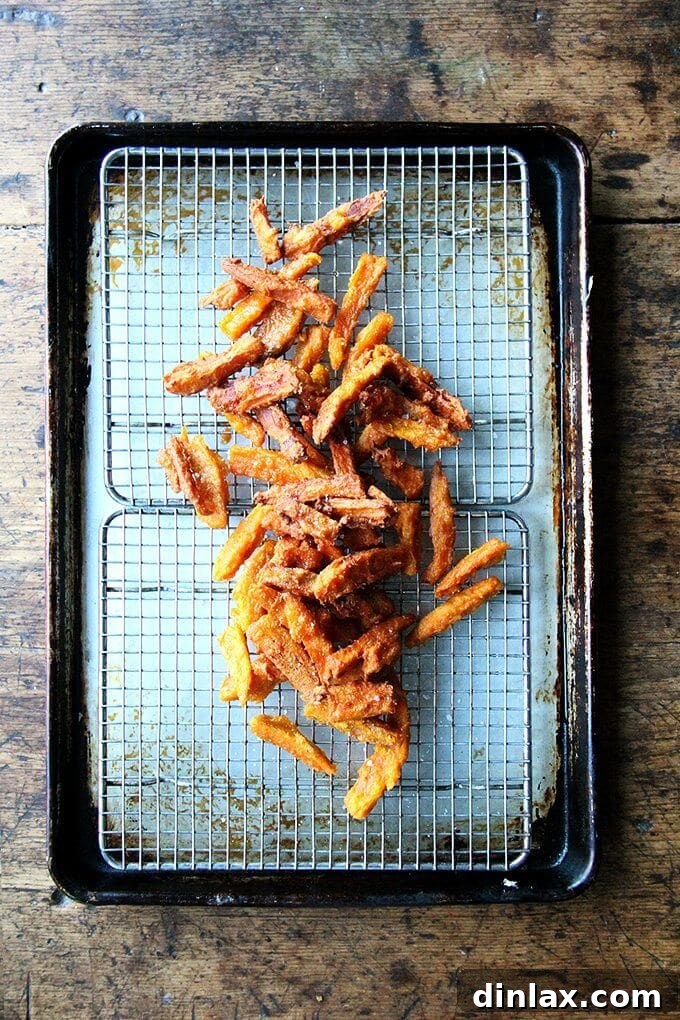
Unlock the Secret to Unforgettable Crispy Thick-Cut Sweet Potato Fries
For years, the quest for truly crispy homemade sweet potato fries seemed like an elusive culinary myth. Many home cooks, myself included, have chased that perfect crunch only to be met with disappointment from oven-baked attempts. While oven-roasted sweet potato wedges, with their beautifully caramelized edges and wonderfully creamy interiors, are undeniably delicious, they simply don’t deliver the satisfying crispness we crave in a true “fry.” They’re a delightful side, but they fall short of replicating the deep-fried experience.
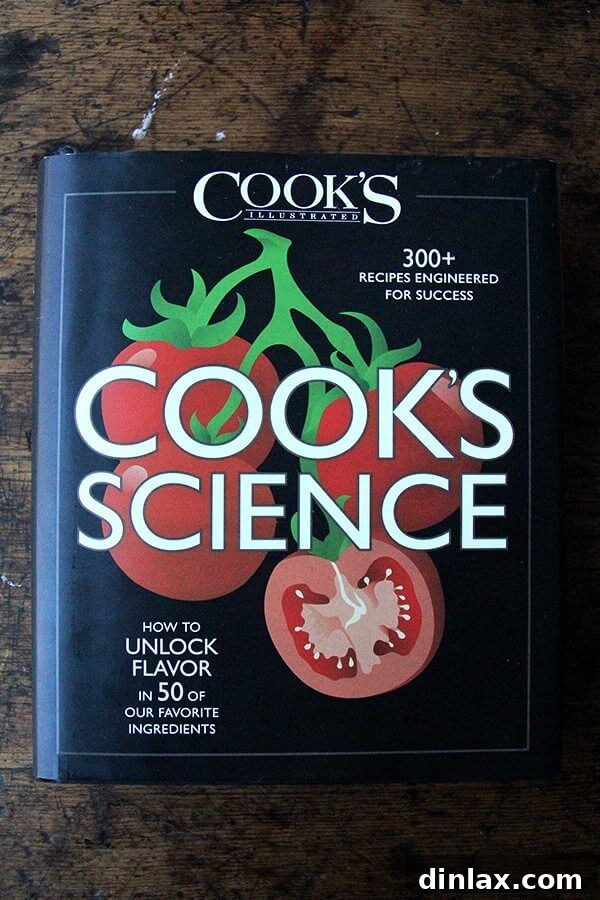
However, my perspective on sweet potato fries shifted dramatically after delving into Cook’s Science, an insightful book from Cook’s Illustrated. This publication is renowned for its scientific approach to cooking, meticulously dissecting recipes to understand the ‘why’ behind every step. What I learned challenged my conventional understanding of frying, revealing that making crispy sweet potato fries isn’t as straightforward as merely deep frying them, or even double-frying them as is common with traditional French fries to achieve extra crispiness.
The fundamental difference lies in the sweet potato itself. Unlike regular potatoes, sweet potatoes boast a higher water content, more natural sugars, and significantly less starch. These distinct characteristics mean they demand a specialized approach to achieve that coveted crispy exterior and tender interior. Traditional frying methods often result in a burnt exterior before the inside can fully cook, or a soggy texture due to the high moisture.
The scientific solution, as presented by Cook’s Science, involves a few counter-intuitive but remarkably effective steps. Sweet potatoes need to be cut thicker to withstand the process, require an ingenious addition of starch, and, most crucially, must be par-boiled before they even touch the hot oil. This rigorous method initially sparked skepticism. It sounded fussy, requiring extra steps and more thought than a simple fry. Yet, faced with an abundance of CSA sweet potatoes on my counter, eagerly awaiting their destiny, I decided to embrace the challenge. The results, I can now confidently say, are nothing short of revolutionary and utterly irresistible.
The Science of Crisp: How to Master Thick-Cut Sweet Potato Fries
Creating these perfectly crispy sweet potato fries involves a precise technique that transforms their inherent characteristics into a culinary masterpiece. Each step is designed to combat the challenges posed by sweet potatoes’ unique composition, resulting in a fry that is both incredibly crunchy and wonderfully tender. Here’s a detailed breakdown of the process:
-
Pre-Boiling for Perfection: The Baking Soda Secret
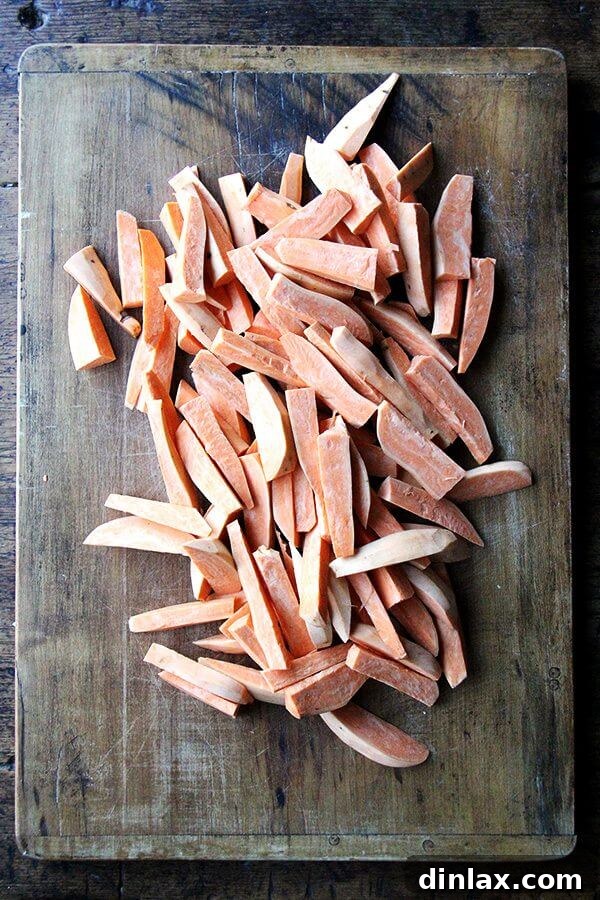
After you’ve carefully cut your sweet potatoes into thick, uniform wedges – ideally around 3/4-inch thick – the very first step is to par-boil them. This isn’t just a simple boil; it’s a strategically seasoned bath. If you were to drop raw sweet potato wedges directly into hot oil, their high sugar content would cause them to burn rapidly on the outside long before their interiors could fully cook through. The boiling process addresses this by softening the potatoes, ensuring they cook evenly once fried.
The magic ingredient here is baking soda, added to generously salted boiling water. The salt infuses flavor deep into the potatoes, while the baking soda serves a more scientific purpose. It’s an alkaline agent that rapidly breaks down the pectin on the exterior of the sweet potato wedges. This breakdown creates a slightly rough, tacky surface – a crucial texture that, when combined with the cornstarch slurry in the next step, will ultimately fry into an exceptionally crisp and flavorful crust. This initial preparation sets the stage for the remarkable crispiness to come.
-
The Starchy Slurry: Building the Crispy Armor
Once the sweet potato wedges have been par-boiled to the point where their exteriors are slightly mushy but their centers remain firm (typically 3 to 5 minutes), they are immediately transferred from the hot water into a large bowl containing a specially prepared slurry. This slurry is a simple yet powerful mixture of equal parts cold water and cornstarch – essentially, the ‘added starch’ that sweet potatoes naturally lack. The cold water ensures the cornstarch doesn’t clump and forms a smooth, even suspension.
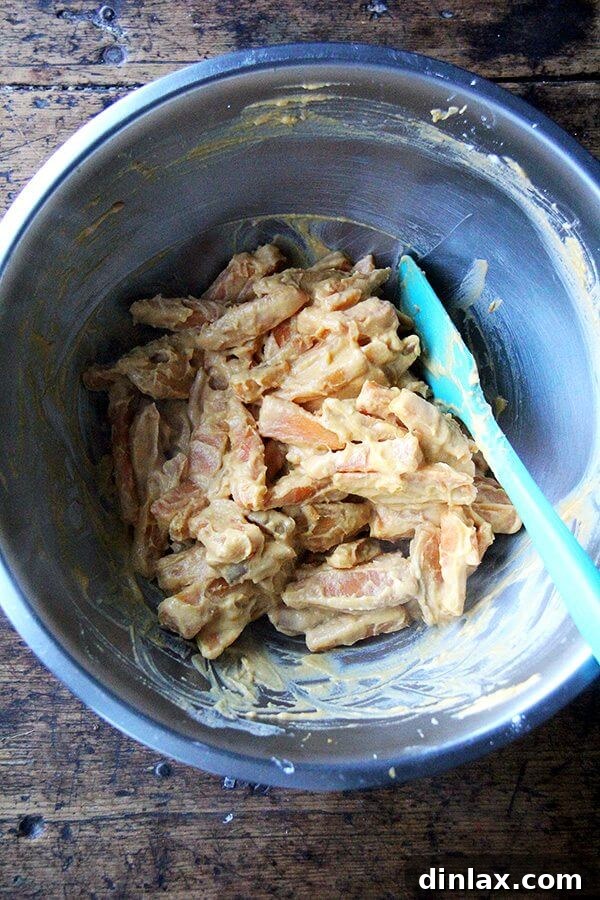
As you gently toss the warm, par-boiled wedges in this cornstarch slurry, something truly transformative happens. The broken-down, tacky surfaces of the sweet potatoes, created by the baking soda, readily absorb and mix with the slurry. Within a minute or so, each wedge becomes coated in a light-orange, slightly thickened paste. This might feel a bit unusual or “unnatural” during the process, but trust the science! This starchy coating is the secret to developing that incredible, shatteringly crisp crust during frying. It acts as a protective barrier and crisping agent, locking in moisture while creating a crunchy exterior.
-
Controlled Frying: The Low-Temperature Advantage
With their starchy armor in place, the coated wedges are now ready for their final transformation. They go straight into a large skillet filled with three cups of oil, heated to a precise 325ºF (approximately 163ºC). Maintaining this specific, lower-than-usual frying temperature is absolutely critical. Remember, sweet potatoes are rich in sugars, which caramelize and burn much faster than the starches in regular potatoes. A high frying temperature would quickly scorch the exterior before the interior is fully cooked and tender.
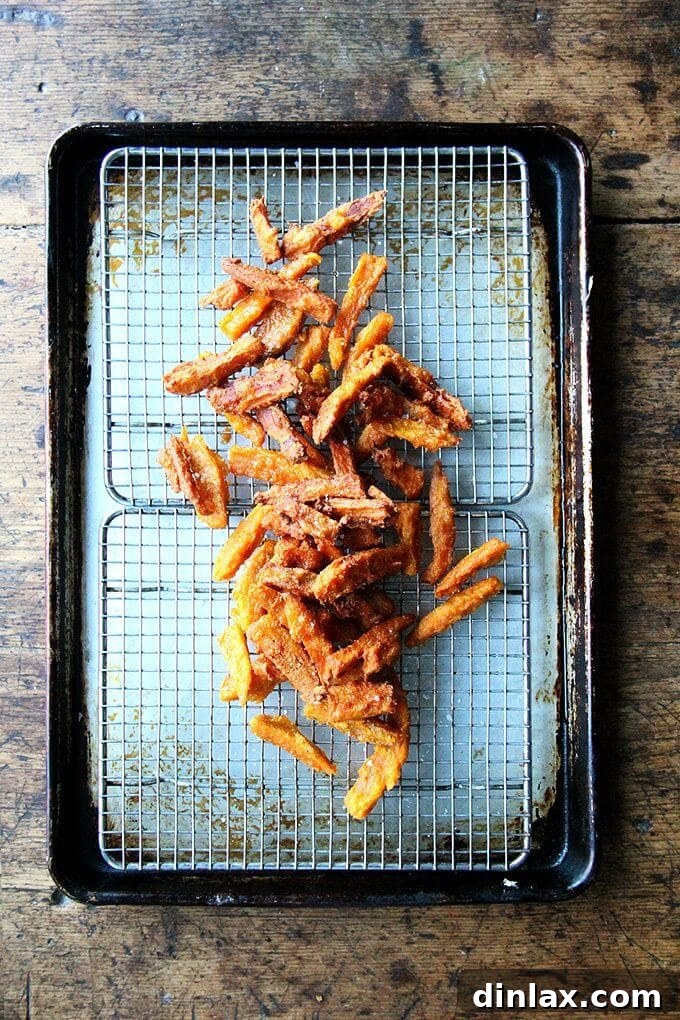
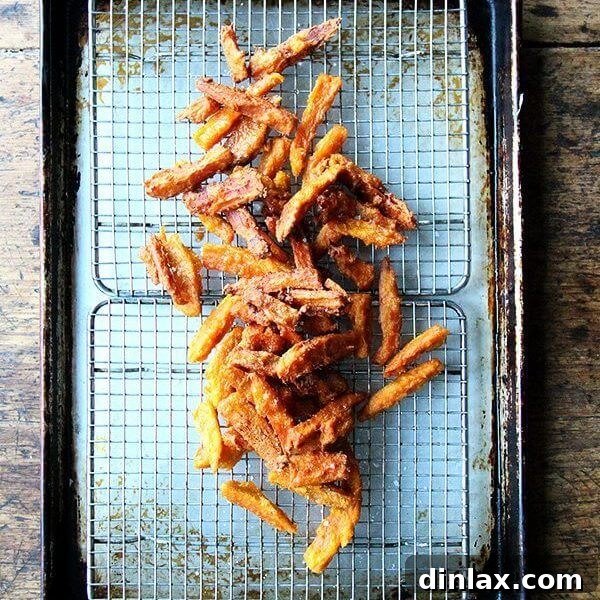
Frying at 325ºF for about 7 to 10 minutes allows the wedges to cook through gently while the cornstarch coating slowly crisps to golden perfection without burning. To ensure even cooking and optimal crispiness, it’s essential to fry the sweet potatoes in batches. For three pounds of wedges, you’ll typically need to fry them in three separate batches, preventing the pan from becoming overcrowded and the oil temperature from dropping too drastically. Overcrowding can lead to soggy, unevenly cooked fries. Carefully monitor the oil temperature and adjust the heat as needed to keep it between 280-300°F (138-149°C) during frying. Once fried to a beautiful golden brown and crispy texture, transfer them to a wire rack set over a baking sheet, season immediately with good sea salt, and keep them warm in a 200°F oven while you fry the remaining batches. This thoughtful approach guarantees each fry achieves its full crispy potential.
Beyond the Fuss: Why These Fries are Worth Every Effort
Is this process a bit fussy? Undeniably. Is it ideal for a hurried weeknight meal? Probably not. But is it utterly delicious and worth every minute of effort? Absolutely, resoundingly yes. If there’s anything that might make you hesitate to embark on this sweet potato frying adventure, let it be the time commitment, not any apprehension about the fat content or the deep frying process itself. In a surprising turn, these meticulously prepared fries are often less greasy than their roasted counterparts. Roasted sweet potato wedges, especially if not cooked at high enough temperatures or on a crowded pan, can absorb a significant amount of oil. The unique par-boiling and cornstarch coating method used here acts as a barrier, effectively minimizing oil absorption during frying.
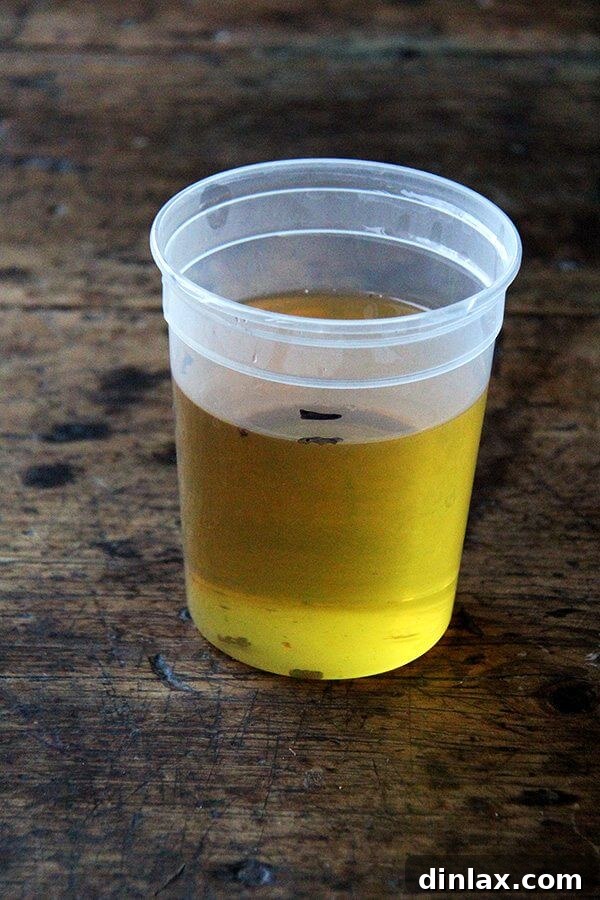
To put this to an unscientific, yet insightful, test, I performed a simple before-and-after weighing/measuring of the oil used. While this didn’t account for every minuscule drop that might have escaped onto the cooling rack, clung to the slotted spoon, or subtly spattered during cooking, the overall oil absorption was remarkably low – amounting to approximately a quarter cup for three pounds of sweet potatoes. This demonstrates that deep frying, when done correctly with this specific technique, can actually result in a less greasy product than many might assume.
As for the deep frying itself, a cooking method that many find intimidating, rest assured that this recipe is surprisingly straightforward. You don’t necessarily need a fancy deep-fry thermometer to achieve success, although it certainly helps. You can effectively gauge the oil’s temperature by dropping a single wedge into the hot oil. Observe how quickly it begins to fizzle and bubble. A rapid, vigorous fizzle indicates too high a temperature, while a slow, reluctant fizzle suggests it’s too cool. It’s quite easy to adjust your stove’s heat to maintain that gentle, consistent bubbling rate necessary for perfect frying.
These thick-cut sweet potato fries are a perfect candidate for a weekend project or a special occasion when you have a bit more leisure time. And here’s another fantastic tip: you can absolutely fry the wedges ahead of time! Once fried, simply keep them warm in a 200°F (93°C) oven until you’re ready to serve. I’ve personally tested this, serving them to my parents last weekend, and they were just as incredibly delicious and crispy, warmed from the oven, as they were fresh out of the fryer. This makes them a feasible option for entertaining, allowing you to focus on your guests rather than juggling hot oil at the last minute.
The Power of Culinary Science: Insights from Cook’s Illustrated
My journey to perfecting sweet potato fries is just one example of the invaluable lessons found within Cook’s Science. I’ve been thoroughly enjoying this book, whose subtitle “How to Unlock Flavor in 50 of our Favorite Ingredients” perfectly encapsulates its mission. It delves into the science behind common ingredients like quinoa, kale, lentils, pork shoulder, red wine, canned white beans, flank steak, olive oil, and almonds, dedicating each chapter to unlocking the full potential of a single ingredient. The unintuitive yet highly effective process for these sweet potato fries is a prime reflection of the book’s core philosophy: understanding the science allows us to overcome culinary challenges and elevate everyday dishes.
While this particular recipe might seem complex, Cook’s Science also features a wealth of simpler, equally delicious recipes. I’ve personally enjoyed dishes like gemelli with kale, caramelized onions, and bacon – a truly satisfying combination – and an overnight kale salad with roasted sweet potatoes and pomegranates, which was surprisingly refreshing and flavorful. My copy is now brimming with bookmarks for future culinary explorations, including savory corn muffins, inventive tofu banh mi sandwiches, a foolproof cold-oven pound cake, and a tantalizing Seville orange marmalade. The range and depth of recipes truly showcase the versatility of a science-first approach.
Earlier this year, another masterpiece from Cook’s Illustrated, The Science of Good Cooking, profoundly influenced my kitchen habits. That book taught me the transformative technique of brining (not merely soaking) my beans before cooking them. This simple change turned me into a bean-cooking-and-eating enthusiast, yielding beans with superior flavor and texture every time. More than just providing recipes, these Cook’s Illustrated books excel at imparting fundamental techniques and scientific understanding that empower home cooks to achieve consistently excellent results across a wide range of dishes. For any cook, whether science-minded or simply looking to improve their skills, these books make an exceptional and truly valuable gift.
As the holiday season approaches, I hope all your preparations are going smoothly and that you find time to enjoy some delicious food and good company!
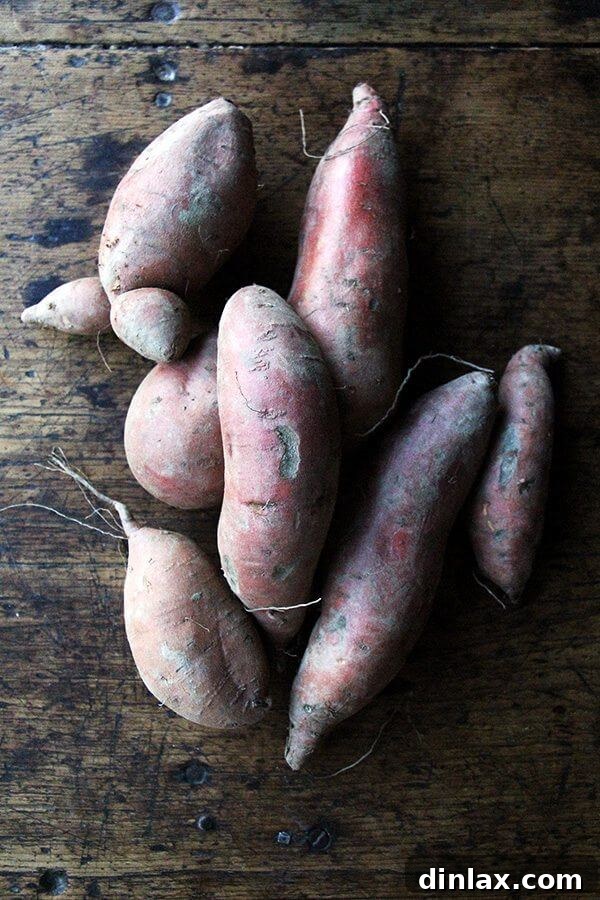
If you’re searching for a practical and highly effective kitchen gadget, consider these Kuhn Rikon peelers. They are a true game-changer in the kitchen, making peeling tasks effortless:
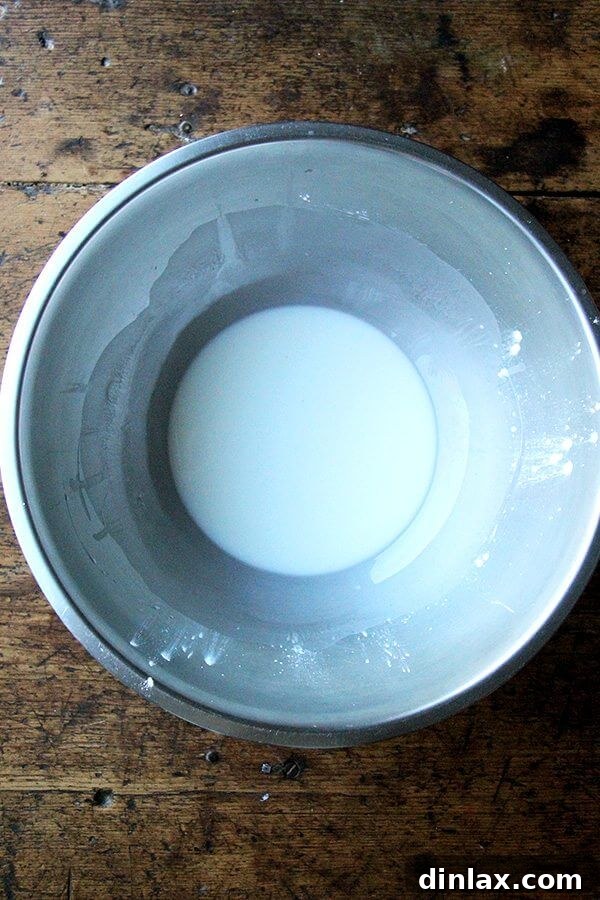
Here’s a visual of the cornstarch slurry: a precise blend of 1/2 cup cornstarch mixed with 1/2 cup cold water, creating the perfect coating for the sweet potato wedges:
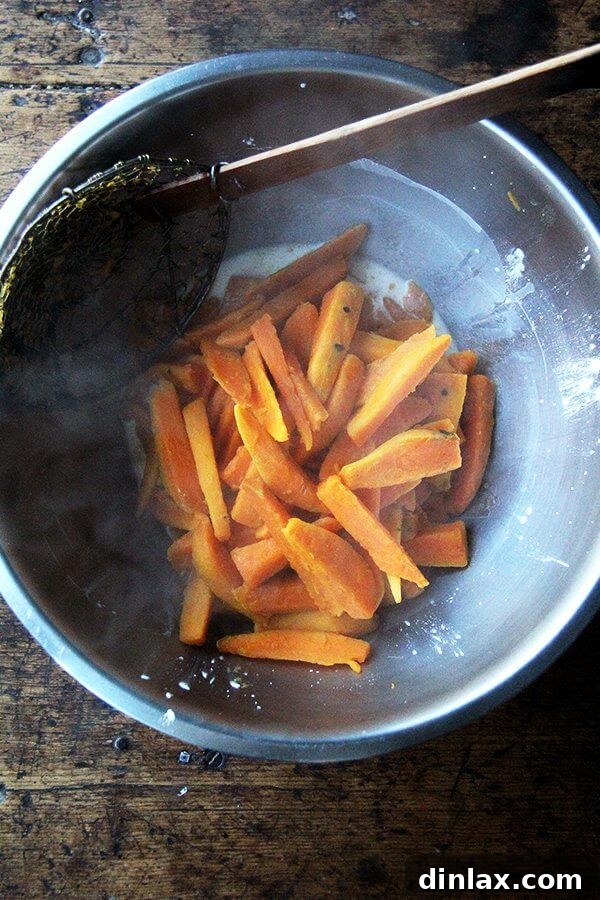
Boiled sweet potato wedges are introduced to the cornstarch slurry, preparing them for their crispy transformation:
The wedges, now beautifully coated in the starchy paste, showcasing the effectiveness of the slurry:
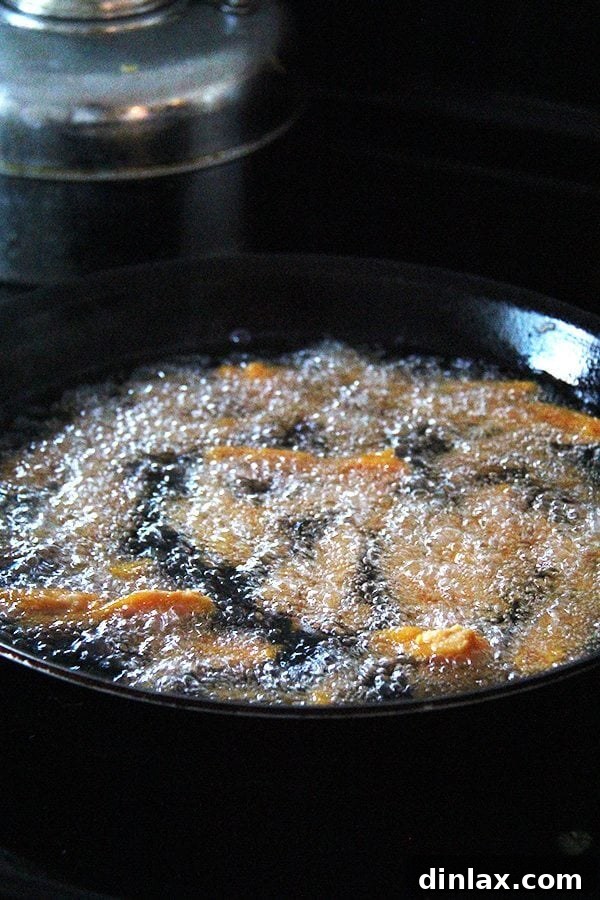
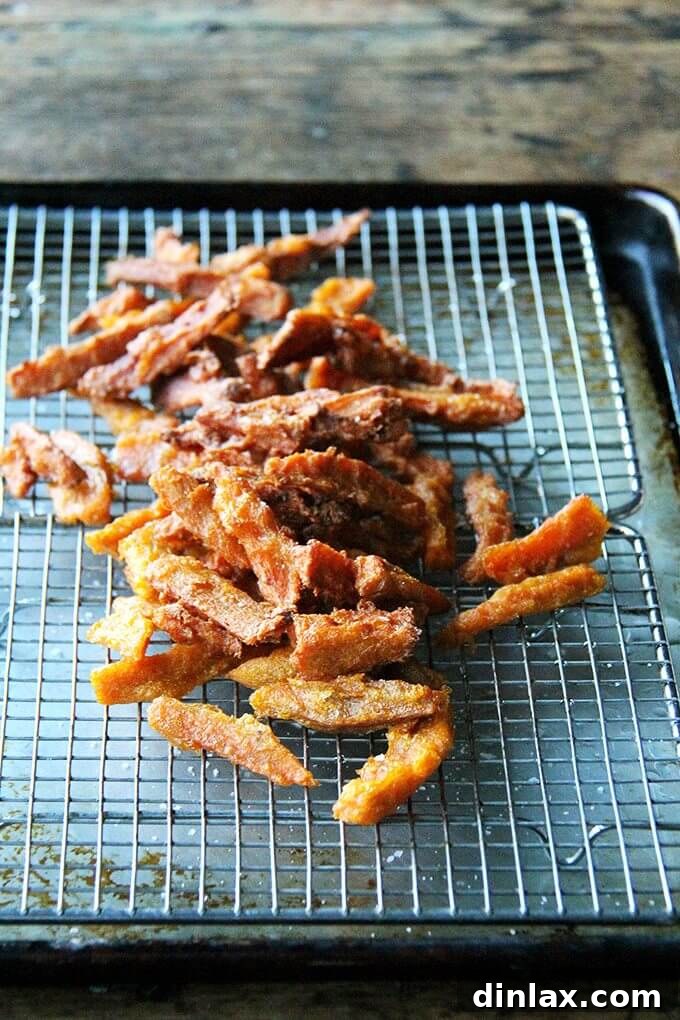
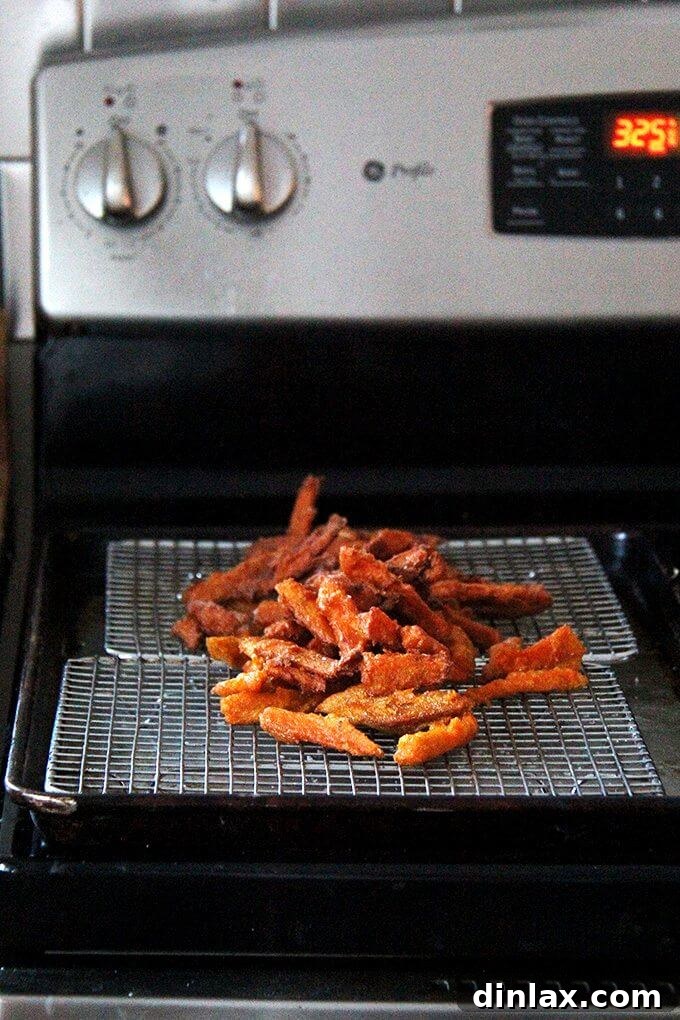
It’s genuinely surprising how little oil is absorbed during this frying process. My informal assessment indicated an absorption of roughly 1/4 cup:
The inspiration for this scientific approach comes from: Cook’s Science:
Print Recipe
Thick-Cut Sweet Potato Fries
Rating: 4.8 from 4 reviews
- Author: Alexandra Stafford
- Total Time: 40 minutes
- Yield: 4-6 servings
Description
A unique and incredibly effective recipe for perfectly crispy thick-cut sweet potato fries, adapted from Cook’s Illustrated’s Cook’s Science.
Ingredients
- ½ cup cornstarch
- Kosher salt
- 1 teaspoon baking soda
- 3 pounds sweet potatoes, peeled and cut into ¾-inch-thick wedges, then wedges cut in half crosswise
- 3 cups peanut oil (or vegetable oil)
- Good sea salt, like Maldon or Fleur de Sel, for sprinkling at the end
Instructions
- Adjust oven rack to middle position and heat oven to 200°F (93°C). Set a wire rack in a rimmed baking sheet. Whisk cornstarch and ½ cup cold water together in a large bowl to create the slurry.
- Bring 2 quarts (approximately 1.9 liters) water, ¼ cup kosher salt, and 1 teaspoon baking soda to a boil in a Dutch oven or large pot. Add the prepared sweet potato wedges and return to a boil. Reduce heat to simmer and cook until the exteriors of the potatoes turn slightly mushy (their centers will remain firm), about 3 to 5 minutes. Whisk the cornstarch slurry again to recombine any settled starch. Using a wire skimmer or slotted spoon, carefully transfer the par-boiled potatoes directly to the bowl with the slurry.
- Using a rubber spatula, gently fold the potatoes with the slurry until the slurry turns a light orange color, thickens to a paste-like consistency, and clings thoroughly to all the sweet potato wedges.
- Heat 3 cups of peanut oil (or vegetable oil) in a 12-inch nonstick skillet over high heat until it reaches 325°F (163°C). Using tongs, carefully add approximately one-third of the coated potatoes to the hot oil, ensuring that the potatoes are not touching one another to prevent sticking and ensure even cooking. Fry until crispy and lightly browned, which typically takes 7 to 10 minutes. Use tongs to flip the potatoes halfway through the frying process. Adjust the heat as necessary to maintain the oil temperature between 280°F and 300°F (138°C and 149°C) for optimal results. Once cooked, use a wire skimmer or slotted spoon to transfer the crispy fries to the prepared wire rack on the baking sheet (any fries that stick together can be gently separated with tongs or forks). Season generously with good sea salt to taste and transfer the baking sheet to the preheated oven to keep the fries warm. Return the oil temperature to 325°F (163°C) and repeat the frying process for the remaining two batches of potatoes. Serve immediately for the best experience.
Notes from America’s Test Kitchen
Sweet Potato Size: If your sweet potatoes are naturally shorter than 4 inches in length, there is no need to cut the wedges crosswise. This ensures a good length for individual fries.
Oil Choice: While peanut oil is preferred for its high smoke point and neutral flavor, vegetable oil can be used as a suitable alternative for frying. For environmental consciousness and cost-saving, leftover frying oil can be saved for future use. Simply strain the cooled oil into an airtight container and store it in a cool, dark place for up to one month, or in the freezer for up to two months.
Optional Fry Sauce: For an extra layer of flavor, consider serving these fries with a simple, yet delicious, homemade fry sauce. To make it, stir together 6 tablespoons of mayonnaise, 1 tablespoon of Asian chili-garlic sauce, and 2 teaspoons of vinegar. This sauce adds a wonderful tang and a hint of spice, though the fries are truly exceptional on their own.
Key Steps Explained:
BLANCH: Blanching the sweet potato wedges in boiling water with baking soda is essential. It ensures that their interiors become wonderfully creamy when fried, while the baking soda creates a tacky exterior. This tacky surface is crucial for the next step.
COAT: The cornstarch slurry adheres perfectly to the par-cooked wedges, thanks to their tacky exteriors. This coating is the secret to a beautifully crisp texture, forming a golden, crunchy layer when it interacts with the hot oil.
FRY: Frying the wedges in a nonstick skillet is recommended to prevent them from sticking to the bottom. Additionally, using a shallow vessel like a skillet makes it possible to deep-fry these fries with significantly less oil than a traditional deep fryer would require.
- Prep Time: 20 minutes
- Cook Time: 20 minutes
- Category: Side Dish
- Method: Deep Fried
- Cuisine: American