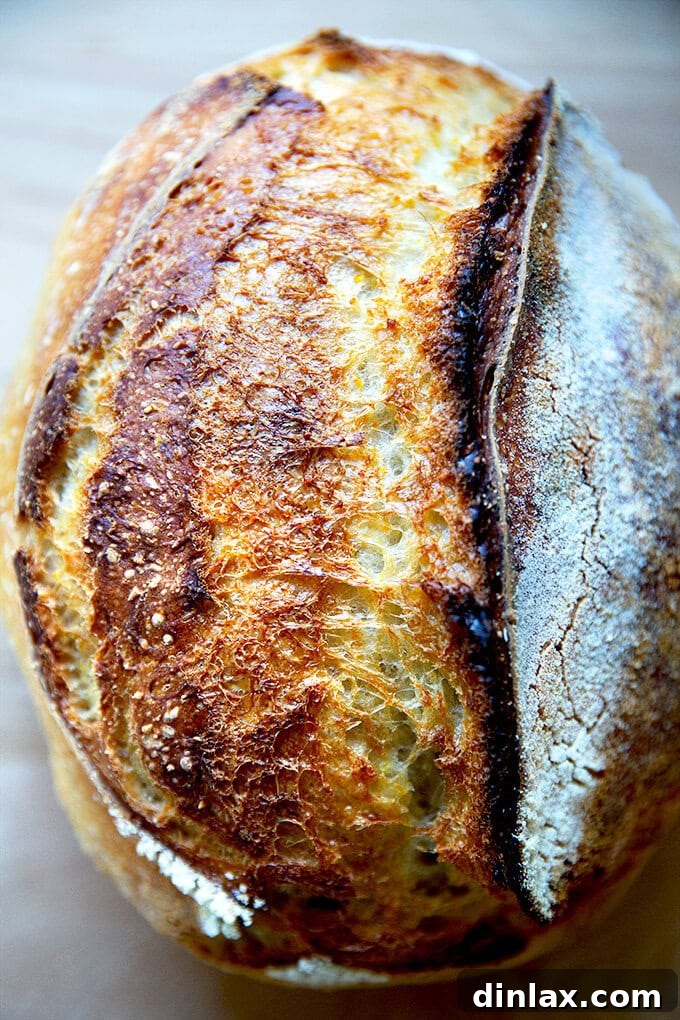
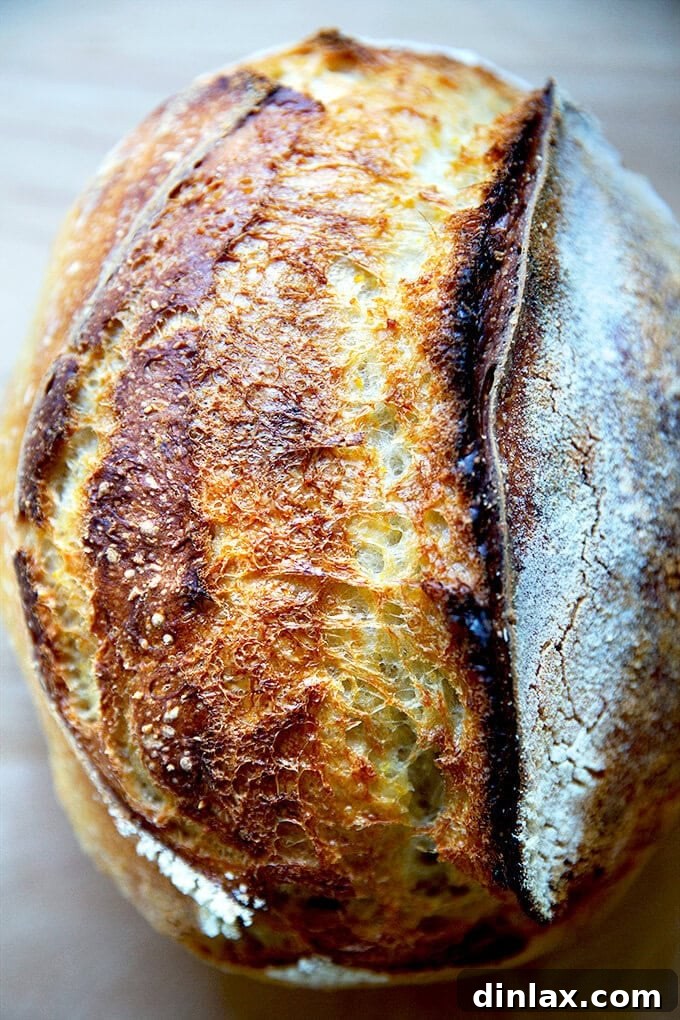
Mastering Sourdough: Overcoming Common Challenges and Baking a Perfect Loaf
Embarking on the sourdough baking journey is a rewarding experience, but it often comes with its fair share of challenges. Many aspiring bakers encounter hurdles that can lead to frustration, from an overly sticky dough to a loaf that resembles a pancake rather than a beautifully risen boule. The good news is that these setbacks are not failures but rather essential learning opportunities on the path to sourdough mastery.
Common troubles that can arise include:
- An impossibly sticky or unmanageable dough.
- A freshly baked loaf that lacks volume and oven spring, looking flat.
- A crust that is unexpectedly tough or difficult to chew.
- A dense, gummy crumb texture instead of an airy, open structure.
Sourdough baking is indeed a journey of discovery, and encountering these challenges is a natural part of the process. By embracing these moments, understanding the underlying causes, and adjusting your techniques, you can transform perceived failures into significant steps toward success.
During a period when many found themselves exploring new hobbies at home, sourdough baking surged in popularity. Consequently, I received a myriad of questions from enthusiastic home bakers. Queries often focused on: “Why is my sourdough dough so wet and sticky?” or “How can I achieve better oven spring?”, and frequently, “How can I integrate sourdough baking into my busy schedule without staying up late?”
Through these interactions, distinct patterns emerged, allowing me to pinpoint the most common issues in sourdough bread making. This guide is designed to address those prevalent problems, offering clear solutions and practical advice to help you bake consistently exceptional sourdough.
This comprehensive guide is structured to cover the following key areas:
- Where Sourdough Goes Wrong: The 4 Most Common Mistakes
- Maintaining a Lean and Active Sourdough Starter
- Frequently Asked Questions (FAQs) About Sourdough Baking
Should you have any additional questions or require further clarification on any topic, please do not hesitate to leave a comment below. I am committed to regularly updating this post to ensure it remains a valuable resource for all sourdough enthusiasts.
For those interested in delving deeper into the fundamentals of sourdough bread baking, much of the information shared here was compiled through engaging with participants of my free Sourdough: Demystified! email course. If you’re looking to solidify your basic understanding and build confidence, I encourage you to sign up for the course.
Where Sourdough Goes Wrong: Identifying and Fixing the 4 Common Mistakes
Before diving into specific issues, it’s crucial to establish a foundational practice: accurate measurement. I assume that everyone reading this uses a digital scale for measuring ingredients. If you are not meticulously weighing your flour, salt, water, and sourdough starter, this is the very first and most impactful change you should implement. Precision in ratios is paramount for consistent sourdough results. A digital scale will eliminate variability and significantly improve your baking.
The 4 Most Common Sourdough Mistakes:
- Utilizing a weak sourdough starter or not using it at its peak activity.
- Incorporating too much water relative to the flour, leading to high hydration dough.
- Over-fermenting the dough, particularly during the bulk fermentation (first rise) phase.
- Using an excessive amount of whole wheat, rye, or freshly milled flours without proper adjustments.
1. Using a Weak Starter or Not Using It at Its Peak
The strength and vitality of your sourdough starter are the bedrock of a successful loaf. Before you begin mixing your dough, you must confirm that your starter is truly ready – robust enough to transform a simple mixture of flour and water into a beautifully airy boule. A weak starter is one of the most frequent culprits behind a dense loaf or a sticky, unworkable dough.
How do you confidently assess if your starter is at its peak and ready for baking?
- It should visibly double in volume within approximately 4 to 6 hours after being fed. This is an excellent indicator of active yeast and bacteria.
- A small spoonful of the starter should float when gently dropped into a glass of water. This float test indicates sufficient gas production.
While both tests are helpful, in my experience, the first indicator—doubling in volume—is a more reliable and consistent measure of your starter’s readiness. If your starter consistently fails to double within the 4-6 hour window, it’s a clear sign that it needs a few days of consistent care to regain its strength. Here’s my recommended approach to strengthening a sluggish starter:
- **Aggressive Discarding:** Be ruthless with your discard. Remove the vast majority of your existing starter, leaving behind only about 1-2 tablespoons. This ensures your starter has ample fresh food to consume.
- **Balanced Feeding:** Feed your starter with equal parts by weight of flour and water. A good starting point is 40g of each. Consistency is key here.
- **Chlorine-Free Water:** Use water that has been left out overnight to allow any chlorine to evaporate, or use filtered water. Chlorine can be detrimental to the delicate microbial balance of your starter. In some regions, tap water can be particularly harsh, making spring water a worthwhile investment for feeding.
- **Quality Flour:** Opt for organic all-purpose flour, or consider incorporating a small amount of rye flour or stone-milled flour. These flours are rich in nutrients that help activate and strengthen your starter. Many find King Arthur Flour’s organic all-purpose flour to be an excellent, accessible choice for consistent starter feedings.
- **Consistent Environment:** After feeding, cover your starter vessel with a breathable lid (to allow gas exchange but prevent drying) and leave it undisturbed at room temperature. After about 6 hours (adjust based on your environment), repeat the process: discard most, then feed with 40g each of fresh flour and water.
Once you have a vibrant, strong starter that reliably doubles in volume, you can use it immediately at its peak for baking or store it in the refrigerator for later use. To accurately track its rise, place a rubber band around the vessel at the initial height of the starter after feeding. This visual marker makes it easy to gauge when it has doubled.
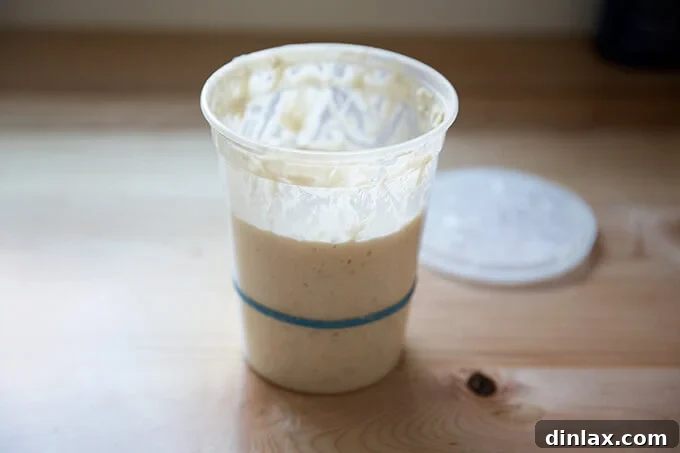
I find a deli quart container to be an ideal storage vessel for my starter. When refrigerating, I use its accompanying solid lid. For room temperature activation, a breathable lid is preferable.
When you’re ready to bake after storing your starter in the fridge, remember to remove it a day beforehand. Discard most of it, then feed it at least once, or ideally twice, to ensure it’s fully active and vibrant before incorporating it into your dough.
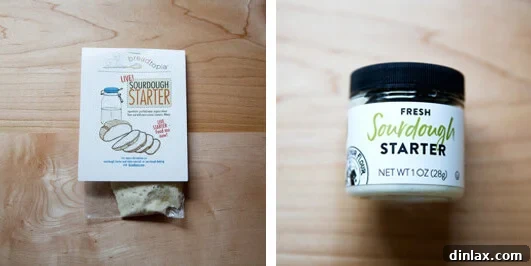
Finally, there’s absolutely no shame in purchasing a starter. In fact, I highly advocate it. A commercially purchased starter is often guaranteed to be vigorous and active almost immediately, saving you the initial weeks of cultivation and uncertainty. While building a starter from scratch is a valuable learning experience, the reality is that a homemade starter might not always achieve the robust strength required for baking consistently lofty loaves.
Recommended sources for acquiring a reliable sourdough starter include Breadtopia and King Arthur Baking.
2. Using Too Much Water Relative to the Flour (High Hydration)
One of the most common pitfalls for sourdough bakers is misjudging the dough’s hydration, often resulting in a frustratingly sticky and unmanageable mixture. The fundamental issue lies in the variable nature of flour and environmental factors.
Not all flours are created equal when it comes to water absorption. The protein content and overall composition vary significantly between different types of flour (bread flour, all-purpose flour, whole wheat flour) and even between brands. Furthermore, environmental conditions, particularly humidity, play a crucial role. In a highly humid climate, flour naturally absorbs moisture from the air, reducing its capacity to absorb additional water during mixing. Conversely, in a dry environment, flour will be drier and can absorb more liquid.
For example, if I prepare a dough with 100g of active starter, 300g of water, and 400g of bread flour in a dry climate, and you follow the exact same recipe in a very humid region, even using the same brand of flour, the texture and consistency of our doughs will likely differ significantly. Your dough might appear much wetter and soupier, while mine might be stiffer.
The solution is simple: treat recipes as a guide rather than an immutable law. Don’t be afraid to experiment and trust your intuition based on how the dough feels. If a recipe calls for a high hydration level (e.g., 75% hydration or more, like 300g water to 400g flour) and you’re in a humid environment, a proactive approach is to hold back a portion of the water—perhaps 50g initially. You can always gradually incorporate more water if the dough feels too stiff or dry during the mixing and folding process. Always measure by weight and keep detailed notes on your adjustments for future reference.
A helpful general principle is that flours with higher protein content, such as bread flour, tend to absorb more water. The same applies to whole grain flours, which have additional fiber particles that increase their water-absorbing capacity. Therefore, doughs made with a significant proportion of whole grain or high-protein bread flours may require a little more water. Conversely, all-purpose flours, which generally have lower protein content, might require less water to achieve the desired consistency.
Many bakers find that once they begin to adjust the water content in their recipes—often by slightly reducing it by around 50g—most of their dough-related troubles, particularly stickiness, are resolved, leading to a much more manageable and successful baking experience.
3. Over-Fermentation: Letting the Bulk Fermentation Go Too Long
The bulk fermentation, often referred to as the “first rise,” is a critical phase in sourdough baking. It begins the moment all ingredients are mixed and concludes when the dough is ready to be shaped. This period allows the starter’s yeast and bacteria to work their magic, developing flavor and creating gas that will give your bread its structure.
Unlike conventional yeast-leavened doughs, which frequently call for the dough to double or even triple in volume, sourdoughs benefit from a more controlled and often less dramatic increase during bulk fermentation. Opinions vary among bakers regarding the optimal percentage increase, with suggestions ranging from a 30-50% rise to a 50-75% increase, and sometimes even more. However, pushing the bulk fermentation too far can have detrimental effects.
Similar to finding the ideal hydration level for your environment, determining the perfect volume increase during bulk fermentation often requires some trial and error. Through my baking experience, I’ve found that stopping the bulk fermentation when the dough has increased by approximately 50% in volume yields excellent results. It’s important to note that, with exceptions like focaccia, I almost always follow the bulk fermentation with a long, cold proof in the refrigerator.
Understanding the interplay between bulk fermentation and proofing is crucial. As a general guideline: if you plan a short (4-6 hours), room-temperature proof before baking, you can allow the dough to increase by a slightly higher percentage during bulk fermentation. However, if you intend to do a long, cold proof, it’s safer and often beneficial to stop the bulk fermentation when the dough has increased by 50% or even slightly less in volume. This leaves enough “food” for the starter to continue working slowly during the cold proof, preventing the dough from becoming over-proofed before it even enters the oven.
The exact time it takes for your dough to reach this 50% increase is influenced by numerous factors: the strength and activity of your starter, the amount of starter used, the dough’s hydration, the type of flour, ambient humidity, and the temperature of your kitchen. Therefore, relying solely on time can be misleading; visual cues are much more reliable. Your dough is ready to be shaped when it exhibits visible bubbles throughout and has roughly increased by 50% in volume.
When bulk fermentation extends too long—often when the dough more than doubles or triples—the dough can become over-fermented. You will recognize over-fermented dough by its extremely slack, liquid-like consistency when you try to turn it out for shaping. It will feel like a wet puddle, very sticky, and will completely lack strength and elasticity. It may also emit a distinct, somewhat alcoholic aroma. Unfortunately, at this stage, the dough is typically unsalvageable for a well-structured loaf.
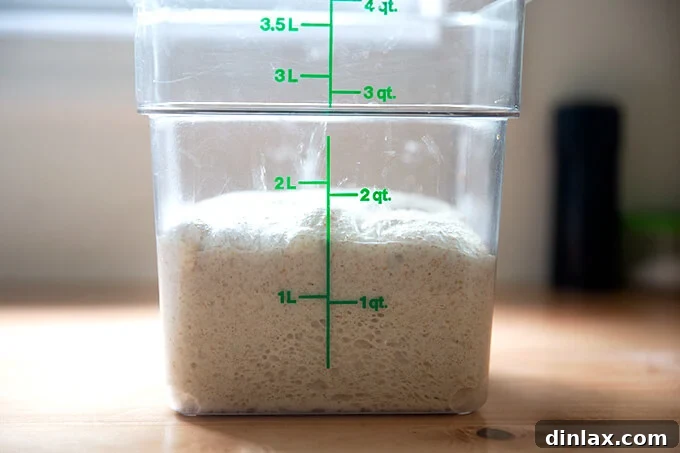
To effectively prevent your dough from over-fermenting:
- **Use a Clear, Straight-Sided Vessel:** Opt for a clear, straight-sided container, such as this one, for your bulk fermentation. Unlike a rounded bowl, a straight-sided vessel allows for accurate observation of both internal bubble activity and, critically, the precise volumetric increase of the dough. Mark the starting point, and you’ll easily see when it reaches your target increase, like the 50% rise shown in the photo above. This visual accuracy is invaluable.
- **Leverage Your Refrigerator:** The refrigerator is your best friend for controlling fermentation. At any point during the bulk fermentation, if you feel the dough is progressing too quickly, or if your schedule demands a pause (e.g., you need to go to bed), simply place your dough container into the fridge. The cold temperature will significantly slow down the fermentation process, allowing you to resume at your convenience, picking up exactly where you left off.
A crucial warning: I strongly advise against using your oven with the light on for bulk fermentation. While some bakers attempt this, especially in colder months, the environment it creates is often too warm and inconsistent. This significantly elevates the risk of rapid, uncontrolled fermentation and ultimately, over-fermentation, leading to a compromised dough.
4. Using Too Many Whole Grain, Rye, or Freshly Milled Flours
Many bakers are drawn to incorporating rye, whole wheat, and freshly milled flours into their bread, primarily for their perceived health benefits and distinct, rich flavors. While these flours can certainly enhance a loaf, using them in high proportions, especially for beginners, can introduce significant challenges.
When bakers inquire about adding more whole wheat flour, my first question is always: “What type of whole wheat flour are you using?” This distinction is vital because not all whole wheat flours are created equal, and commercial varieties aren’t always superior in nutritional value to commercial all-purpose or bread flours.
For a more in-depth exploration of this topic, I recommend reading my post, Favorite, Easy Whole Wheat-ish Sourdough Bread. To summarize: if your goal is truly to maximize the nutritional benefits and introduce complex flavors, prioritize freshly milled, stone-milled flours. Their milling process ensures that the bran, germ, and endosperm components of the grain remain intact, preserving a wider spectrum of nutrients that are often lost or separated in conventionally processed flours. You can source these specialty flours online or seek them out at local farmers’ markets or co-ops. These flours impart an unparalleled depth of flavor and aroma to your breads.
However, these whole grain and freshly milled flours can be more challenging to work with, primarily for two reasons:
- **Increased Water Absorption and Dough Stickiness:** Due to the higher presence of fiber particles, whole grain flours absorb more liquid than refined white flours. This necessitates adding more water to achieve a workable dough consistency, which can result in a significantly wetter dough. For those new to sourdough, managing and shaping a very wet dough, or trying to develop sufficient tension in it, can be incredibly frustrating and disheartening.
- **Impact on Crumb Structure:** Whole grain flours inherently contribute to a denser crumb. The bran particles, often likened to tiny razor blades, can cut through and impede the development of the gluten network. Gluten is essential for creating the elastic structure that traps gas and produces a light, airy crumb. While there’s nothing inherently wrong with a denser loaf (many prefer it!), it’s important to manage your expectations when incorporating a high proportion of whole grain flours. You won’t achieve the same open, ethereal crumb as with 100% white bread flour.
For these reasons, I always advise beginners to start their sourdough journey using 100% bread flour or all-purpose flour. This allows you to master the core sourdough process, understand the various stages, and develop a feel for the dough without the added complexity of whole grains. Once you’re comfortable and confident, you can then gradually introduce whole grain flours. Begin by substituting just 12-15% of the white flour with your chosen whole grain. If you’re pleased with the results, you can incrementally increase this to 25% and beyond, experimenting to find your preferred balance of flavor, texture, and workability.
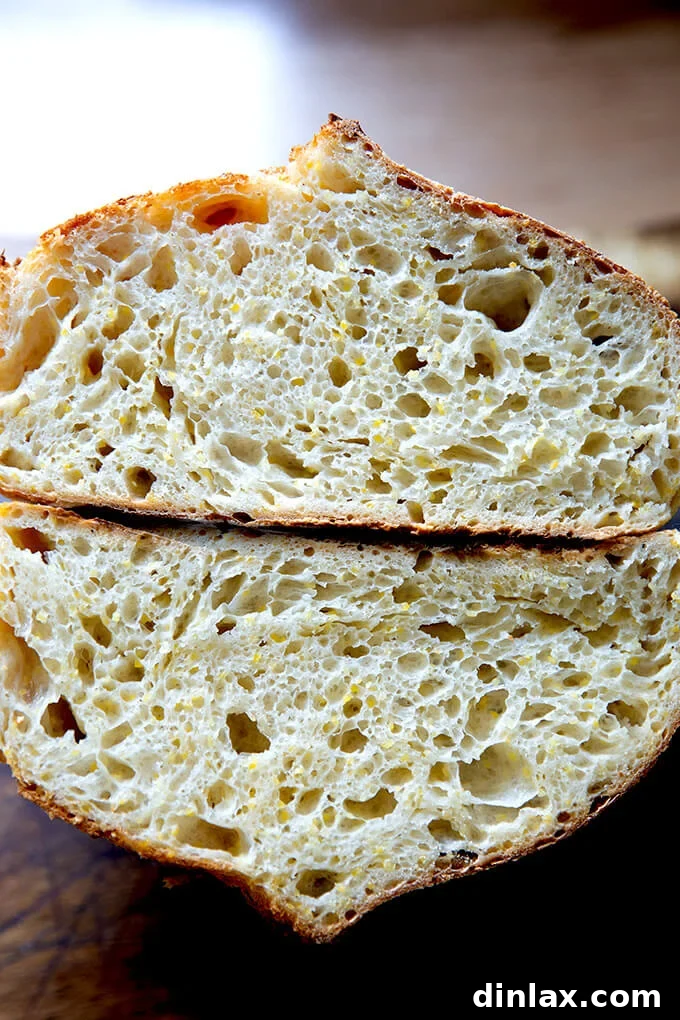
Adding cornmeal, as shown in the image below, can also provide wonderful flavor and textural complexity to your bread doughs:
Maintaining a Lean and Active Sourdough Starter
One of the most frequent questions I receive revolves around sourdough discard: “What do you do with all that discard?” While I’ll offer a suggestion below, the truth is, I don’t generate a lot of discard because I maintain a very lean starter. This approach minimizes waste and simplifies starter management.
My starter maintenance routine is designed for efficiency and vitality:
I dedicate a single vessel—specifically, a deli quart container—to my sourdough starter. I typically keep only about 100g of starter on hand at any given time. This small quantity is easily stored in the refrigerator, covered with the container’s solid lid, until I’m ready to bake.
When it’s time to activate my starter for baking:
- I remove it from the fridge.
- I discard the majority of it, leaving behind only about 2 tablespoons. This lean base ensures the fresh food is fully utilized for vigorous activity.
- I feed it with 60g of flour and 60g of water (equal parts by weight).
- I cover the container with a breathable lid and let it sit at room temperature for 4 to 6 hours, or until it has visibly doubled in volume.
Once it doubles, it’s at its peak and ready to be used in a recipe. I scoop out the required amount for my dough. After using it, I replenish the remaining starter with a smaller feeding—typically 40g each of water and flour—then return it to the fridge. When I’m ready to bake again, I simply repeat this streamlined process: discard most, feed, allow to double, and then use it. This method ensures a consistently active starter with minimal waste.
Frequently Asked Questions (FAQs) About Sourdough Baking
When is the Best Time to Use My Sourdough Starter?
For optimal results, use your sourdough starter when it has reached its peak activity, which is typically when it has doubled in volume. This usually occurs 4 to 6 hours after a fresh feeding. At this stage, the starter is most vigorous and ready to provide maximum leavening power to your dough.
If you observe that your starter is not consistently doubling within this 4-6 hour timeframe, it indicates that it may be weak and needs strengthening. Refer back to the section “1. Using a weak starter or not using a starter at its peak” for detailed instructions on how to revive and fortify your starter.
How Do I Keep My Sourdough Starter Alive and Thriving?
Many individuals hesitate to delve into sourdough baking due to the misconception that maintaining a starter is a demanding, high-maintenance task, often comparing it to caring for a pet. However, the truth is that sourdough starters are far less needy than commonly perceived. They are remarkably resilient organisms.
I have personally left my starter in the refrigerator for extended periods, sometimes for 3 to 4 weeks at a time, without any feeding, and it has consistently revived beautifully with a few attentive feedings. When I do neglect it for several weeks, I simply dedicate a day or two to getting it back to full strength and activity. My detailed starter maintenance routine, outlined in the “How to Keep A Lean Starter” section above, provides a simple and effective approach to keeping your starter healthy and ready for baking without excessive daily intervention.
What is a Recommended Baking Schedule for Sourdough? How Can I Avoid Baking Bread at Midnight?
A common concern among home bakers is managing the long sourdough process to fit their personal schedules and avoid inconvenient late-night baking sessions. While there are many flexible schedules you can adopt, my most crucial piece of advice for making sourdough work seamlessly with your routine is to **effectively utilize your refrigerator**.
I often find myself mixing my bread doughs in the evening. This inevitably means that I would be in the middle of the bulk fermentation (the first rise) when it’s time to go to bed. In cooler months, letting the dough rise overnight on the countertop might work, but during warmer seasons, it becomes a risky gamble. Prolonged bulk fermentation, especially in a warm environment, significantly increases the likelihood of over-fermentation.
My preferred method is as follows: After I complete at least two to four sets of stretches and folds (if you’re unfamiliar with this technique, refer to this post), I cover the dough vessel and transfer it to the refrigerator. The cold temperature drastically slows down the fermentation. The following morning, I remove the dough from the fridge, let it come to room temperature, and continue the bulk fermentation until the dough has increased by approximately 50% in volume.
After the bulk fermentation is complete, I turn the dough out, shape it, and then place it in a floured banneton or a flour sack-lined bowl, returning it to the refrigerator for a long, cold proof, typically lasting anywhere from 12 to 48 hours. This brings me to my next key tip: **plan ahead**. If I mix my dough on a Wednesday evening, I generally don’t anticipate baking it until Friday, allowing maximum flexibility.
Here’s a sample schedule to illustrate this approach:
Wednesday:
- **Evening:** Prepare your starter. If you bake frequently, you might just need one feeding after removing it from the fridge. If it hasn’t been fed recently, two feedings may be better to ensure peak activity.
- **Late Evening:** Mix your dough ingredients. Perform initial stretches and folds for a couple of hours. Then, to prevent over-fermentation overnight, place the dough in its covered vessel into the refrigerator.
Thursday:
- **Morning:** Remove the dough from the fridge. Let it continue its bulk fermentation at room temperature until it has increased by about 50% in volume.
- **Midday/Afternoon:** Shape the dough and transfer it to a floured bowl or banneton. Place it back into the refrigerator for a cold proof lasting 12 to 48 hours. (Note: If you have work during the day, simply take the dough out of the fridge when you return home, let it finish its bulk fermentation, then shape and return to the fridge.)
Friday:
- **Anytime:** Bake your perfectly proofed sourdough loaf at your convenience!
To put this schedule into practice, consider trying these two easy sourdough boule recipes:
- Simple Sourdough Boule (Whole Wheat-ish)
- Simple Sourdough Bread
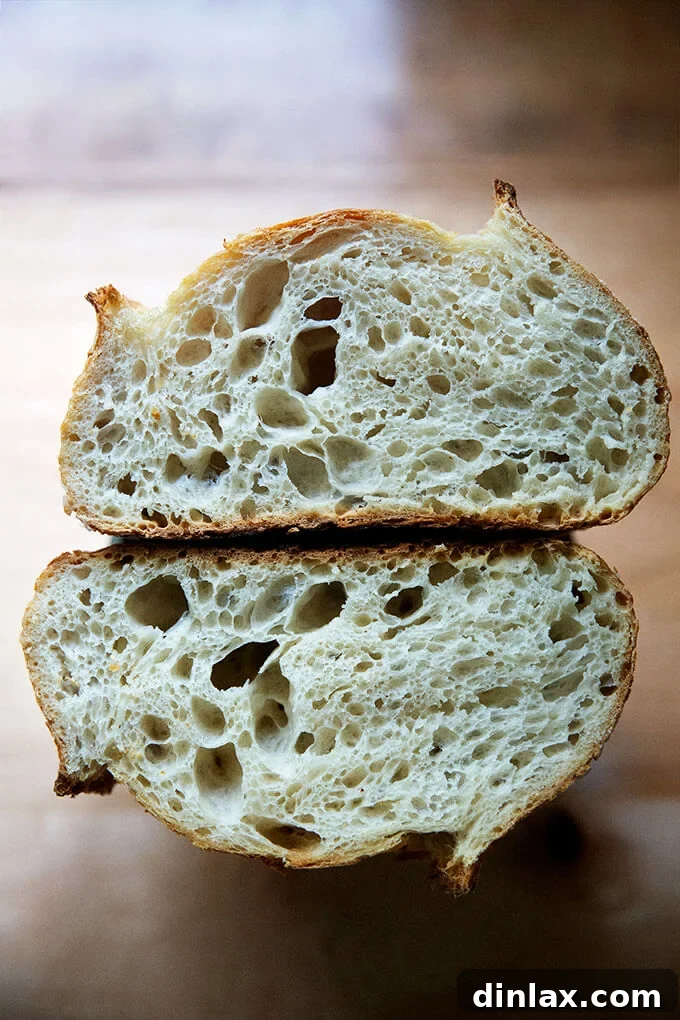
How Can I Achieve Better Oven Spring and a Loftier Boule?
Achieving impressive oven spring, which is the final burst of expansion your loaf undergoes in the hot oven, is a hallmark of successful sourdough baking. A high, airy boule is the goal for many bakers, and it’s influenced by a combination of factors. As discussed in the “Common Mistakes” section, issues such as a weak starter, overly hydrated dough, over-fermented dough, or excessive whole grain flour can all contribute to a squat, dense loaf. Ensuring these foundational elements are correct is the first step.
However, if you are confident in your strong starter, appropriate hydration, optimal bulk fermentation, and balanced flour mix, then consider these additional factors that significantly impact oven spring:
- **Creating Good Tension During Shaping:** Effective shaping is crucial for developing surface tension, which acts like a skin that helps the dough hold its structure and direct its rise upwards during baking. This skill requires practice. I prefer using an un-floured work surface and a bench scraper to achieve this. You can watch a video of me shaping a high-hydration dough here, but I highly recommend exploring YouTube for tutorials from various skilled bakers to find techniques that resonate with you.
- **The Benefits of Cold Proofing:** Cold proofing, typically done in the refrigerator for an extended period, is a game-changer for oven spring. The cold environment dramatically slows down fermentation, allowing the shaped loaf to accumulate a significant amount of gas over a longer duration. As Trevor Wilson explains in his book Open Crumb Mastery, “More gas equals more oven spring.” The contracted gases in the cold dough expand rapidly when introduced to the hot oven, pushing the dough upwards with force.
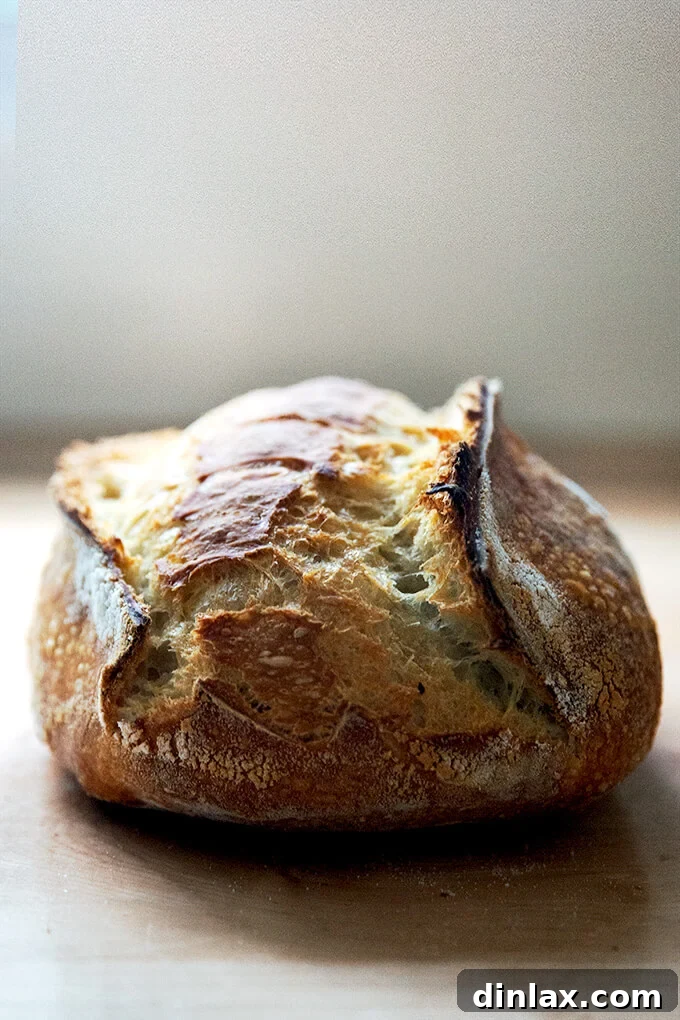
- **The Art of Proper Scoring:** Scoring is not just for aesthetics; it’s a functional step that directs the oven spring. An unscored loaf will burst erratically at the weakest points in the dough, preventing it from rising to its full potential and creating an uneven, often undesirable appearance (as seen in the image below). Proper scoring allows for controlled expansion.
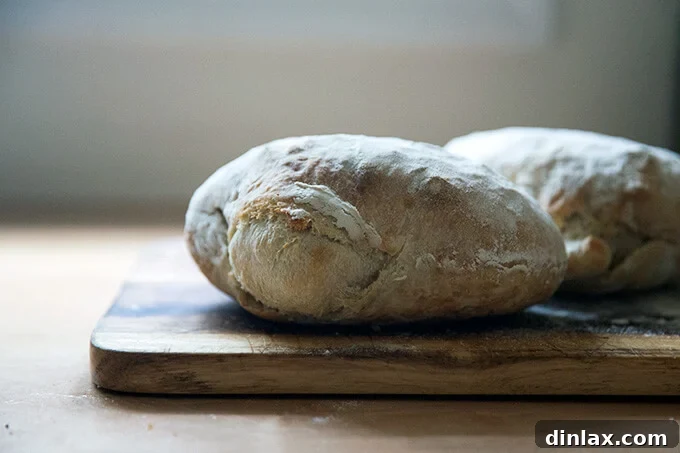
Like shaping, scoring improves with practice. The key is to make swift, confident cuts. A sharp blade (lame) is indispensable. For oblong loaves (batards), start with a simple, long slash down the middle. For round loaves (boules), a simple “X” cut is a great starting point. I personally find scoring a cold dough much easier than a room temperature one, as it’s firmer and holds its shape better, which is another reason I’m a strong advocate for cold proofing. Regardless of the dough’s temperature, aim for a consistent cut of roughly 1/2-inch deep.
- **Using a High-Quality Baking Vessel:** The choice of your baking vessel dramatically impacts oven spring and crust development. Many sourdough recipes call for baking in a preheated Dutch oven for a reason: its sealed environment creates a super-heated, steamy chamber around the bread. As Chad Robertson eloquently states in Tartine Bread, “Baking your bread in a cast-iron combo cooker gives you the same results you’d get with a professional deck oven by creating a completely sealed, radiant-heat environment. The loaf itself generates the perfect amount of steam until you remove the cooker lid to allow the formation of the crust to finish the bake. The cooker’s sealed steam-saturated chamber gives considerably better results in oven spring and score development than baking a loaf on a baking stone placed in a home oven.” The steam prevents the crust from setting too early, allowing maximum expansion.
I confidently recommend two excellent baking vessels that deliver consistent results:
- For years, I exclusively used the 5-Qt Lodge Double Dutch oven for all my sourdough bread. At around $50, it’s a very reasonably priced investment. If your goal is that perfectly crackling, lofty boule, this Dutch oven will prove its worth many times over.
- A more recent, significant splurge has been The Challenger Bread Pan. This pan is particularly outstanding if you frequently bake batards (oblong loaves) in addition to round boules. Its thoughtful design, especially the lid with handles, makes for a remarkably user-friendly experience. While it is a premium investment at $295, for those deeply committed to sourdough and bread baking, I believe it’s an investment you won’t regret.
Pictured here is the versatile 5-Qt Lodge Double Dutch oven:
What if I Don’t Have a Dutch Oven for Baking?
While a Dutch oven is undeniably the optimal tool for achieving superior oven spring and crust in sourdough, it’s understandable that not everyone owns one. If you find yourself without a Dutch oven, there are alternative methods you can employ, though it’s important to manage expectations; these alternatives may not yield the exact same professional-level results as a dedicated Dutch oven. Nevertheless, they can still produce delicious bread, and I strongly encourage investing in one of the recommended pots when circumstances allow.
Here are some viable options:
- **Any Oven-Safe Pot with a Lid:** If you have any other heavy, oven-safe pot with a tight-fitting lid (like a large casserole dish or another type of lidded ceramic/cast iron pot), you can preheat it in the oven and use it much like a Dutch oven. The key is the sealed environment.
- **Pot with an Inverted Sheet Pan (or vice versa):** You can preheat an oven-safe pot and place a sheet pan over the top as a lid, or use a preheated sheet pan with an inverted pot placed over your loaf. The goal is to trap steam around the bread.
- **Baking Steel or Stone with an Inverted Pot:** If you have a baking steel or stone, preheat it thoroughly. Then, place your shaped dough directly on it and invert a large, oven-safe pot over the top of the dough. This creates a similar steamy environment.
- **Creating Your Own Steam with Ice:** With any of these alternative methods, you can enhance steam production by also preheating a smaller, oven-safe vessel (such as a cast iron skillet) alongside your main baking setup. Once you’ve placed your bread in its baking vessel, quickly throw a few ice cubes into this smaller hot vessel. As the ice melts, it will release steam, which, as discussed earlier, is highly beneficial for maximizing oven spring and developing a beautiful crust.
What Should I Do with Sourdough Discard?
As mentioned in the section on maintaining a lean starter, I generally don’t accumulate large quantities of sourdough discard. However, when I do have some, I’ve found several delicious and inventive uses for it. I’ve been particularly pleased with incorporating discard into these sourdough flour tortillas, this Irish soda bread recipe, and my personal favorite pancake recipe. Each offers a unique way to enjoy the subtle flavor complexities that sourdough discard can impart.
However, my absolute favorite way to utilize sourdough discard is to: **make more bread!**
I often adapt my mother’s peasant bread recipe, but you can apply this principle to any yeast-leavened bread recipe you enjoy, provided you have the ingredient measurements by weight. The trick is to adjust the flour and water amounts in the recipe to account for the flour and water already present in your sourdough discard.
For example, if you wish to use 100g of sourdough discard (assuming it’s made with equal parts by weight of flour and water) in a bread recipe, you would simply subtract half of the discard’s weight (50g) from the total flour quantity and the other half (50g) from the total water quantity specified in your recipe. Other ingredients like salt, yeast, and sugar remain unchanged.
Applying this to my mother’s peasant bread recipe, the proportions would adjust as follows:
- **Flour:** 462 g (originally 512 g minus 50 g from discard)
- **Water:** 404 g (originally 454 g minus 50 g from discard)
- **Salt:** 10 g (same amount)
- **Instant Yeast:** 8 g (same amount)
- **Sugar:** 8 g (same amount)
You can seamlessly incorporate any amount of discard you have on hand by adapting the recipe’s flour and water components accordingly. This method works beautifully with any yeast-leavened bread recipe you love.
I particularly enjoy making bread with discard because while my primary sourdough loaf is slowly materializing over several days, I can still indulge in a warm, delicious, freshly baked yeast bread in just about three hours. It’s a fantastic way to ensure there’s always homemade bread available.
My Bread is Burnt on the Bottom. How Can I Prevent This?
A burnt or excessively dark bottom crust is a common frustration, especially when baking in a preheated Dutch oven. This issue usually stems from the direct, intense heat conducted through the bottom of the vessel. Fortunately, there are several effective strategies to prevent it:
- **Lower the Baking Temperature:** If you’re consistently experiencing a burnt bottom, your oven temperature might be too high for your specific Dutch oven and loaf. Consider lowering your oven’s set temperature slightly.
- **Strategic Temperature Adjustment:** The next time you bake, observe your dough after the initial 30 minutes of covered baking. If the bottom is already browning excessively at this stage, it indicates that the issue is occurring early in the bake. In this scenario, for future loaves, reduce your oven’s initial temperature by about 25°F (15°C) from the start. If, however, the bottom isn’t browning too much after 30 minutes but darkens significantly later, you can remove the loaf from the Dutch oven after the initial covered baking period and transfer it directly onto a sheet pan for the remaining 15-20 minutes of baking.
- **Insulate with Multiple Sheet Pans:** A very effective trick is to place your Dutch oven on top of two stacked sheet pans in the oven. This creates an insulating air gap between the oven rack and the bottom of your Dutch oven, reducing direct heat transfer. I frequently use this method for baking challah to prevent burning, and it works just as well for sourdough.
- **Use a Broiling Pan:** Similarly, placing your Dutch oven on a broiling pan (with its rack) can provide a similar insulating effect, lifting the Dutch oven slightly and allowing air circulation underneath.
- **Switch to Rice Flour for Dusting:** This tip makes a significant difference. Instead of using wheat flour for dusting your banneton or proofing basket, switch to rice flour. Rice flour does not burn or scorch in the same way wheat flour does, preventing those dark, bitter spots on the bottom crust. Moreover, it leaves the loaf with a cleaner finish, avoiding any unpleasant raw flour taste. A single bag of rice flour will last you a very long time.
How Do I Know if My Dough Has Proofed Sufficiently?
Let’s clarify the terminology first: **Bulk fermentation** is essentially the first rise of the dough after mixing, which we discussed in detail earlier. **Proofing** (or final proofing) is the second rise, occurring after the dough has been shaped and before it’s baked.
Confession time: I rarely perform any specific test to ascertain if my dough has proofed sufficiently. My confidence in its readiness stems from knowing two critical factors: whether the dough underwent a proper bulk fermentation (i.e., it wasn’t over-fermented), and whether it spent adequate time in the refrigerator during its cold proof (typically at least 12 hours, but ideally up to 48 hours). If these two conditions are met, I trust that my dough is perfectly proofed.
However, if you prefer a tangible test, the “finger poke” test is a commonly used method:
In his insightful book Open Crumb Mastery, Trevor Wilson describes it:
“As its name implies, the finger poke test is just that — a finger poke. As commonly prescribed, the baker should poke a finger into the proofing loaf about a half-inch deep or so. If the dough springs back completely and quickly, then that means the dough is not ready to bake. It’s still underproofed. If the dough barely springs back — or doesn’t spring back at all — then that means the dough is past its peak. It has overproofed. If, however, the dough slowly springs back completely or almost completely, then that means it’s just right.”
It’s important to note that Trevor Wilson also points out several limitations and potential inaccuracies of this test, and for a more comprehensive explanation, his book is an excellent resource. In summary, my opinion is that by meticulously managing the length and conditions of your bulk fermentation and consistently utilizing a cold, refrigerated final proof, you can largely eliminate the need to worry about whether your dough is under or over-proofed, leading to more consistent and less stressful baking.
How to Convert Fahrenheit Temperatures to Celsius, Gas Mark, and Fan Forced?
For bakers working with different oven temperature systems, conversion can be a common hurdle. To quickly and accurately convert Fahrenheit temperatures to Celsius, Gas Mark, or fan-forced equivalents, you can consult this handy oven temperature conversion table. It provides a straightforward reference to ensure you’re baking at the correct temperature, regardless of your oven type or regional standards.
What is the Difference Between a Levain and a Starter?
While the terms “levain” and “sourdough starter” are often used interchangeably, there’s a subtle distinction in common baking practice, especially in specific methods. You can think of a levain simply as your sourdough starter’s offspring or a specially prepared build from your main starter.
The renowned Tartine Bread method, for instance, prominently features the use of a levain for naturally leavened bread. In this approach, a small amount of your mature sourdough starter (e.g., just a tablespoon) is mixed with fresh flour and water (e.g., 200g each of flour and water) and allowed to ferment overnight. This freshly built mixture is the levain, and it is then used as the primary leavening agent in your dough the following morning. This method allows for a controlled, often milder, fermentation profile in the final dough compared to directly using the bulk starter.
How Do I Incorporate Olives or Other Ingredients into My Loaves?
Adding inclusions like olives, nuts, sun-dried tomatoes, or herbs can dramatically enhance the flavor and texture of your sourdough bread. The key to successful incorporation is timing, ensuring the ingredients are evenly distributed without tearing the gluten network or disrupting the dough’s development.
The best time to add these ingredients is during the early part of the bulk fermentation, specifically after you’ve completed at least one set of stretches and folds. After your first round of stretches and folds, gently sprinkle your desired inclusions over the surface of the dough. As you perform the subsequent sets of stretches and folds, the gentle manipulation will gradually and evenly incorporate these ingredients throughout the dough. This method prevents the inclusions from interfering with initial gluten development and ensures they are well integrated by the time you shape the loaf.
How Do I Get a More Open Crumb in My Sourdough Bread?
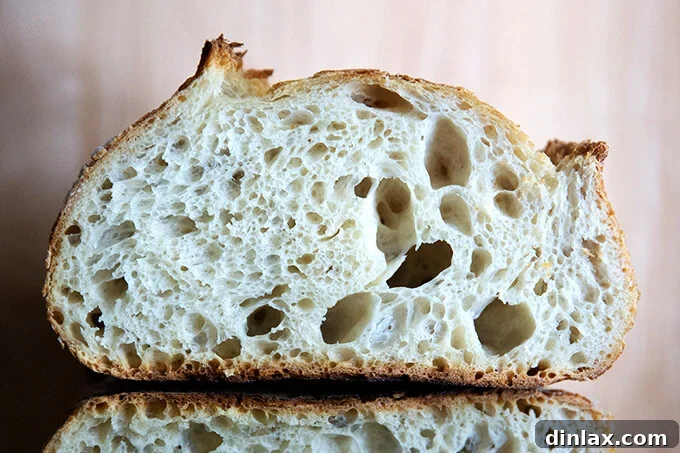
Achieving that coveted open, airy, honeycomb-like crumb is a goal for many sourdough bakers, and it’s something I continually strive to master. It’s a complex interplay of various factors throughout the entire baking process.
As with many of the challenges discussed previously, I believe an open crumb comes with consistent practice and refinement of technique. As I improve my ability to accurately assess the bulk fermentation, develop more precise and gentle shaping methods to create optimal tension, and execute delicate yet confident scoring, I anticipate seeing more of that beautiful, expansive crumb in my boules.
That said, I also acknowledge my personal limits regarding the effort I’m willing to expend for a loaf of bread. This might seem surprising given my deep love for bread, but it reflects my preference for a more approachable and sustainable baking routine. If you’ve explored any of the sourdough bread recipes on this blog, you’ll know that I favor simplicity. For instance, I’m generally unwilling to perform an autolyse—a technique where flour and water are mixed and allowed to rest for a period before adding salt and starter. Many sourdough bakers believe autolyse significantly benefits dough extensibility, gluten development, crust color, and flavor. While these benefits are valid, for me, it often feels like an extra, time-consuming step.
If achieving an exceptionally open crumb is a primary objective for you, I highly recommend downloading Trevor Wilson’s Open Crumb Mastery. I am currently working my way through it and have found it incredibly informative, though it can be quite dense and overwhelming for a novice. It’s truly intended for the intermediate sourdough baker seeking advanced understanding.
For me, engaging with such a comprehensive resource is similar to my experience with Tartine Bread: a book I revisit year after year, immersing myself in its wisdom for a period, then setting it aside until I feel inspired to delve deeper again. “Open Crumb Mastery” is brimming with invaluable insights, and if an open crumb is your ultimate goal, it’s an indispensable addition to your baking library. I have yet to encounter a sourdough baking book packed with such an extensive amount of detailed information.
How Do I Make My Sourdough Loaves Taste More Sour?
The distinctive tangy flavor is a hallmark of sourdough, and if you’re aiming to intensify that sourness, there are several effective strategies you can employ:
- **Long, Cold, Refrigerated Proof:** This is perhaps the most impactful tip. Allowing your shaped loaf to proof in the refrigerator for an extended period significantly enhances its sour flavor. The cold temperature slows down fermentation, giving the beneficial bacteria in your starter more time to produce acetic and lactic acids, which are responsible for the characteristic tang. Aim for at least 24 hours of cold proofing, and for maximum sourness, extend it to 48 hours.
- **Use Less Starter:** This might seem counterintuitive, but using a smaller percentage of starter in your dough often leads to a more sour flavor. A reduced amount of starter will prolong the bulk fermentation phase. During this longer period, the microorganisms in your starter consume their food source at a slower rate, allowing them to produce more acetic acid over time. While I personally observe little difference in bulk fermentation length or resulting sourness between using 50g and 100g of starter in my recipes, experimenting with lower starter quantities might be worth trying if you’re specifically targeting increased tang.
How Do I Make My Sourdough Loaves Taste Less Sour?
Conversely, if you prefer a milder, less tangy sourdough, several adjustments can help you achieve that desired flavor profile:
- **Room Temperature Proof:** After completing the bulk fermentation and shaping your dough, you can opt for a room temperature proof instead of refrigerating it. Allow the dough to proof at room temperature for approximately 4 to 5 hours, or until it has visibly increased and feels ready for baking. (Refer to the “How do I know if my dough has proofed sufficiently?” section above for guidance on assessing readiness, noting the nuances of the poke test).
- **Shorter Cold Proof:** While I generally advocate for a 24-hour refrigerator proof for its positive impact on crumb structure, understand that the longer the dough spends in the fridge, the more pronounced its tangy flavor becomes. If you want to reduce sourness while still benefiting from cold proofing, opt for a much shorter refrigeration period, such as 12 hours. Keep in mind that a shorter cold proof might result in a slightly less open or airy crumb.
- **Utilize the Levain Method:** This method, often employed in Tartine Bread, typically produces a less sour flavor. The night before baking, combine 20g of active, peak-strength sourdough starter with 50g of water and 50g of flour. Let this mixture (your levain) sit overnight. The following morning, integrate this levain into your main dough ingredients (e.g., 300g water, 10g salt, 400g flour). Proceed with your chosen recipe through the shaping step. After shaping, you can then either perform a room temperature proof or a shorter refrigerator proof.
- **Use Starter at Its Peak:** Ensure you use your sourdough starter precisely when it reaches its peak activity, or just slightly before its peak, after a feeding. Sometimes, if I miss the exact doubling point and use the starter when it’s a little “riper” or past its peak, it tends to impart a more sour flavor to the bread. Using it when it’s vibrant and fresh helps ensure a milder flavor.
- **Use More Starter (with a caveat):** As noted in the “How do I make my loaves taste more sour?” section, using a *moderate* increase in starter can actually lead to a less sour loaf because the fermentation progresses more quickly, consuming the acids faster. However, there’s a limit to this. If you use an excessive amount of starter—for instance, 200g of sourdough starter for a 400-500g flour loaf—the sheer volume of starter will contribute a significant sour flavor regardless of fermentation speed. To prevent an overly sour loaf, I generally recommend using no more than about 100g of starter for a loaf made with 400-500g of flour.
My Sourdough Crust is So Tough. What Can I Do to Prevent This?
A tough, overly chewy crust can detract from the enjoyment of a beautifully baked sourdough loaf. While a good crust should have a pleasant chew and crispness, an unyielding crust is undesirable. Here are a few considerations and solutions:
First, ensuring you have the right tools makes a significant difference. A **sharp bread knife** is essential for cleanly slicing through a crusty loaf without tearing or squashing the crumb. Here are two bread knives I recommend:
- This one is both aesthetically pleasing and affordably priced, offering excellent value.
- This model is a bit more of an investment but features a superb design and exceptional sharpness.
Second, if you’re consistently struggling with a tough crust and are open to different bread styles, consider trying recipes that are designed for a softer crust, such as sourdough focaccia or sourdough sandwich bread. These typically result in a tender crust that is easier to manage.
However, if your heart is set on a traditional crusty sourdough boule but you simply want to temper its toughness, here are a few adjustments you can make:
- **Use Rice Flour for Dusting:** As previously mentioned, using rice flour instead of wheat flour for dusting your proofing basket can contribute to a less tough crust. It helps create a barrier that can influence the crust’s texture during baking.
- **Ensure Adequate Steam with a Good Dutch Oven:** The initial period of high heat and steam is crucial for crust development. A high-quality Dutch oven, which creates a sealed and steamy environment, prevents the crust from setting too quickly and becoming overly rigid. This allows for better expansion and a more tender final crust. I recommend the 5-Qt Lodge Double Dutch oven or The Challenger Bread Pan.
- **Lightly Spray Dough with Water:** Before you cover your Dutch oven and place it in the oven, give the surface of your dough a light spray with water. This extra bit of moisture contributes to a steamy environment, which can result in a slightly thinner and more tender crust.
- **Adjust Baking Temperature:** While preheating your Dutch oven at a high temperature (like 500ºF or 260ºC) is beneficial for heat retention, you can lower the oven temperature to around 425ºF (220ºC) immediately after placing your dough inside. Bake covered for 30 minutes. Then, uncover the pan and, if desired, transfer the loaf to a regular sheet pan to finish baking for another 15 minutes or so. This approach allows for good initial oven spring with less aggressive heat during the later, crust-forming stages. To confirm your bread is fully baked, an instant-read thermometer inserted into the center should register 207ºF (97ºC) or above.
- **Insulate the Bottom of the Dutch Oven:** As a preventive measure against a tough bottom crust (which can contribute to overall toughness), place your Dutch oven on two stacked sheet pans or a broiling pan. This insulation helps moderate the direct heat from the oven rack.