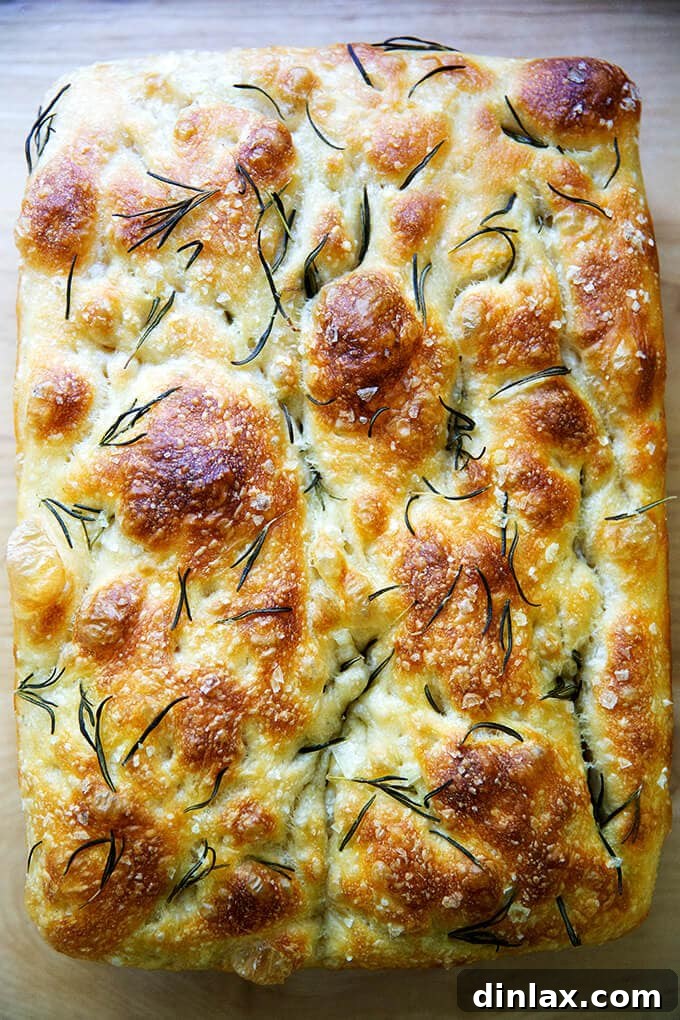
Unlock the secret to irresistible focaccia with a simple trick: cold, refrigerated dough! This magical method allows the dough to rest for 18 to 48 hours in the fridge, resulting in an exceptionally pillowy, airy, and flavorful focaccia that’s truly a cut above. While the extended cold fermentation is highly recommended for optimal results, a quicker version can be prepared from start to finish in just 3 hours if you’re short on time. This remarkable 4-ingredient recipe demands only 5 minutes of active hands-on time, making it incredibly accessible for bakers of all skill levels. Dive into the simple process with our detailed guide and video instructions below!
⭐️⭐️⭐️⭐️⭐️ Rave Review:
“This recipe is an absolute gem! I’ve baked this focaccia so many times, I’ve lost count. It’s incredibly simple to follow and consistently delivers delicious results. My entire family adores it, and it has become my go-to recipe whenever friends ask for focaccia advice. Truly awesome! Thank you for sharing this culinary treasure!” — Lucy
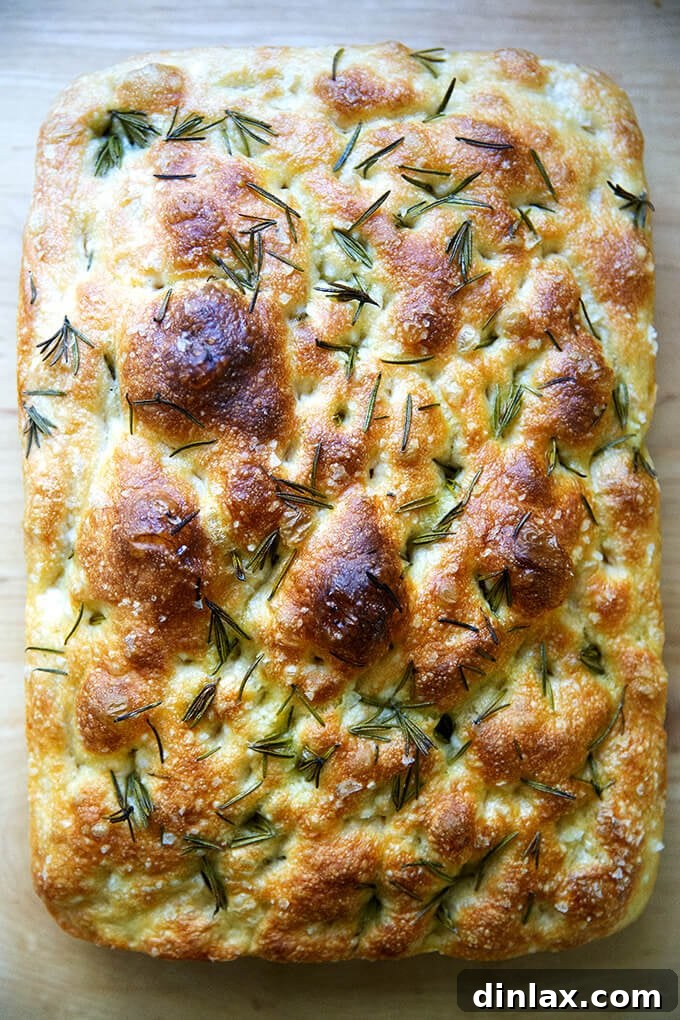
Few culinary endeavors offer such an incredible effort-to-reward ratio as baking focaccia, and this particular recipe stands out as exceptionally rewarding. If the thought of baking bread typically intimidates you, this is the perfect starting point. Its remarkable simplicity, combined with its profound flavor and delightful texture, makes it an ideal first bread-baking project. Why is this recipe so approachable and universally loved?
- It features a **no-knead, 4-ingredient dough** that comes together in less than 5 minutes of active mixing time.
- You won’t need any special equipment, complex shaping techniques, or intimidating scoring methods.
- All you require is a standard 9×13-inch baking pan and your fingertips (for creating those signature dimples), and you’re all set to bake!
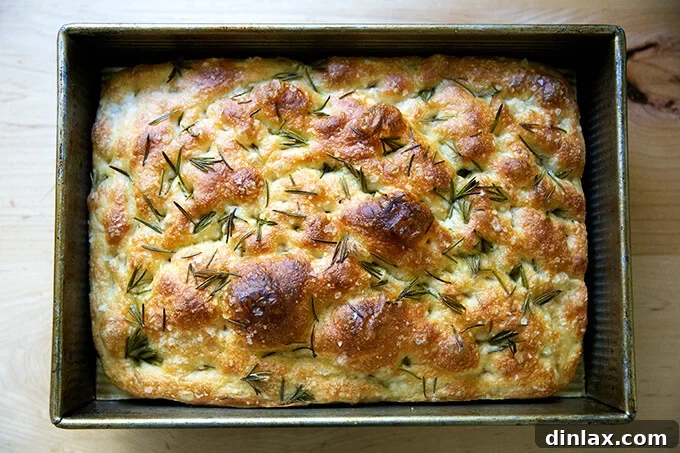
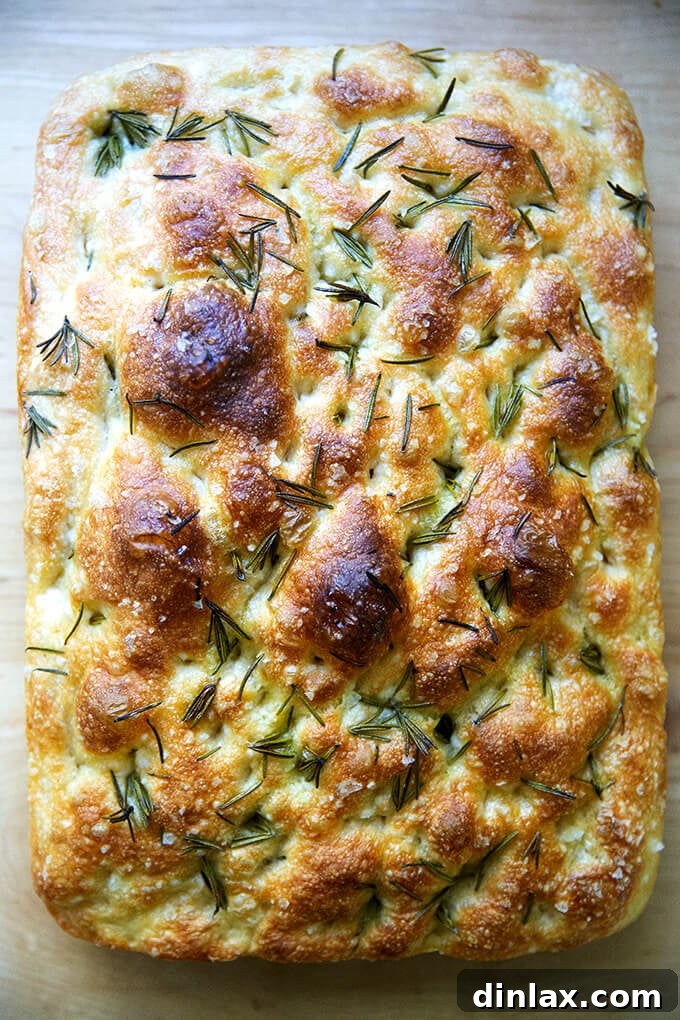
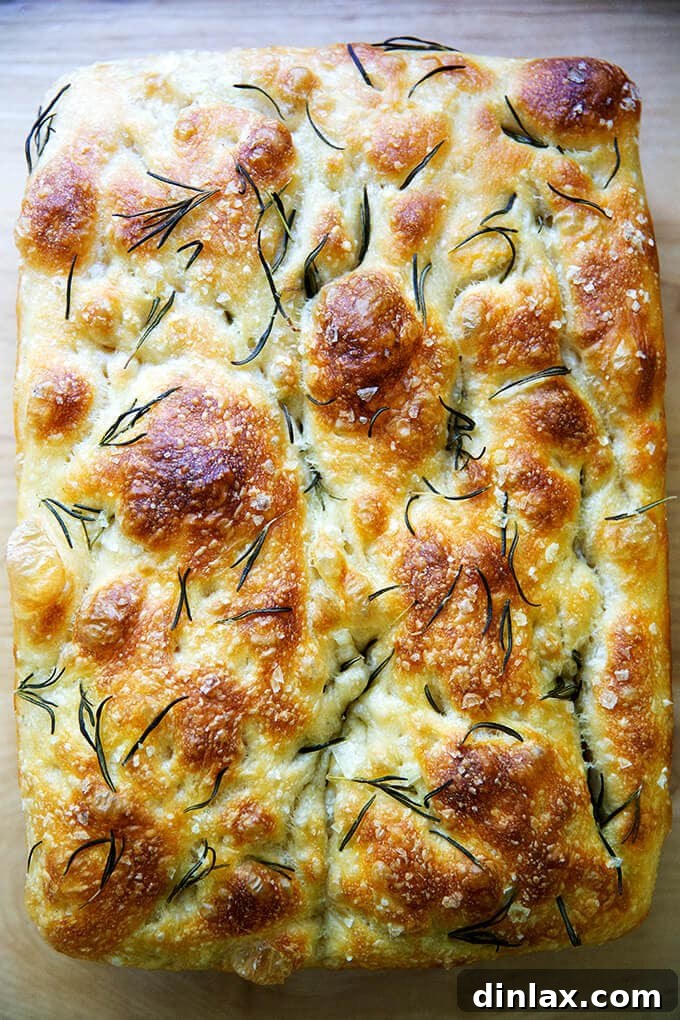
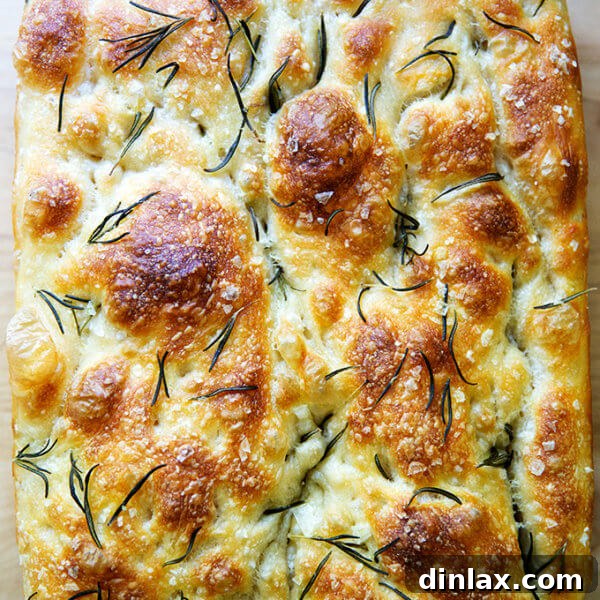
- The finished focaccia emerges from the oven incredibly soft and pillowy, boasting a beautifully olive oil-crusted exterior and a golden-brown hue all around. The aroma alone is utterly irresistible.
Mastering the Perfect Focaccia: Two Essential Secrets
This focaccia consistently emerges from the oven with a stunning golden crust and an exquisitely pillowy interior, its surface beautifully dimpled with deep crevices that capture pools of aromatic olive oil. This perfect result is primarily due to two fundamental techniques that elevate this recipe above the rest:
- High Hydration Dough: This focaccia is crafted with an impressive 88% hydration level.
- Long, Cold, Slow Fermentation: The dough undergoes a lengthy cold fermentation in the refrigerator, resting for a minimum of 18 hours and often for as long as three days.
Let’s delve deeper into each of these critical elements and understand how they contribute to the ultimate focaccia experience:
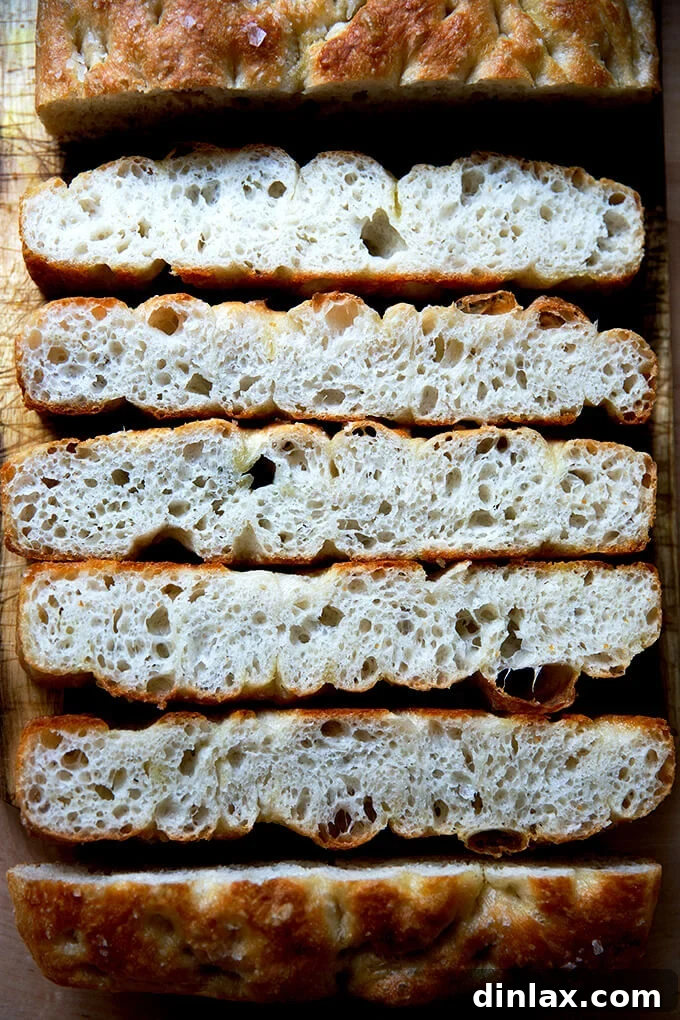
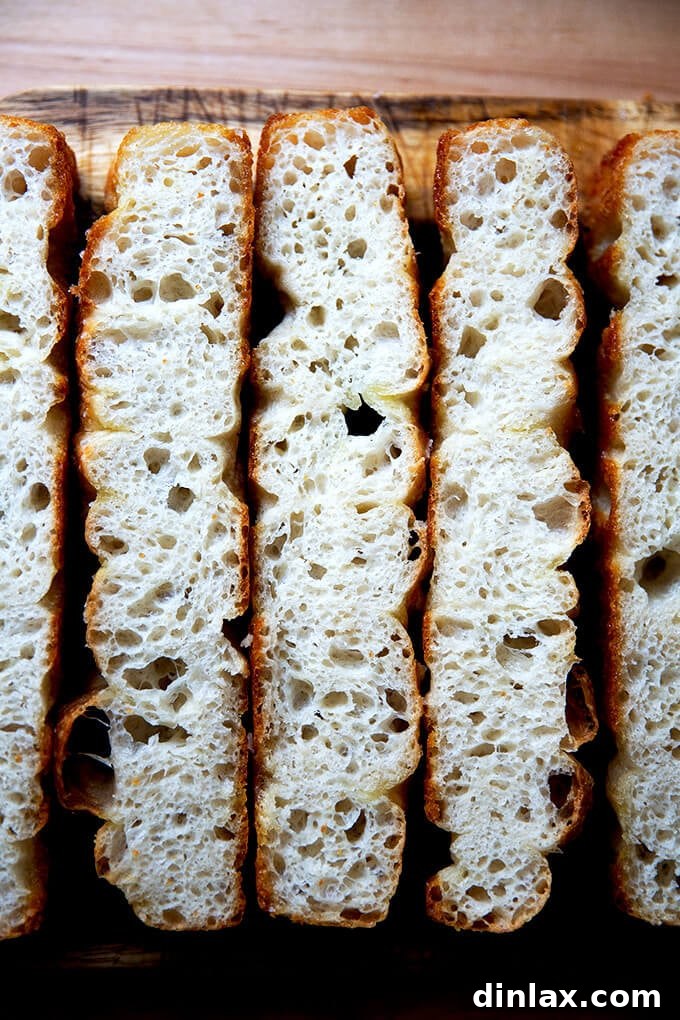
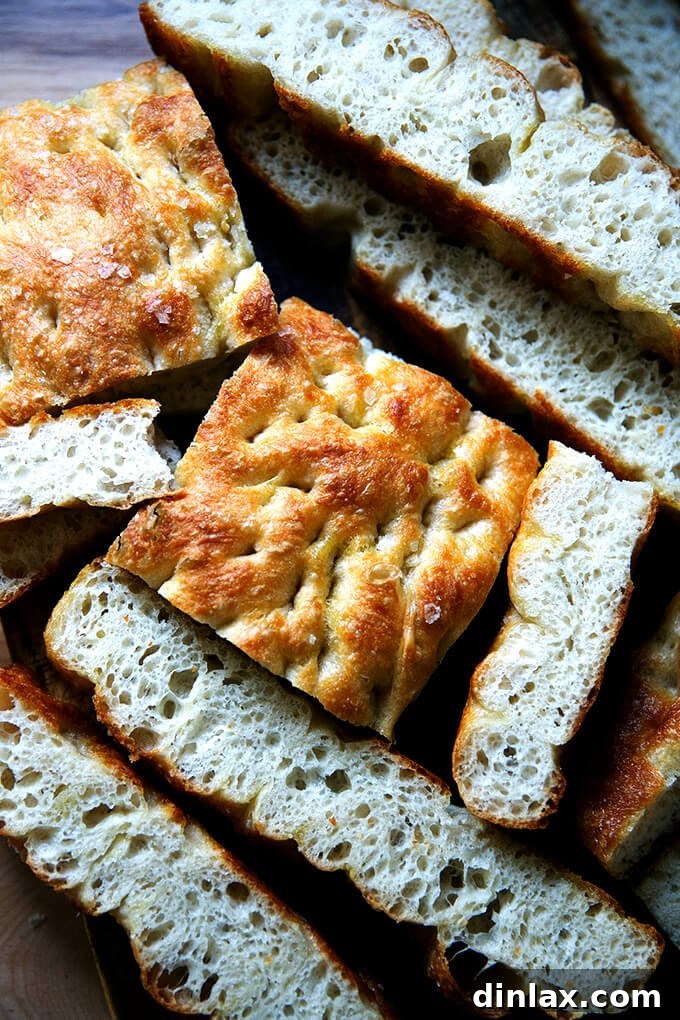
A **high-hydration dough** is characterized by a significantly elevated proportion of water relative to the flour. This generous amount of water is key to creating an exceptionally light, tender, and airy dough structure. When baked, this translates into a focaccia with a truly beautiful open crumb and characteristic large air pockets throughout. (Interestingly, this very principle is also the secret behind crafting outstanding homemade pizza dough, yielding a similarly delightful chew and texture.)
The magic of a **long, cold fermentation** lies in its ability to transform simple ingredients into a complex, flavorful bread. During this slow, refrigerated rise, enzymes present in both the flour and the yeast work diligently to break down the complex starches in the flour into simpler sugars. These naturally produced sugars are not only fundamental to developing a rich, nuanced flavor profile in the focaccia, but they also contribute significantly to its beautiful golden-brown crust during baking. It’s a fascinating process that yields incredible results, don’t you think?
Moreover, a prolonged **slow fermentation** process plays a crucial role in strengthening the gluten network within the dough. This enhanced gluten structure is vital for promoting a crumb that is not only robust but also riddled with numerous, enticing air pockets, contributing to that desired light and airy texture we all crave in a perfect focaccia. The wait truly is worth it for such a superior internal structure.
Unveiling the Unique Aspects of This Focaccia Recipe
In a culinary world brimming with countless focaccia bread recipes, you might wonder what makes this particular one stand out. This recipe distinguishes itself from many others through two key innovative approaches:
- The indispensable long, cold rise in the refrigerator.
- The deliberate omission of any sugar, honey, or other sweeteners from the dough.
You might be asking, why is there no sweetener in this recipe? The answer is quite simple and rooted in sound baking science: a sweetener is simply not necessary. Contrary to a widely held belief, yeast does not require sugar to activate or to thrive. While sugar can indeed accelerate the fermentation process, our goal with this recipe is precisely the opposite. When we employ a long, slow rise, speed is not the priority; rather, we are optimizing for flavor development and exceptional texture.
As we touched upon earlier, during the extended period of cold fermentation, the enzymes naturally present in both the flour and the yeast diligently break down the complex starches within the flour into simple sugars. These naturally occurring sugars are more than sufficient to contribute both to the focaccia’s deep, rich flavor profile and to its desirable golden-brown coloration during baking, rendering added sugar completely superfluous. This natural process enhances the bread’s intrinsic qualities without the need for artificial sweetness.
PS: Once you’ve mastered this incredibly simple focaccia, we highly encourage you to try your hand at our equally straightforward sourdough bread recipe. It’s another culinary adventure that demands minimal effort but consistently delivers spectacularly delicious results.
Crafting Your Own Focaccia Bread: A Step-by-Step Guide
Embark on your focaccia journey by gathering these essential ingredients: 4 cups (512 g) of all-purpose or bread flour, 2 teaspoons (12 g) of kosher salt, 2 teaspoons (8 g) of instant yeast (we highly recommend SAF instant yeast for consistent results), and 2 cups (455 g) of lukewarm water. The precise measurements, especially by weight, are crucial for achieving the perfect dough consistency.
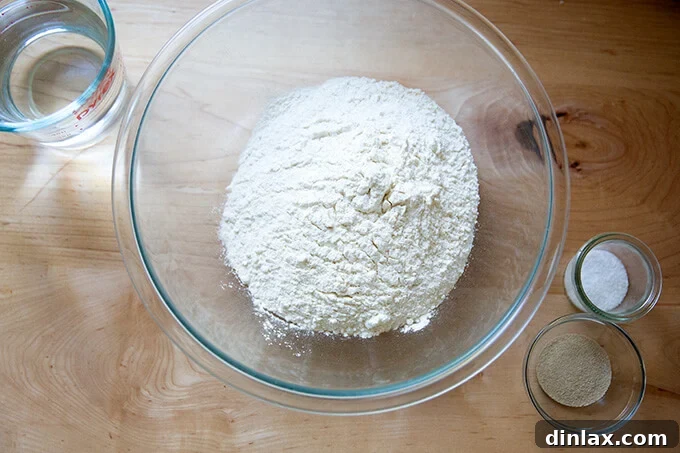
Begin by thoroughly whisking together the dry ingredients – the flour, salt, and instant yeast – in a large mixing bowl. Ensure they are evenly distributed, laying the foundation for a cohesive dough.
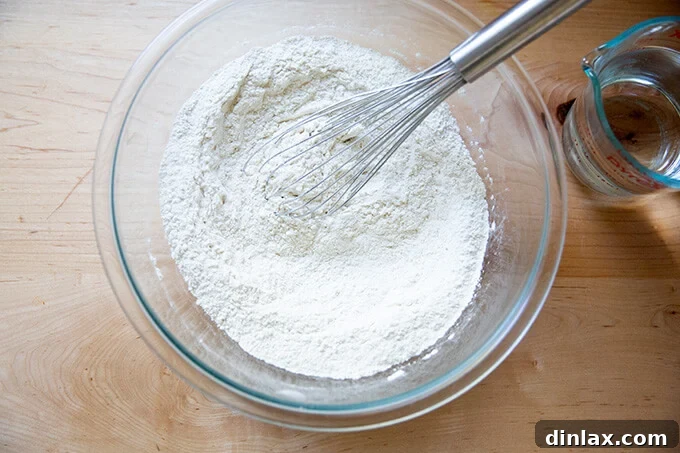
Next, pour the measured lukewarm water into the bowl with the whisked dry ingredients. This is where the dough begins to take shape, so be ready to mix it gently.
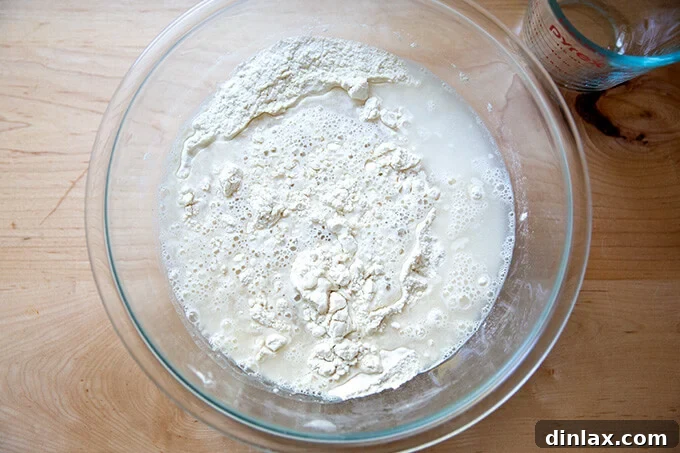
Utilize a sturdy rubber spatula to gently stir the wet and dry ingredients together. Continue mixing just until the liquid is fully absorbed and a sticky, shaggy dough ball forms. Avoid overmixing; a few lumps are perfectly fine at this stage.
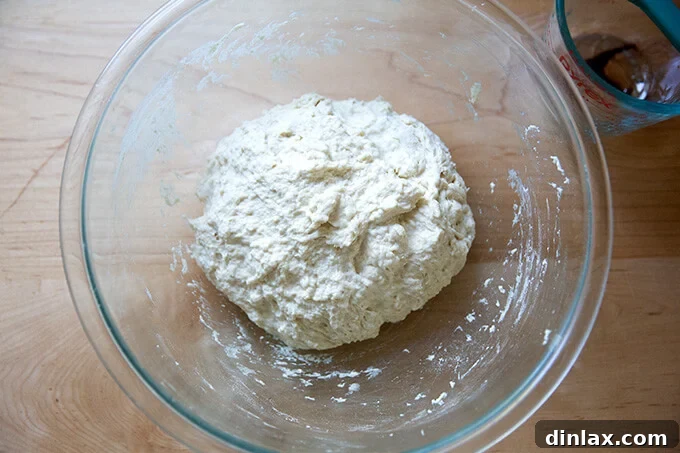
Lightly slick the surface of the dough with a generous drizzle of olive oil. This not only prevents a skin from forming but also contributes to the rich flavor of the finished bread.
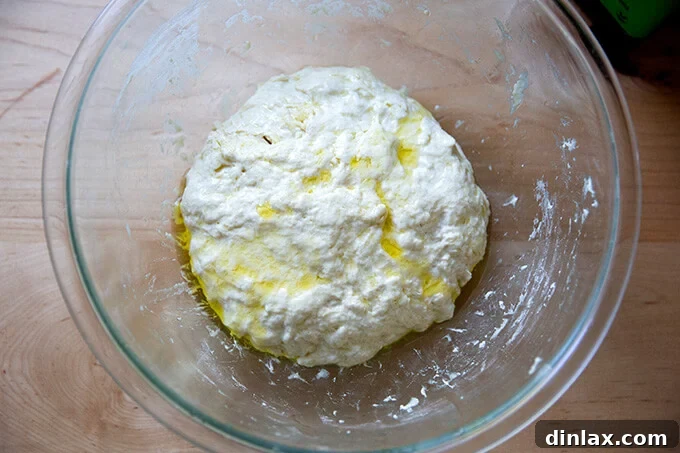
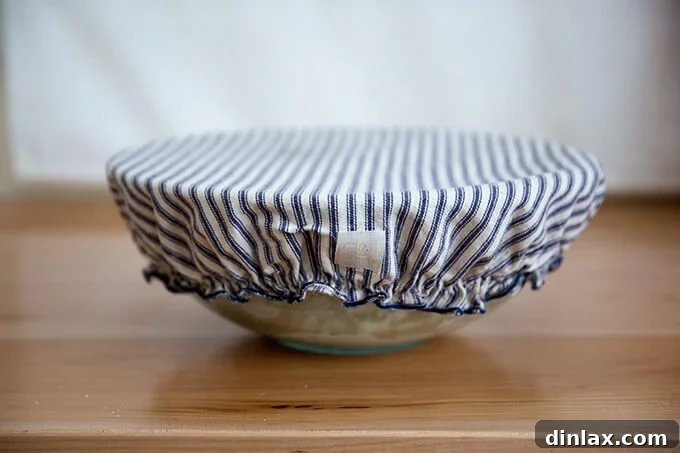
Once oiled, cover the bowl securely – preferably with a tight-fitting lid, or alternatively with plastic wrap or a cloth bowl cover. Immediately transfer the covered bowl to the refrigerator. Allow the dough to undergo its crucial cold fermentation for a minimum of 12 to 18 hours, or for an even more enhanced flavor and texture, up to three full days. The longer the chill, the richer the results!
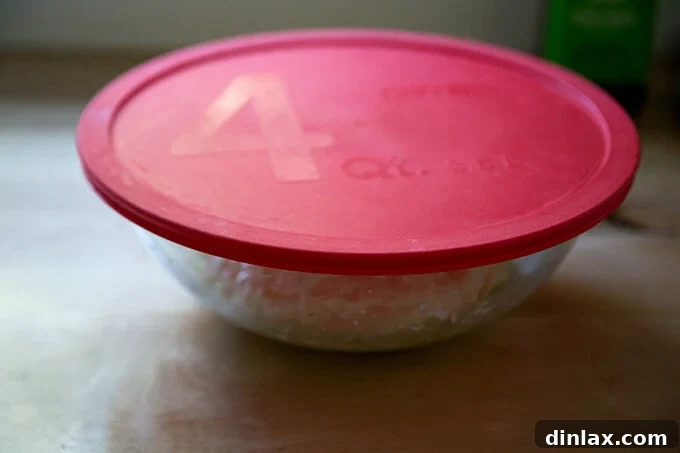
IMPORTANT NOTE: It is absolutely essential that the dough is thoroughly slicked with olive oil before covering, especially if you are using a cloth bowl cover or a tea towel instead of plastic wrap or a rigid lid. For cloth covers, consider securing it with a rubber band to create a more airtight seal. If the dough is not coated with sufficient oil, you run the risk of it drying out and forming an undesirable crust on its exposed surface during the long refrigeration period, which can impede its rise and texture.
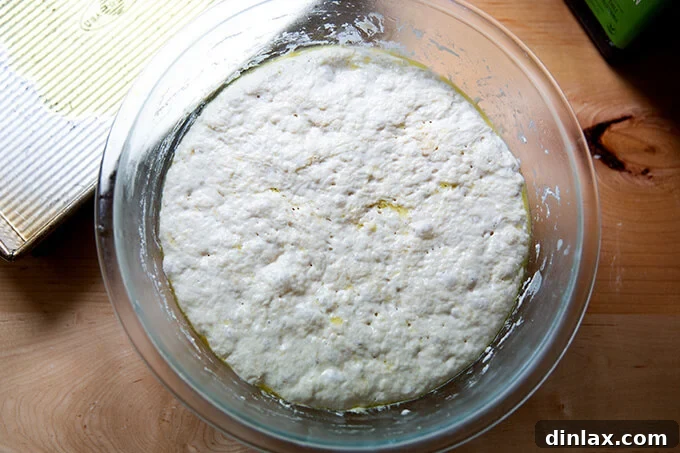
Once the cold fermentation period is complete, carefully remove the bowl from the refrigerator and gently lift off its cover. You’ll notice a beautifully risen, bubbly dough.
Gently deflate the dough and then carefully transfer it to a prepared baking pan. For consistent results, we highly recommend this 9×13-inch USA pan due to its excellent non-stick properties and heat distribution. If you don’t have this specific pan, you can effectively use two 8- or 9-inch pie plates or similarly sized baking dishes. When using glass baking dishes, it’s crucial to first generously grease them with butter before adding a tablespoon of olive oil to each. The butter acts as an extra layer of protection, ensuring the focaccia won’t stick. Once transferred, resist the urge to handle the dough again; allow it to rest undisturbed in the pan for 2 to 4 hours, depending on the ambient temperature of your kitchen. This second rise is vital for its final texture.
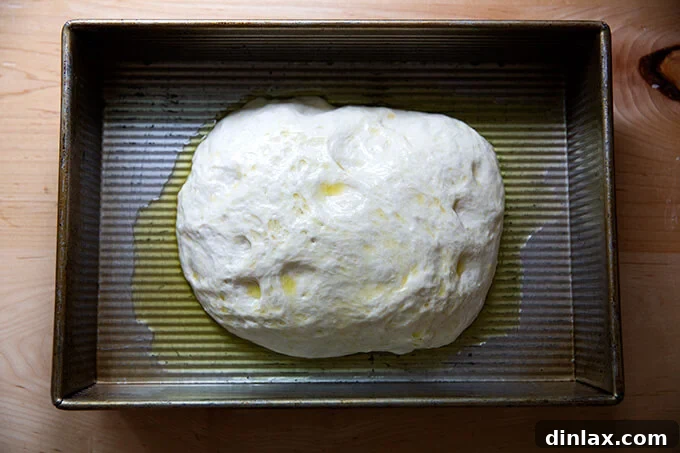
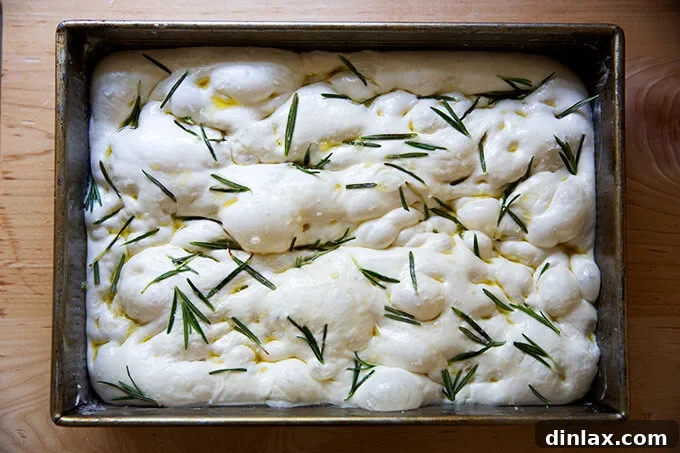
After two to four hours of resting at room temperature, or when the dough has visibly expanded and taken on a wonderfully bubbly appearance like this…
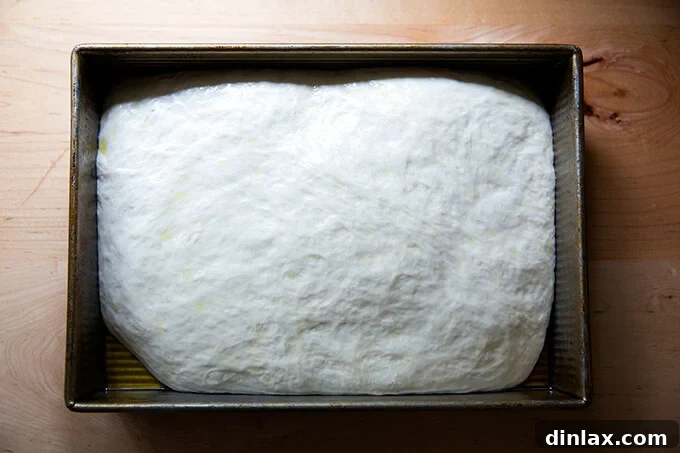
…it’s finally time for the satisfying act of dimpling! You can keep it beautifully simple with just olive oil and salt – for this, we highly recommend using a good, flaky sea salt, which adds both texture and bursts of flavor. As a noteworthy observation, the dough pictured below spent three full days in the fridge, resulting in an exceptionally bubbly and airy texture – a testament to the power of extended cold fermentation!
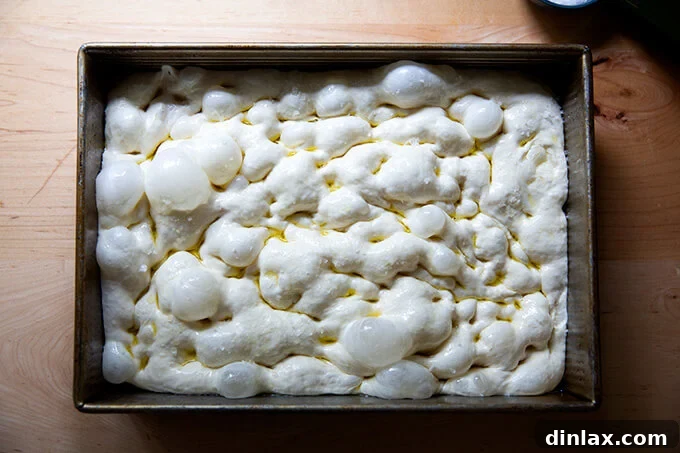
If you’re enhancing your focaccia with aromatic rosemary, sprinkle the fresh leaves evenly over the surface of the dough at this point. Next, generously drizzle two tablespoons of high-quality olive oil over the entire dough. Now, using all your fingertips, press straight down firmly into the dough to create those characteristic deep dimples. Ensure your fingers are coated with some of the olive oil to prevent sticking and to facilitate the dimpling process. Finish by sprinkling a generous amount of flaky sea salt over the top – again, a premium salt like Maldon is absolutely superb for this, providing a wonderful textural crunch and briny burst.
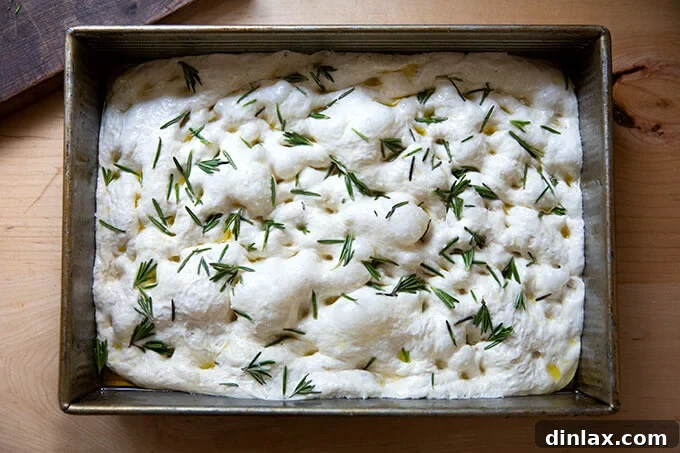
Without delay, transfer the prepared pan directly into the preheated oven. Bake at 425°F (218°C) for approximately 25 to 30 minutes, or until the focaccia achieves a beautiful golden-brown color all around and sounds hollow when tapped. Once baked to perfection, carefully remove the focaccia from its pan and place it on a cooling rack to prevent the bottom from becoming soggy. Allowing it to cool slightly enhances its texture.

Elevating Your Focaccia: Incorporating Rosemary, Herbs, & Diverse Toppings
One of the most frequently asked questions we receive pertains to customizing focaccia with additional ingredients and toppings. The versatility of focaccia dough allows for wonderful creative expressions, and there are two primary methods to incorporate your desired flavors effectively:
- **Adding Ingredients as a Topping:** This method is ideal for rosemary and other fresh herbs, thinly sliced vegetables, or even cheeses. The critical step here is to ensure that any ingredients placed on top are lightly slicked with olive oil. This subtle coating prevents them from burning or becoming overly dry in the oven, ensuring they cook beautifully and contribute moisture and flavor. Our preferred technique is to first sprinkle fresh rosemary (or other herbs) over the dough, then generously drizzle with olive oil, and finally proceed with the dimpling process. This embeds the herbs slightly and ensures they are well-coated.
- **Incorporating Ingredients Directly into the Dough:** For heartier additions like chopped olives, sun-dried tomatoes, roasted garlic cloves, or even grated cheese, you can mix them directly into the dough. Perform this in step one, immediately after whisking together the flour, salt, and instant yeast. Add your chosen ingredients to the dry flour mixture and toss them gently to ensure they are lightly coated. This prevents them from clumping and helps them integrate evenly throughout the dough. After this, proceed with adding the water as usual.
PS: For a truly spectacular meal idea, explore our guide on How to Make Focaccia Slab Sandwiches – they are perfect for entertaining or a hearty family lunch!

Can You Bypass the Overnight Rise for This Focaccia Recipe?
Absolutely, yes, you can definitely make this incredible focaccia without the extended overnight rise, though with a slight trade-off in texture and depth of flavor. In fact, a similar approach is detailed in my cookbook, Bread Toast Crumbs, where the recipe can be completed from start to finish in approximately three hours. While the resulting bread may not achieve the exact same extreme pillowy softness and complex flavor nuances as its slow-fermented counterpart, it will still be delightfully light, airy, and undeniably delicious.
To implement this quicker method, simply allow the freshly mixed dough to rise at room temperature until it has visibly doubled in size. This process typically takes about 1.5 to 2 hours, depending on the warmth of your kitchen. Once the first rise is complete, you can then proceed with the remainder of the recipe as instructed, keeping in mind that the second rise will be significantly shorter, usually requiring only about 30 minutes. This allows for a much faster path to enjoying homemade focaccia without sacrificing too much of its charm.
PS: For another delicious variation, try our delightful Cinnamon-Sugar Focaccia!
Print
The Best, Easiest Overnight Focaccia Bread Recipe
5 Stars 4 Stars 3 Stars 2 Stars 1 Star
5 from 2384 reviews
Author: Alexandra Stafford
Total Time: 18 hours 30 minutes
Yield: 2 loaves 1x
Description
The secret to achieving truly extraordinary focaccia lies in cold, refrigerated dough! Allowing your focaccia dough to rest and ferment for a minimum of 18 to 24 hours (and ideally up to 3 days) in the fridge will consistently yield an extra-pillowy, incredibly airy, and profoundly flavorful bread. However, for those moments when time is of the essence, this versatile recipe also offers a quicker alternative that can be prepared from start to finish in just 3 hours. Best of all, this simple 4-ingredient focaccia requires a mere 5 minutes of hands-on effort, making it remarkably accessible. For visual learners, comprehensive video guidance is provided below!
This recipe has been thoughtfully adapted and perfected from the original focaccia recipe found in my acclaimed cookbook, Bread Toast Crumbs.
A few important notes and tips for optimal results:
- Planning Ahead for Perfection: While a quicker method is available, the unparalleled texture and depth of flavor of this focaccia truly shine when you embrace the slow, cold fermentation. We strongly recommend mixing the dough the day before you intend to bake it. Additionally, be mindful that the second rise, performed at room temperature, typically requires a significant 2 to 4 hours to reach its ideal state.
- If You’re Short on Time (3-Hour Focaccia): Should your schedule not permit an overnight cold proof, you can still enjoy delicious focaccia. After mixing, simply allow the dough to rise at room temperature until it has doubled in volume, which usually takes about 1.5 to 2 hours. Once this initial rise is complete, you can proceed directly with the rest of the recipe instructions, noting that the subsequent second rise will only take approximately 30 minutes. The resulting bread will still be light and flavorful, albeit with a slightly less complex crumb structure.
- Choosing Your Baking Pan: This recipe is adaptable to various baking vessels to suit your preference and kitchen equipment:
- For two round loaves, use two 9-inch Pyrex pie plates. Remember to generously grease them with butter *before* adding olive oil to prevent sticking.
- For a thicker, more substantial focaccia, use a single 9×13-inch pan, such as the highly recommended USA pan. If using this option, do not divide the dough.
- For a thinner focaccia, perfect for creating delicious slab sandwiches, opt for a 13×18-inch rimmed sheet pan.
- Precision with a Scale: As with all bread baking, for the most accurate and consistent results, we highly recommend using a digital kitchen scale to measure both your flour and water by weight. This eliminates variations that can occur with volume measurements.
- Salt Considerations: A general rule of thumb for bread dough is that the salt content should be between 2% and 3% of the flour’s weight. For this recipe, that translates to 10 to 15 grams. Bear in mind that you will also be sprinkling flaky sea salt over the dough before baking, which contributes additional salinity. If you are sensitive to salt, aim for 10 grams in the dough; otherwise, 12 to 15 grams is ideal for a well-seasoned loaf. We exclusively use Diamond Crystal kosher salt for its consistent texture and flavor.
- Yeast Preference: We are ardent fans of SAF instant yeast for its reliability and direct incorporation. We purchase it in bulk, transfer it to an airtight quart storage container, and store it in the refrigerator (or freezer) for months, maintaining its potency.
- Using Active-Dry Yeast: If your recipe calls for active-dry yeast instead of instant, simply sprinkle the yeast over the lukewarm water and allow it to stand for about 15 minutes, or until it becomes noticeably foamy. This indicates activation. Once foamy, proceed with the recipe as directed.
- Flour Type & Humidity: Both all-purpose and bread flour will yield excellent results for this focaccia. However, if you reside in a particularly humid climate, we recommend opting for bread flour, as its higher protein content can better manage the increased moisture. For bakers in Canada or the UK, where flour absorption rates can differ, also consider using bread flour or holding back a small amount of the water initially. Refer to the accompanying video to gauge the desired dough texture, then gradually add more water back in as needed to achieve the correct consistency.
Ingredients
- 4 cups (512 g) all-purpose flour or bread flour (see notes above for guidance)
- 2 to 3 teaspoons (10 to 15 grams) kosher salt (adjust to preference, see notes above)
- 2 teaspoons (8 g) instant yeast (refer to notes if using active dry yeast)
- 2 cups (455 g) lukewarm water (achieved by combining 1/2 cup boiling water with 1 1/2 cups cold water)
- butter for greasing pans (essential for glass dishes)
- 4 tablespoons high-quality olive oil, divided (for oiling dough and dimpling)
- flaky sea salt, such as Maldon (for sprinkling before baking)
- 1 to 2 teaspoons whole fresh rosemary leaves, optional (for aromatic topping)
Instructions
- Prepare the Dough (Mixing & Initial Rest): In a spacious mixing bowl, thoroughly whisk together the flour, salt, and instant yeast until evenly combined. Pour in the measured lukewarm water. Using a sturdy rubber spatula, mix the ingredients just until the liquid is fully absorbed and they coalesce into a sticky, shaggy dough ball. Cover the bowl loosely and allow the dough to rest undisturbed for 30 minutes. Following this rest, consider an optional but highly recommended step (added 9/17/2025) for an exceptionally bubbly focaccia: **Perform a series of stretch and folds.** To do this, lightly wet one hand in a small bowl of water. Grab an edge of the dough, gently stretch it upwards, and fold it towards the center of the bowl. Rotate the bowl a quarter turn and repeat this stretching and folding process 8 to 10 times, moving your hand around the edge of the dough with each set. As you continue, you’ll observe the dough gradually transforming from its initial sticky and shaggy state to a smoother, more cohesive mass, indicating gluten development. For a visual demonstration, find video guidance here.
- The Essential Cold Proof: After the initial rest or stretch and folds, lightly rub the entire surface of the dough with olive oil. This is a crucial step to prevent a dry crust from forming during refrigeration. Cover the bowl securely – ideally with a hard, tight-fitting lid, or if unavailable, with plastic wrap. For cloth covers, ensure it’s secured tightly, perhaps with a rubber band, to create a more airtight environment. Immediately transfer the covered bowl to the refrigerator. Allow the dough to cold proof for a minimum of 12 hours, and for the most profound flavor and texture development, allow it to ferment for as long as three days. (Refer to the notes section above if you need to bypass the overnight rise for a quicker bake.) IMPORTANT NOTE: It is imperative that the dough is genuinely slicked with a generous amount of olive oil, especially when not using a hard lid. Insufficient oil risks the dough drying out and developing a hard crust on its top layer, which can hinder its rise and overall quality.
- Prepare Your Baking Pans: Ready your chosen baking pans. If using two 8- or 9-inch pie plates or a single 9×13-inch pan (consult notes above for pan options), line them with parchment paper for easy release, or grease them thoroughly with butter and/or coat with nonstick cooking spray. (A note on greasing: This step might seem redundant, but for certain pan types, particularly glass baking dishes, proper greasing is absolutely vital to prevent the focaccia from sticking. With high-quality USA pans, olive oil alone often suffices; however, for glass dishes, a foundation of butter is a non-negotiable must.)
- Second Rise & Dough Transfer: Pour one tablespoon of olive oil into the center of each prepared round pan, or two tablespoons if you are using a single 9×13-inch pan. Remove the dough from the fridge. Using two forks or lightly oiled hands, gently deflate the dough by releasing it from the sides of the bowl and folding it towards the center, rotating the bowl as you go until it forms a rough ball. If using two pans, use the forks to divide the dough into two equal portions. Place one piece into each prepared pan (or the entire dough into the 9×13-inch pan). Gently roll the dough in the olive oil to ensure it’s fully coated. Allow these dough balls to rest, uncovered, at room temperature for 3 to 4 hours. The exact time will depend on the warmth of your kitchen; look for a noticeable increase in volume and a bubbly surface.
- Preheat Oven & Dimple the Dough: Position an oven rack in the middle of your oven and preheat it to 425°F (218°C). If you’re adding fresh rosemary, sprinkle the leaves evenly over the surface of the dough now. Drizzle another tablespoon of olive oil over each round of dough (or two tablespoons for a 9×13-inch pan). Lightly rub your hands with some of this oil to coat them. Then, using all your fingertips, press straight down into the dough to create deep, characteristic dimples. As you dimple, gently stretch the dough towards the edges of the pan, ensuring it fills the entire space. Finish by generously sprinkling flaky sea salt all over the surface.
- Bake to Golden Perfection: Immediately transfer the pans (or pan) into the preheated oven. Bake for 25 to 30 minutes, or until the top is a beautiful golden brown and the underside is crisp and golden when lifted. Remove the focaccia from the oven. Carefully transfer the hot focaccia loaves from their pans to a wire cooling rack to prevent the bottoms from steaming and becoming soggy. Allow the focaccia to cool for at least 10 minutes before slicing and serving warm. If you intend to use it for sandwiches and need to halve it, allow it to cool completely for cleaner cuts.
- Storage and Reheating: To maintain its freshness, once the focaccia has completely cooled, transfer it to an airtight bag or container and store it at room temperature for up to 3 days. For longer storage, you can freeze it for up to 3 months. To revive day-old or frozen focaccia and restore its wonderful crust, always reheat it before serving: bake at 350°F (175°C) for approximately 15 minutes, or until warmed through and crisp.
Notes
To Craft Delightful Muffin Tin Focaccia Bites:
- Follow the primary focaccia recipe instructions through step 3, preparing the dough and allowing for the cold proof.
- Generously butter a standard muffin tin. For any leftover dough, also butter 2 small ramekins or a crème brûlée dish.
- Drizzle a small amount of olive oil into the bottom of each muffin well and prepared ramekin.
- Gently deflate the cold dough. Using two forks, portion the dough into small, roughly equal pieces, dropping one piece into each muffin well and ramekin. Each well should be about 3/4 full, or nearly full. Drizzle a little more olive oil over each dough piece in the wells. Turn each piece gently to ensure it is thoroughly coated in the oil.
- Allow these mini focaccia doughs to undergo a final rise until they have puffed up significantly and are visible above the rim of the muffin wells, typically taking 30-45 minutes at room temperature.
- Once risen, drizzle a final touch of olive oil over each piece, then gently dimple them with your fingertips. Finish by sprinkling with flaky sea salt and fresh rosemary, if desired.
- Bake the muffin tin focaccia in a preheated oven at 425ºF (218°C) for approximately 20-25 minutes, or until they are beautifully golden brown. If they appear dry upon removal from the oven, you may brush them with a tiny bit more olive oil for extra shine and flavor.
- Prep Time: 18 hours
- Cook Time: 30 minutes
- Category: Bread
- Method: Oven
- Cuisine: Italian